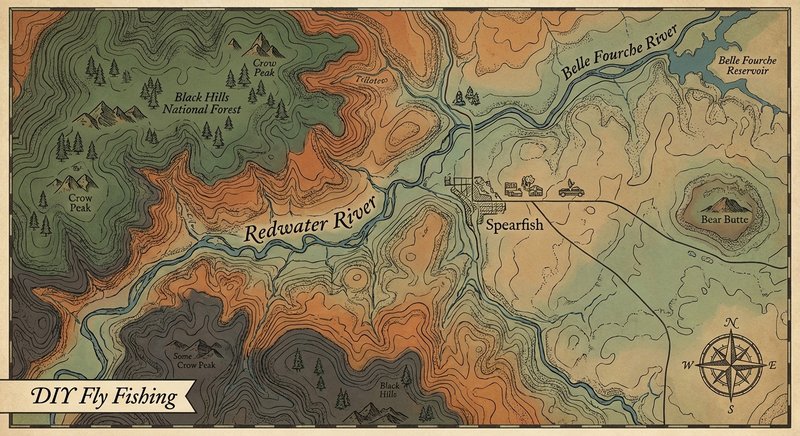
Redwater River
Fly fishing in South Dakota · intermediate · Best seasons: spring, summer, fall
Target Species
Brown Trout
About This Water
Black Hills stream near Belle Fourche. Wild brown trout fishing.
Fishing Recommendations
The Redwater River is one of the Black Hills' best-kept secrets. While many anglers flock to the more famous Rapid Creek or Spearfish Creek, the Redwater offers a unique, low-gradient meadow stream experience that feels more like a miniature version of a Montana spring creek than a typical mountain stream.
As your guide, here is the deep-dive intel you need to tackle the Redwater for its resident Brown Trout.
🎣 Location Overview
The Redwater River originates in Wyoming and flows eastward into South Dakota, eventually joining the Belle Fourche River. The South Dakota stretch, particularly near the town of Spearfish and the McNenny State Fish Hatchery, is the prime water for fly anglers.
What makes the Redwater special is its spring-fed influence. Thanks to the cold-water contribution from Sand Creek (its tributary), the water temperatures remain relatively stable. It is a meandering, "snake-like" river characterized by deep undercut banks, slow-moving pools, and silty bottoms punctuated by gravel riffles. It is a technical fishery that rewards stealth and precise presentation rather than long-distance casting.
🐟 Target Species & Behavior
The Brown Trout is the undisputed king of the Redwater. While you will find occasional Rainbows—mostly escapees from the hatchery or migrants from the Belle Fourche—the wild, buttery Brown Trout is the primary draw.
- Behavior: These fish are notoriously "spooky." Because the water is often clear and the flow is slow, they have plenty of time to inspect your fly.
- Holding Zones: 90% of the fish are tucked under the banks. If you aren't putting your fly within three inches of the grassy overhanging edge, you are out of the zone. They also hold in the deep "buckets" at the tail-outs of riffles.
- Feeding: They are highly opportunistic. They key in on high-protein sources like scuds and sowbugs year-round, but they become aggressive surface feeders during the Trico and Hopper seasons.
📅 Best Times to Fish
Spring (March – May)
This is "Blue Winged Olive" (BWO) season. On overcast days, the BWO hatches can be prolific. The fish are hungry after winter and less pressured.
- Window: 11:00 AM – 3:00 PM.
Summer (June – August)
The highlight here is the Trico hatch in the early mornings (tiny white/black mayflies) and Terrestrial fishing in the afternoons.
- Window: 7:00 AM – 11:00 AM (Dries); 1:00 PM – Sunset (Hoppers).
Fall (September – November)
This is arguably the best time for trophy Browns. As they prepare for the spawn, they become territorial and aggressive. The fall colors along the Redwater are spectacular.
- Window: All day, but low-light periods (dawn/dusk) are best for big fish.
🪰 Recommended Flies & Techniques
Nymphing (The Consistent Producer)
Because the Redwater has a limestone influence, crustacean life is abundant.
- Top Flies: Ray Charles (Grey or Pink, size 16-18), Soft Hackle Sowbugs (size 16-18), Zebra Midges (Black/Silver, size 20), and Pheasant Tails (size 18).
- Technique: Use a "Tippet Devise" or a very small, sensitive strike indicator. The takes are often subtle.
Dry Fly (The Purist’s Choice)
- Top Flies: Trico Spinners (size 22-24), Parachute Adams (size 18-22), and Sparkle Duns.
- Terrestrials: Hippie Stompers, Fat Alberts, and Dave’s Hoppers (size 10-14).
- Technique: Use a long leader (9-12 feet) tapering to 6X or 7X fluorocarbon. Accuracy is more important than distance.
Streamers (For the Monsters)
- Top Flies: Wooly Buggers (Olive or Black, size 8), Gold Retrievers, or small Sculpin patterns.
- Technique: "Strip and Pause" along the undercut banks. Don't be afraid to fish streamers even in low, clear water—just move them fast to trigger a reactionary strike.
💡 Pro Tips & Local Knowledge
- The "Stealth" Approach: The Redwater is a meadow stream. The vibration of your footsteps on the bank can alert fish before you even cast. Walk softly, stay back from the bank, and consider kneeling while casting.
- The "Red" Water: The river gets its name from the red soil in the drainage. After a heavy rain, the river can turn "chocolate milk" (or rather, "strawberry milk") very quickly. If it's murky, move further upstream toward the Wyoming border where the water clears faster.
- McNenny Hatchery Stretch: The area around the McNenny State Fish Hatchery provides excellent public access and high fish counts. However, these fish have "PhD diplomas" in fly patterns. Go smaller and lighter on your tippet here.
- Drag is the Enemy: Because the current is slow and deceptive, micro-drag on your dry fly will result in a refusal every time. Practice your "reach cast" to ensure a dead drift.
⚠️ Important Information
- Access: Much of the Redwater flows through private ranch land. However, there are several public access points provided by South Dakota Game, Fish & Parks (GFP) and the Fish Hatchery grounds. Always look for "Walk-In Area" signs and respect private property boundaries.
- Regulations:
- A valid South Dakota Fishing License is required.
- Check current GFP regulations for any specific "Catch and Release" zones or lure restrictions, though much of the Redwater is under general statewide regulations.
- Wading: The bottom can be very soft and silty (muck). Be careful not to get stuck, and avoid wading through the middle of the slow pools, as you will kick up silt and ruin the fishing for 100 yards downstream.
Guide’s Final Word: The Redwater is a "thinking man's" river. It won't give up its secrets easily, but if you slow down, stay low, and match the hatch, you'll find some of the most beautiful Brown Trout in the Black Hills region. Tight lines!
Bug Hatches & Matching Flies
| Hatch | Type | Peak months | Time of day | Hook sizes | Matching flies |
|---|---|---|---|---|---|
| Blue-Winged Olive Baetis | mayfly | April, May, September, October | Midday | #18-22 | Parachute Adams #18-22, RS2 #20-22, Pheasant Tail #18-20 |
| Pale Morning Dun Ephemerella excrucians | mayfly | June, July | Morning/Afternoon | #16-18 | PMD Sparkle Dun #16-18, Military Mayfly #16-18, Pale Morning Dun Spinner #16-18 |
| Little Black Stonefly Capniidae | stonefly | March, April | Midday | #14-18 | Little Black Stone #16-18, Zebra Midge #16-20, Pats Rubber Legs #14-16 |
| Trico Tricorythodes | mayfly | August, September | Morning | #20-24 | Trico Spinner #20-24, Sunken Trico Spinner #22-24 |
| Grannom Caddis Brachycentrus | caddis | May | Afternoon/Evening | #14-16 | Elk Hair Caddis #14-16, Deep Sparkle Pupa #14-16, Peacock Caddis #16 |
| Grasshoppers Acrididae | terrestrial | July, August, September | Midday/Afternoon | #8-12 | Morrish Hopper #10-12, Joe's Hopper #8-12, Parachute Hopper #10-14 |
| Spotted Sedge Hydropsyche | caddis | June, July, August | Evening | #14-18 | X-Caddis #16-18, Soft Hackle Hare's Ear #14-16 |
| Midges Chironomidae | midge | February, March, November | All day | #18-24 | Griffith's Gnat #18-22, Zebra Midge #18-22, Morgan's Midge #20-22 |
| Cinnamon Ant Formicidae | terrestrial | August, September | Afternoon | #16-20 | Cinnamon Ant #16-20, Transparant #18 |