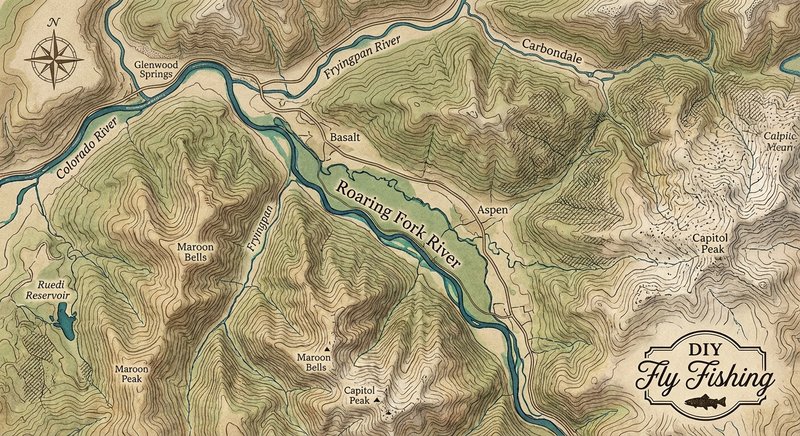
Roaring Fork River
Fly fishing in Colorado · Intermediate · Best seasons: Summer, Fall
Target Species
Rainbow Trout, Brown Trout
About This Water
A Gold Medal stream flowing through Aspen. Excellent caddis and mayfly hatches with healthy populations of rainbows and browns.
Fishing Recommendations
The Roaring Fork River, or "The Fork" as locals call it, is one of Colorado’s most prestigious freestone rivers. Flowing from the high alpine tundra of Independence Pass down through Aspen, Basalt, and Carbondale before joining the Colorado River in Glenwood Springs, it offers over 70 miles of diverse, high-quality trout water.
As your guide, here is the deep dive into mastering this Gold Medal fishery.
🎣 Location Overview
The Roaring Fork is unique because it is one of the longest stretches of "Gold Medal" water in the state. Unlike the neighboring Fryingpan (a tailwater), the Roaring Fork is a freestone river, meaning its flows are dictated by snowmelt and rain.
Anglers love it for its "big water" feel and the sheer variety of its three distinct sections:
- The Upper Fork (Aspen to Basalt): Fast, tight pocket water and smaller crystalline pools.
- The Middle Fork (Basalt to Carbondale): The confluence with the Fryingpan adds volume and nutrients. This is classic "braided" water with deep runs.
- The Lower Fork (Carbondale to Glenwood): Big, powerful water best fished from a drift boat. This section holds the largest "log-burning" Brown Trout.
🐟 Target Species & Behavior
The river is a factory for Rainbow and Brown Trout, with occasional Mountain Whitefish.
- Rainbow Trout: These fish are found in the oxygenated riffles and at the heads of pools. During the summer, they are exceptionally acrobatic and will hit dries with aggression.
- Brown Trout: The "Fork" is famous for its wild Browns. They are more calculated, often hugging undercut banks, deep woody debris, or the dark shadows of large boulders. In the fall, they become highly territorial and predatory.
- Behavior: Because it’s a freestone, these fish are "opportunistic." They don't have the luxury of the steady temperatures of a tailwater, so when a hatch happens, they feed with a sense of urgency.
📅 Best Times to Fish
While the Fork can be fished year-round, you’ve asked for the prime windows:
Summer (Late June – August)
- The Draw: The legendary Green Drake hatch. This is the Super Bowl of Colorado fly fishing. It typically starts in Glenwood in late June and moves up-river to Aspen by August.
- Conditions: Post-runoff. The water clears and drops, revealing perfect pocket water.
- Time of Day: Morning nymphing, followed by frantic dry fly action from 11:00 AM to 3:00 PM (PMDs) and late evening (Caddis/Drakes).
Fall (September – October)
- The Draw: Pre-spawn Brown Trout and the Blue Winged Olive (BWO) hatches.
- Conditions: Low, clear water and stunning golden Aspen trees. The fish are eager to bulk up before winter.
- Time of Day: Mid-day is best. The BWO hatches are most prolific on cloudy, overcast days between 1:00 PM and 4:00 PM.
🪰 Recommended Flies & Techniques
Top Fly Patterns
- Dries:
- Green Drake: Colorado Green Drake (Size 10-12), H&L Variant.
- Attractors: Royal Wulff, Chubby Chernobyl (Sizes 8-12).
- Mid-Summer: Sparkle Dun PMD (Size 16), Elk Hair Caddis (Size 14-16).
- Fall: BWO Vis-A-Dun (Size 18-22).
- Nymphs:
- The "Fork" Staples: 20-Incher Stonefly, Prince Nymph, Pats Rubber Legs (Black/Tan).
- Droppers: RS2 (Gray/Black), Zebra Midge (Red/Silver), Pheasant Tail.
- Streamers:
- Sculpzilla, Autumn Splendor, or an Olive/Black Wooly Bugger.
Techniques
- Dry-Dropper: This is the "bread and butter" on the Fork. Use a buoyant fly (like a Chubby or a Drake) and hang a heavy nymph 2-3 feet below it. It allows you to cover two water columns in the pocket water.
- European Nymphing: The Upper and Middle sections are perfect for tight-line nymphing due to the high frequency of riffles and seams.
- Streamer Stripping: In the fall, especially on the Lower Fork, "pound the banks" with streamers from a boat or by wading deep and casting toward the shore.
💡 Pro Tips & Local Knowledge
- Watch the "Drake Progression": The Green Drake hatch moves upstream about a mile or two per day. Check with local shops (like Taylor Creek or Roaring Fork Anglers) to find the "active" zone.
- The "Two-Fly" Rule: Always fish two flies. If there’s no hatch, go with a big attractor and a tiny midge.
- Mind the Wading: The Roaring Fork is notoriously "greasy." The rocks are round and slick. Wading boots with studs and a wading staff are highly recommended.
- Target the Seams: Because the current is fast, trout sit right on the "seam"—the visible line where fast and slow water meet. If your fly isn't tracking perfectly on that line, you won't get the eat.
⚠️ Important Information
- Access: Much of the Roaring Fork is bordered by private property. Use the Rio Grande Trail (a bike path that follows the river) to find public access points. Jaffee Park and the Basalt Bridge are popular but productive spots.
- Regulations:
- Much of the river is Gold Medal, meaning artificial flies and lures only.
- Specific sections (like from the Fryingpan confluence down to Glenwood) have a two-fish limit over 16 inches, but catch and release is the local culture and strongly encouraged to preserve the fishery.
- Flows: Keep an eye on the USGS gauges. If the river is above 1,500 CFS at Emma, wading can be dangerous. Ideal wading flows are under 800 CFS.
Guide’s Final Thought: If you only have one day, fish the "Middle Fork" near the town of Basalt. You get the best of both worlds: the bug life of the Fryingpan and the wild, powerful trout of the Roaring Fork. Tight lines!
Bug Hatches & Matching Flies
| Hatch | Type | Peak months | Time of day | Hook sizes | Matching flies |
|---|---|---|---|---|---|
| Green Drake Drunella grandis | mayfly | July, August | Late Afternoon/Evening | #10-12 | Colorado Green Drake #10-12, Drake Cripple #12, 20 Incher #10-14 |
| Blue Winged Olive Baetis | mayfly | March, April, September, October | Late Morning/Afternoon | #18-22 | RS2 #18-22, Parachute Adams #18-22, Pheasant Tail #18-22 |
| Pale Morning Dun Ephemerella excrucians | mayfly | June, July, August | Late Morning/Early Afternoon | #16-18 | PMD Sparkle Dun #16-18, Military May #16-18, CDC Pheasant Tail #16-18 |
| Golden Stonefly Hesperoperla pacifica | stonefly | June, July | All Day/Evening | #8-12 | Pat's Rubber Leg #8-12, Chubby Chernobyl #10-12, Cat Puke #10-12 |
| American Grannom (Mother's Day Caddis) Brachycentrus | caddis | May | Afternoon | #14-16 | Peacock Caddis #14-16, Graphic Caddis #14-16, Holy Grail #14-16 |
| Midge Chironomidae | midge | January, February, March, December | Late Morning | #20-24 | Zebra Midge #20-22, Griffith's Gnat #20-24, Top Secret Midge #20-24 |
| Yellow Sally Isoperla | stonefly | June, July | Late Afternoon/Evening | #14-16 | Yellow Sally Stimulator #14-16, Iron Sally #14-16, Sallie Girl #14-16 |
| Red Quill Rhithrogena morrisoni | mayfly | May, June | Afternoon | #12-14 | Red Quill #12-14, Hare's Ear #12-14 |