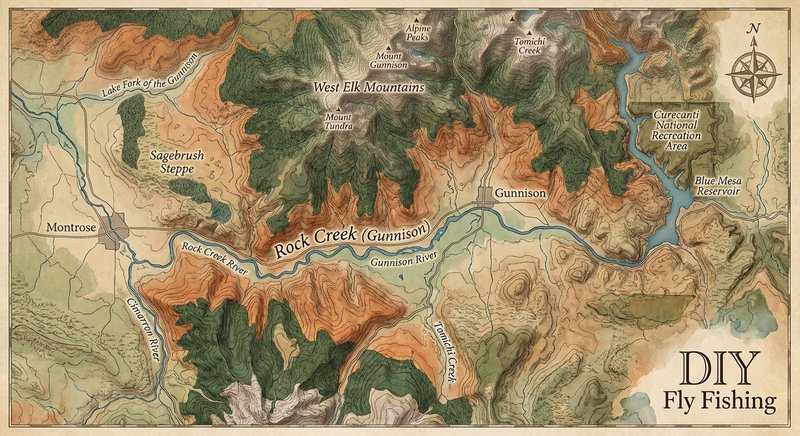
Rock Creek (Gunnison)
Fly fishing in Colorado · Beginner · Best seasons: Summer, Fall
Target Species
Brook Trout, Rainbow Trout
About This Water
Tributary of the Gunnison near Crested Butte. Wild trout in beautiful mountain setting.
Fishing Recommendations
Rock Creek, located in the Taylor Park area northeast of Gunnison, Colorado, is a quintessential high-country gem. As a tributary to the Taylor River, it offers an intimate, rugged, and rewarding fly fishing experience far from the more crowded "Dream Stream" tailwaters.
Here is your comprehensive guide to fishing Rock Creek.
🎣 Location Overview
Rock Creek is a high-elevation mountain stream (sitting above 9,000 feet) that flows through a mix of tight timbered canyons and lush alpine meadows. It is a "pocket water" paradise. What makes it special is its character: it isn't a long, flat river; it’s a series of stair-stepping plunge pools, glassy tail-outs, and undercut banks.
Anglers love Rock Creek for its solitude and the sheer eagerness of its inhabitants. While the fish may not reach the gargantuan proportions of the Taylor River tailwater, they are wild, beautiful, and willing to rise to a well-presented dry fly. It is the perfect destination for the angler who prefers a 3-weight rod and a hike over a drift boat.
🐟 Target Species & Behavior
- Brook Trout: These are the superstars of Rock Creek. They are prolific throughout the system, especially in the upper reaches. They are opportunistic feeders, often striking out of pure aggression. Look for them in the slower water behind large boulders and in the deep "buckets" at the base of waterfalls.
- Rainbow Trout: Found more frequently in the lower stretches closer to where the creek nears Taylor Park Reservoir. They tend to hold in the slightly faster riffles and the deeper runs.
- Behavior: Because the growing season is short at this altitude, these fish are not picky, but they are spooky. The water is crystal clear; if they see your silhouette or a splashy fly line, the pool is "put down" for an hour.
📅 Best Times to Fish
Optimal Seasons
- Summer (July – August): This is the prime window. Runoff in Taylor Park usually subsides by late June or early July. This is the era of the "Dry Fly Feast."
- Fall (September – Early October): My personal favorite. The Brook Trout move into their spawning colors (vibrant oranges and reds) and become extremely aggressive. The aspen trees in the drainage turn gold, making for a spectacular backdrop.
Best Times of Day
- 10:00 AM – 4:00 PM: At high altitudes, the water stays cold. You don’t need to be on the water at dawn. Wait for the sun to hit the water and activate the insects.
Conditions
- Watch for the "Monsoon Season" in late July. Afternoon thunderstorms are common. If the sky turns dark, get off the water (graphite rods are lightning rods). A light rain can actually trigger a great terrestrial bite.
🪰 Recommended Flies & Techniques
Top Fly Patterns
- Dry Flies:
- Royal Wulff or Royal Stimulator (#12-16): High visibility and high buoyancy.
- Elk Hair Caddis (#14-18): A staple for the evening rise.
- Amy’s Ant or Foam Hoppers (#10-14): Perfect for the "Dry-Dropper" rig in August.
- Nymphs:
- Bead-head Pheasant Tail (#16-20): Mimics almost any mayfly nymph in the system.
- Prince Nymph (#14-18): The "attractor" nymph that Brookies love.
- Streamers:
- Black or Olive Wooly Bugger (#10-12): Best used in the deeper beaver ponds or larger plunge pools to find the "boss" of the hole.
Techniques
- The Dry-Dropper: This is the most effective way to fish Rock Creek. Use a buoyant hopper or stimulator on top and hang a small Pheasant Tail about 18 inches below it.
- Short Line Nymphing: In the canyon sections, don't worry about long casts. Use a "high-stick" technique to keep your line off the complex currents, letting your fly drop into the small pockets behind rocks.
- The Stealth Approach: Kneel when approaching a pool. Use the boulders as cover.
💡 Pro Tips & Local Knowledge
- Keep Moving: This is "blue lining" at its finest. If you don't get a strike in 5-10 casts, move to the next pocket. The best fish are often in the hardest-to-reach spots.
- Focus on the "Tail-outs": While everyone fishes the white water at the head of a pool, the larger fish often sit in the very back of the pool (the tail-out) just before the water breaks over the next drop.
- The "Meadow Stretch": There are sections where the creek flattens out into meadows. Here, the fish are much more technical. Long leaders (9-12ft) and 6x tippet are required to avoid spooking fish in the glassy water.
- Rod Choice: A 7'6" to 8'6" 3-weight or 4-weight rod is ideal. You want something short enough to cast under overhanging willow branches.
⚠️ Important Information
- Access: Much of Rock Creek is within the Gunnison National Forest, but there are pockets of private land nearby. Always use a map (like OnX or a Forest Service map) to ensure you are on public land. Access is generally via Forest Service Road 742 to the Taylor Park area.
- Regulations: A valid Colorado Fishing License is required. Standard mountain stream regulations usually apply (8 fish limit), but most local guides strongly advocate for Catch and Release to preserve the wild genetics of these high-country trout.
- Wildlife & Safety: This is remote country. You are in Black Bear and Moose territory. Carry bear spray, tell someone where you are going, and be prepared for rapid temperature drops.
- Wading: The rocks can be incredibly slick. Felt soles (where legal) or studded rubber soles are highly recommended.
Guide’s Final Word: Rock Creek isn't about the size of the fish on the scale; it's about the colors of the Brookies and the silence of the woods. Slow down, observe the water, and enjoy one of the purest trout streams in the Rockies.
Bug Hatches & Matching Flies
| Hatch | Type | Peak months | Time of day | Hook sizes | Matching flies |
|---|---|---|---|---|---|
| Blue Winged Olive (BWO) Baetis | mayfly | April, May, September, October | Late Morning/Afternoon | #18-22 | JujuBaetis #18-22, RS2 #20-22, Parachute Adams #18-22 |
| Green Drake Drunella doddsi | mayfly | July, August | Afternoon | #10-12 | Colorado Green Drake #10-12, Drake Cripple #12, Picket Pin #10-12 |
| Golden Stonefly Hesperoperla pacifica | stonefly | June, July | Morning/Evening | #8-12 | Pats Rubber Legs #8-12, Chubby Chernobyl (Gold/Tan) #8-12 |
| Pale Morning Dun (PMD) Ephemerella invaria | mayfly | July, August | Mid-Morning/Afternoon | #16-18 | Pheasant Tail #16-18, PMD Sparkle Dun #16-18 |
| Yellow Sally Isoperla | stonefly | July, August | Late Afternoon/Evening | #14-16 | Yellow Sally Foam Dry #14-16, Iron Sally #14-16 |
| American Grannom Brachycentrus occidentalis | caddis | May, June | Afternoon/Evening | #14-16 | Peacock Caddis #14-16, Deep Blue Poison Tung #14-16 |
| Midges Chironomidae | midge | March, April, September, October | All Day | #20-24 | Zebra Midge #20-22, Griffith's Gnat #20-24 |
| Grasshoppers Orthoptera | terrestrial | August, September | Late Morning/Afternoon | #8-14 | Morrish Hopper #10-14, Amy's Ant #12-14 |
| Spotted Sedge Hydropsyche | caddis | July, August | Evening | #14-18 | Elk Hair Caddis (Tan) #14-18, LaFontaine's Deep Sparkle Pupa #16 |