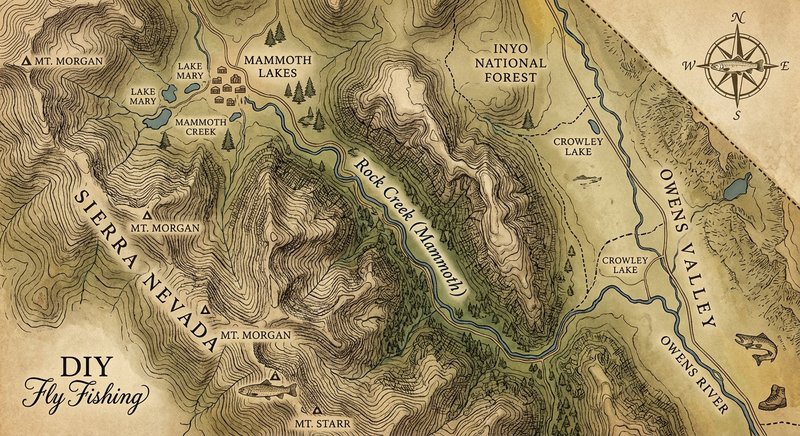
Rock Creek (Mammoth)
Fly fishing in California · Beginner · Best seasons: Summer, Fall
Target Species
Brook Trout, Rainbow Trout
About This Water
Eastern Sierra stream near Mammoth Lakes. Wild brook and rainbow trout in alpine setting.
Fishing Recommendations
Welcome to the Eastern Sierra! As your guide, I’m excited to break down one of the crown jewels of high-altitude angling: Rock Creek.
Located south of Mammoth Lakes near Tom’s Place, Rock Creek is a classic "staircase" freestone stream. It offers everything from technical meadow winding to high-gradient pocket water, all set against the backdrop of some of the most dramatic granite peaks in the Sierra Nevada.
🎣 Location Overview
Rock Creek is unique because of its elevation and accessibility. The creek runs from the high alpine Little Lakes Valley (over 10,000 ft) down to the Owens Valley floor. However, the prime fly fishing water is located between Rock Creek Lake and Tom’s Place.
What makes it special is the diversity of water types. You’ll find slow, meandering glass-smooth stretches in the meadows near the pack station, and boisterous, oxygen-rich pocket water as the creek tumbles toward the lower canyon. It is a "numbers" fishery—while you might not land a 20-inch trophy, the action is often fast, and the fish are stunningly beautiful.
🐟 Target Species & Behavior
- Brook Trout: These are the stars of the upper reaches and the high-altitude meadows. They are aggressive, colorful, and love to hide under overhanging banks or in the shadows of granite boulders.
- Rainbow Trout: Found throughout the system. The wild rainbows are smaller and feisty, while the "Alpers-style" stocked rainbows tend to hold in the deeper pools near the campgrounds.
- Brown Trout: Occasionally found in the lower, warmer stretches near Tom's Place.
Behavior: Because the growing season is short at 9,000 feet, these fish are opportunistic. They don't have the luxury of being overly picky. They hold in "textbook" spots: behind mid-stream rocks, in the soft water at the head of pools, and deep under the "undercut" sod banks in the meadow sections.
📅 Best Times to Fish
Seasons:
- Summer (Late June – August): This is the prime window. Once the snowpack melts (usually by late June), the insect life explodes. This is the best time for "dry-dropper" fishing.
- Fall (September – October): My personal favorite. The aspens turn gold, the crowds thin out, and the Brookies enter their spawning colors (vibrant orange bellies). The fish feed heavily to prepare for the long winter.
Time of Day:
- 10:00 AM – 4:00 PM: Unlike lower elevation rivers, you don't need to be there at dawn. At high altitudes, the water needs to warm up a few degrees to trigger insect activity.
- Evening: During mid-summer, the "caddis hour" at dusk can provide frantic dry fly action.
🪰 Recommended Flies & Techniques
Top Fly Patterns:
- Dry Flies:
- Parachute Adams (#14-18): The gold standard.
- Elk Hair Caddis (#14-16): Tan or Olive.
- Royal Wulff or Humpy (#14-16): High visibility for fast water.
- Amy’s Ant or Chernobyl Ant (#10-12): Great for late summer terrestrials.
- Nymphs:
- Bead-head Pheasant Tail (#16-18): Mimics Mayflies.
- Hare’s Ear (#14-16): Generalist bug.
- Zebra Midge (#18-20): Black or Red—essential for the slower meadow pools.
- Streamers:
- Woolly Bugger (#10-12): Olive or Black for the deeper pools near the lake.
Techniques:
- Dry-Dropper: This is the most effective way to fish Rock Creek. Use a buoyant dry fly (like a Stimulator) and hang a small nymph 18-24 inches below it.
- Short Line Nymphing: In the steep, rocky sections, use a "high-stick" technique. Keep as much fly line off the water as possible to avoid drag in the complex currents.
- Dapping: In the meadows, the brush is thick. Sometimes you just poke the rod tip through the willows and drop the fly on the water.
💡 Pro Tips & Local Knowledge
- The "Sneak" Factor: The water in the meadows is crystal clear. If you can see the fish, they have likely already seen you. Wear earthy colors, stay low, and approach the bank on your knees.
- Focus on the Pocket Water: Most casual anglers fish the easy-to-reach pools near the bridges. If you hike 15 minutes away from any trailhead or campground, the fishing pressure drops significantly, and the fish become much less wary.
- The "Rock Creek Lake" Inlet: Where the creek enters Rock Creek Lake is a prime spot for larger Brookies and Rainbows to congregate, especially in the fall.
- Go Small on the Leader: I recommend a 5x or 6x fluorocarbon tippet. The fish aren't huge, but they are sharp-eyed in that clear alpine water.
⚠️ Important Information
- Access: Follow Rock Creek Road off Hwy 395. There are numerous turnouts. The "Little Lakes Valley" trailhead at the very end of the road (Mosquito Flat) provides access to the highest reaches.
- Regulations:
- The creek is generally open from the last Saturday in April through November 15th.
- Check the California Department of Fish and Wildlife (CDFW) map for specific zone regulations, as some areas may have different bag limits or gear restrictions (though most of the creek allows for standard mountain regs).
- Altitude Warning: You are fishing at 7,000 to 10,000+ feet. Drink twice as much water as you think you need, wear high-SPF sunscreen, and take it slow if you aren't acclimated.
- Bears: This is active Black Bear country. If you are keeping fish (where legal) or carrying lunch, use bear-resistant containers or keep your gear within arm's reach.
Tight lines, and enjoy the views—they are just as good as the fishing!
Bug Hatches & Matching Flies
| Hatch | Type | Peak months | Time of day | Hook sizes | Matching flies |
|---|---|---|---|---|---|
| Midges Chironomidae | midge | April, May, September, October | All Day | #18-24 | Zebra Midge #18-22, Griffith's Gnat #20-22, Morgan's Midge #20-22 |
| Blue Winged Olive Baetis | mayfly | May, September, October | Late Morning/Afternoon | #18-22 | RS2 #18-22, BWO Parachute #18-20, Pheasant Tail #18-20 |
| Pale Morning Dun Ephemerella excrucians | mayfly | July, August | Morning/Early Afternoon | #16-18 | PMD Parachute #16-18, Split Case PMD #16-18, Sparkle Dun #16-18 |
| Spotted Sedge Hydropsyche | caddis | July, August | Late Afternoon/Evening | #14-18 | Elk Hair Caddis #14-18, LaFontaine's Deep Sparkle Pupa #14-16, Peeking Caddis #14-16 |
| Golden Stonefly Hesperoperla pacifica | stonefly | June, July | Morning/Evening | #8-12 | Pat's Rubber Leg #8-12, Rogue River Stone #10-12, Stimulator #10-14 |
| Yellow Sally Isoperla | stonefly | July, August | Afternoon/Evening | #14-16 | Yellow Sally Stimulator #14-16, Iron Sally #14-16 |
| Ants and Beetles Formicidae / Coleoptera | terrestrial | July, August, September | Midday/Afternoon | #12-18 | Carpenter Ant #12-16, Foam Beetle #14-18, Chernobyl Ant #10-14 |
| Callibaetis Callibaetis | mayfly | July, August | Morning/Afternoon | #14-16 | Callibaetis Spinner #14-16, Hares Ear #14-16, Mercer's Missing Link #14-16 |