Rock Creek
Fly fishing in Montana · Intermediate · Best seasons: Spring, Summer, Fall
Target Species
Rainbow Trout, Brown Trout, Cutthroat Trout
About This Water
A beautiful freestone stream known for its salmonfly hatch and wild trout population. Offers solitude and classic western fly fishing.
Fishing Recommendations
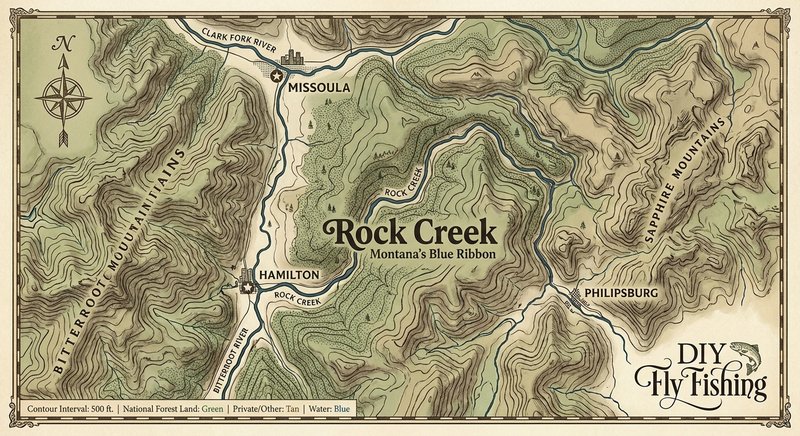
Rock Creek is often whispered about in fly fishing circles as the "perfect" trout stream. Located in Western Montana, just east of Missoula, it is a Blue Ribbon tributary of the Clark Fork River. Flowing through a narrow, rugged canyon, it offers over 50 miles of public access and a classic "bouldery" pocket-water character that is a fly fisher's dream.
Here is your comprehensive guide to fishing Rock Creek, Montana.
🎣 Location Overview
Rock Creek is unique because it feels like a high-mountain stream but produces the size and quantity of fish usually found in larger valley rivers. The water is characterized by fast riffles, deep plunge pools, and endless "pocket water"—small soft spots behind large rocks where trout wait for a meal.
What makes it special is the diversity of water. The lower section (near the confluence with the Clark Fork) is wider and more traditional, while the upper sections (near the Sapphire Mountains) are tighter and more technical. Because it is largely protected by the Lolo National Forest, the scenery is pristine, and the access is unparalleled.
🐟 Target Species & Behavior
Rock Creek is home to a "Montana Slam" opportunity:
- Rainbow Trout: The most common resident. They love the fast, oxygenated water in the riffles and the heads of pools. They are aggressive and spectacular fighters.
- Brown Trout: Found primarily in the lower 20 miles. They hold in the deeper undercut banks and behind large submerged boulders. They become more active—and predatory—during low light or high water.
- Westslope Cutthroat Trout: The "native" gems of the creek. They are found throughout but are more prevalent in the upper reaches. They are notorious for being "surface-oriented" and will often rise to a dry fly even when no hatch is present.
- Bull Trout: Note: These are protected (ESA listed). You may see them, but you cannot target them. If you hook one incidentally, keep it in the water and release it immediately.
📅 Best Times to Fish
Spring (April – May)
- The Draw: The Skwala Stonefly hatch. This is the first major dry fly event of the year.
- Conditions: Can be fickle due to early snowmelt. If the water is clear, the fishing is world-class.
Summer (June – August)
- The Draw: The legendary Salmonfly Hatch (early to mid-June). It’s a "big bug" frenzy.
- Conditions: Following the Salmonflies, you get Golden Stones, Yellow Sallies, and Spruce Moths in late summer. This is the prime window for dry-fly purists.
Fall (September – October)
- The Draw: Mahogany Duns, Blue Winged Olives (BWOs), and aggressive Brown Trout.
- Conditions: The crowds thin out, the water cools, and the fish feed heavily to prepare for winter. The fall colors in the canyon are breathtaking.
Best Time of Day: During summer, fish the "trico" or "spinner" falls at dawn, then take a break during the heat of the afternoon. In spring and fall, the 10:00 AM to 4:00 PM window is usually most productive as the water warms.
🪰 Recommended Flies & Techniques
Top Fly Patterns
- Dries: Rogue River Stone (Orange/Black #4-8), Chubby Chernobyl (various colors #6-12), Parachute Adams (#12-18), Elk Hair Caddis (#14-16), and the Spruce Moth (#12) in August.
- Nymphs: Pat’s Rubber Legs (the "workhorse"), Prince Nymph, Pheasant Tail, and the San Juan Worm (especially during runoff/high water).
- Streamers: Olive or Black Wooly Buggers, Sparkle Minnows, and Sex Dungeon (for big Browns in the fall).
Effective Techniques
- The "Dry-Dropper" Rig: This is the most effective way to fish Rock Creek. Use a buoyant Stonefly or Chubby as your "indicator" and hang a weighted nymph (like a Pheasant Tail) 18–24 inches below it.
- Pocket Water Picking: Don't just cast into the big pools. Cast into the tiny pockets of calm water behind rocks. Keep a short line and high rod tip (Euro-style or high-sticking) to avoid drag.
- Streamer Stripping: In the fall or during spring runoff, pound the banks with streamers. Use a sink-tip line in the deeper runs of the lower creek.
💡 Pro Tips & Local Knowledge
- The "Rock Creek Crawl": The rocks here are notoriously slippery and round (often called "bowling balls"). Wear felt-soled wading boots or studded boots, and use a wading staff.
- The Spruce Moth Secret: In late July and August, Spruce Moths emerge from the pines. Unlike many hatches, these moths are clumsy and fall into the water. If you see white moths fluttering near the trees, switch to a tan/cream-colored caddis or a specific Spruce Moth pattern.
- Upper vs. Lower: If you want bigger fish, fish the lower 15 miles. If you want high numbers and a more "wilderness" feel, drive past the "Valley of the Moon" and fish the upper sections toward Gillies Bridge.
⚠️ Important Information
- Access: The Rock Creek Road (a.k.a. "The Ditch") runs along the creek. Note: The road is narrow, bumpy, and mostly gravel. Give yourself extra travel time.
- Regulations: Rock Creek has specific regulations including "Catch and Release Only" for certain species and sections, and it is closed to commercial float outfitting (meaning fewer drift boats and more wading anglers). Always check the current MT FWP Regulations.
- Wildlife: This is Bear Country. Both Black Bears and Grizzly Bears frequent the canyon. Always carry bear spray and know how to use it.
- Permit: A valid Montana Fishing License with a Conservation License and AIS (Aquatic Invasive Species) prevention pass is required.
Guide's Final Word: Rock Creek is a place that rewards the observant angler. Watch the bushes for shucks and the air for birds. If you find the rhythm of the "pockets," you’ll have one of the best fishing days of your life. Good luck!
Bug Hatches & Matching Flies
| Hatch | Type | Peak months | Time of day | Hook sizes | Matching flies |
|---|---|---|---|---|---|
| Salmonfly Pteronarcys californica | stonefly | May, June | All Day | #4-8 | Rogue River Stone #4-6, Pats Rubber Legs #4-8, Cat Puke #6-8 |
| Skwala Skwala americana | stonefly | March, April | Afternoon | #8-12 | Skwala Stone #10-12, Bullet Skwala #10-12, Double Bead Stone #10-12 |
| Golden Stonefly Hesperoperla pacifica | stonefly | June, July | Morning/Afternoon | #8-12 | Chubby Chernobyl #8-12, Water Walker #10-12, Iron Lotus #12-14 |
| Pale Morning Dun Ephemerella excrucians | mayfly | June, July | Late Morning/Early Afternoon | #14-18 | Sparkle Dun #14-18, Pheasant Tail #14-18, PMD Emerger #16-18 |
| Blue Winged Olive Baetis spp. | mayfly | April, May, September, October | Mid-day/Overcast | #16-22 | Parachute Adams #18-22, RS2 #18-22, WD-40 #18-22 |
| Western Grannom Brachycentrus occidentalis | caddis | April, May | Afternoon/Evening | #14-16 | Elk Hair Caddis #14-16, Peacock Caddis #14-16, Deep Sparkle Pupa #14-16 |
| March Brown Rhithrogena morrisoni | mayfly | April, May | Afternoon | #12-14 | March Brown Western Red #12-14, Hare's Ear #12-14 |
| Grasshoppers | terrestrial | August, September | Late Morning/Afternoon | #8-12 | Morrish Hopper #8-12, Dave's Hopper #10-12, Parachute Hopper #10-14 |