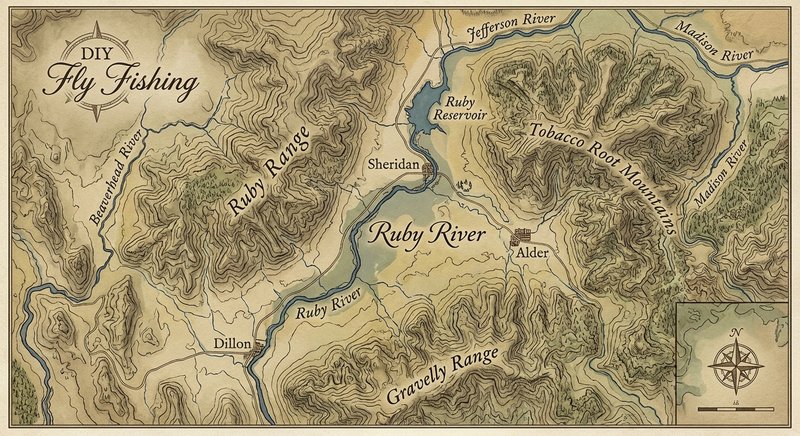
Ruby River
Fly fishing in Montana · Intermediate · Best seasons: Summer, Fall
Target Species
Brown Trout, Rainbow Trout
About This Water
Southwest Montana freestone with wild brown and rainbow trout. Less pressured than nearby rivers.
Fishing Recommendations
Welcome to one of Southwest Montana’s best-kept secrets. As a guide, I often call the Ruby River the "intimate alternative" to the high-traffic waters of the Madison and the Big Hole. It is a winding, willow-lined gem that rewards technical precision and stealth.
Here is your comprehensive guide to fly fishing the Ruby River.
🎣 Location Overview
The Ruby River is a classic meandering meadow stream located in the heart of the Ruby Valley. It originates in the Gravelly and Snowcrest Ranges, flows into the Ruby River Reservoir, and then snakes its way toward the Beaverhead and Jefferson Rivers.
What makes the Ruby special is its character. It is a small-to-medium-sized river characterized by tight oxbow bends, deep undercut banks, and dense willow thickets. Unlike the broad Madison, the Ruby feels private and secluded. Anglers love it because it requires "real" trout fishing—creeping through grass, making accurate short-range casts, and navigating complex currents. It is a river that tests your skill rather than your casting distance.
🐟 Target Species & Behavior
- Brown Trout: The stars of the Ruby. They dominate the lower and middle sections. These fish are notorious for hugging the undercut banks and hiding beneath overhanging willows. They are predatory and territorial.
- Rainbow Trout: Found more frequently in the faster riffles and the upper reaches above the reservoir. They tend to be more opportunistic feeders than the browns.
Behavioral Note: Ruby trout are notoriously "spooky." Because the water is often clear and the river is narrow, they can sense vibration on the banks and see shadows easily. If you see a fish, it has likely already seen you. Stealth is mandatory.
📅 Best Times to Fish
While you can fish the Ruby in the spring, the Summer and Fall are when it truly shines.
- Summer (Late June – August): This is the prime window for hatches. Late June brings the PMDs (Pale Morning Duns). July and August are all about Tricos in the early morning and Terrestrials (hoppers) in the afternoon.
- Fall (September – October): This is "Big Brown" season. As the water cools, the brown trout become aggressive ahead of the spawn. The crowds (which are already small) disappear, and the Blue Winged Olives (BWO) hatch on cloudy days.
- Best Time of Day:
- Summer: Get on the water at dawn for the Trico spinners or wait until 11:00 AM for the PMDs. Afternoon heat is perfect for hopper "splat" fishing.
- Fall: Mid-morning to late afternoon is best as the water needs time to warm up.
🪰 Recommended Flies & Techniques
Top Fly Patterns
- Dries: Sparkle Dun (PMD) #16-18, Trico Spinner #20-22, Elk Hair Caddis #14-16, Parachute Adams #14-20.
- Terrestrials: Morrish Hopper (Pink or Tan) #8-12, Chubby Chernobyl #10-14, Ants and Beetles #16-18.
- Nymphs: Zebra Midge #18-20, Pheasant Tail #16-18, Pat’s Rubber Legs (Small) #10-12, Perdigons #16-18.
- Streamers: Black or Olive Wooly Buggers, Sculpzilla #4-8 (especially in the fall).
Effective Techniques
- The "Hopper-Dropper": This is the bread and butter of the Ruby. Use a high-visibility hopper as your float and hang a small nymph (like a Pheasant Tail) 18–24 inches below it. This covers both the surface and the subsurface holding spots.
- Tight-Line Nymphing: In the deeper bends and riffles, a Euro-style or short-line nymphing technique works wonders because it prevents the complex micro-currents from dragging your line.
- Bank-Crawling: During the summer, cast your hopper within inches of the grassy banks. If you aren't occasionally getting stuck in the willows, you aren't fishing close enough to the fish.
💡 Pro Tips & Local Knowledge
- The Upper vs. Lower: The section above the reservoir is smaller and feels more like a mountain creek with eager, smaller fish. The section below the dam to Alder is the "trophy" water with bigger browns and more technical hatches.
- Wade Quietly: The Ruby has a silty bottom in many places. If you stomp around, you’ll send a plume of mud downstream that alerts every fish to your presence. Move like a heron.
- The "Willow Flick": You will rarely have room for a full backcast. Practice your roll cast and your side-arm "flick" to get under overhanging branches.
- Cloudy Day Streamers: If you get a low-light, drizzly day in September, put away the dry flies. Strip a dark streamer tight against the undercuts. This is how you find the 20-inchers.
⚠️ Important Information
Access
Montana has excellent stream access laws, but the Ruby is notoriously difficult to access because it flows through private ranch land.
- Public Access Points: Use the bridges! The bridges at Alder and various county road crossings are your primary entry points.
- The Law: You must stay below the ordinary high-water mark. Once you enter at a public bridge, you can wade up or downstream, but you cannot cross fences or enter private upland.
Regulations & Permits
- A valid Montana Fishing License and Conservation License are required.
- Check the current MT FWP (Fish, Wildlife & Parks) regulations, as certain sections may have "Catch and Release" or "Artificial Lure Only" restrictions.
- Hoot Owl Restrictions: In the peak of summer, if water temperatures get too high, the FWP may implement "Hoot Owl" rules, which close fishing from 2:00 PM to midnight to protect the fish. Always check the FWP website before heading out.
Special Considerations
- Moose & Bears: The willow bottoms of the Ruby are prime habitat for Moose. They can be aggressive. Keep your eyes up while walking through thick brush.
- Leave No Trace: This is a fragile ecosystem. Pack out what you pack in and handle fish with wet hands, keeping them in the water as much as possible.
Guide’s Final Word: The Ruby is a "thinking man's" river. If you want high numbers and easy casting, go to the Madison. If you want a challenge and the chance to outsmart a wild brown trout in a beautiful, quiet setting, the Ruby is your home.
Bug Hatches & Matching Flies
| Hatch | Type | Peak months | Time of day | Hook sizes | Matching flies |
|---|---|---|---|---|---|
| Blue Winged Olive (BWO) Baetis | mayfly | April, May, September, October | Late Morning/Afternoon | #18-22 | Parachute Adams #18-22, RS2 (Grey or Olive) #20-22, Pheasant Tail #18-20 |
| Pale Morning Dun (PMD) Ephemerella excrucians | mayfly | June, July, August | Morning/Early Afternoon | #16-18 | Sparkle Dun #16-18, Split Case PMD #16-18, Rusty Spinner #16-18 |
| Trico Tricorythodes | mayfly | July, August, September | Early Morning | #20-24 | Trico Spinner #20-24, Sunray Trico #20-22, Zebra Midge #20-22 |
| Mother's Day Caddis Brachycentrus occidentalis | caddis | May | All Day | #14-16 | Elk Hair Caddis (Dark) #14-16, Peeping Caddis #14-16, LaFontaine's Deep Sparkle Pupa #14-16 |
| Yellow Sally Isoperla | stonefly | June, July | Late Afternoon/Evening | #14-16 | Little Yellow Sally #14-16, Kush's Yellow Sally #14-16, Iron Lotus #16 |
| Midges Chironomidae | midge | February, March, April | Late Morning | #18-24 | Griffith's Gnat #18-22, Morgan's Midge #20-22, Zebra Midge (Black/Silver) #18-22 |
| Grasshoppers Acrididae | terrestrial | August, September | Mid-day/Afternoon | #8-12 | Chubby Chernobyl #10-14, Morrish Hopper #8-12, Parachute Hopper #10-12 |
| Cinnamon Caddis Hydropsyche | caddis | July, August, September | Evening | #14-18 | Tan Elk Hair Caddis #14-18, Godzilla Caddis #16, Holy Grail #16 |