Russian River
Fly fishing in California · Beginner · Best seasons: Winter, Spring
Target Species
Steelhead
About This Water
Sonoma County steelhead fishery. Winter-run fish with good public access.
Fishing Recommendations
The Russian River is a legendary coastal waterway that winds through the heart of California’s wine country. For the fly angler, it is synonymous with Winter Steelhead. While it doesn't have the same "wilderness" feel as the rivers of the far north, it offers a classic California steelheading experience characterized by emerald-green water, redwood-lined banks, and hard-fighting anadromous fish.
🎣 Location Overview
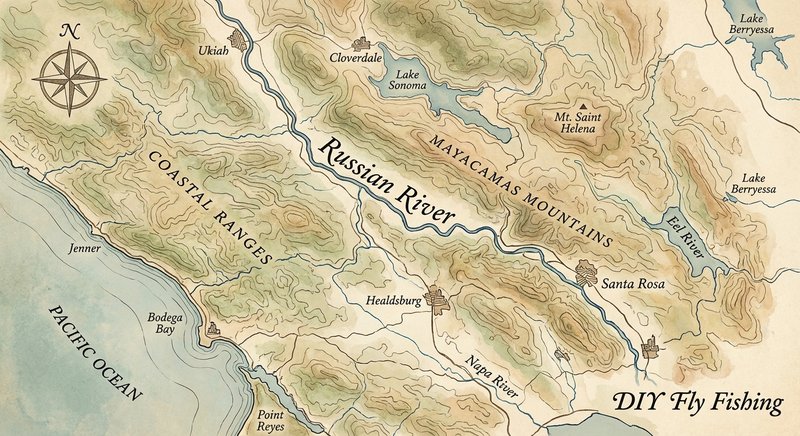
Flowing from the mountains of Mendocino County down through Sonoma County to the Pacific Ocean at Jenner, the Russian River is a large, meandering system. It is one of the most accessible steelhead rivers for those in the San Francisco Bay Area.
What makes the Russian special is its "Green Room"—a specific state of water clarity that occurs as the river "drops and clears" after a winter storm. When the water hits that perfect translucent emerald hue with 2–4 feet of visibility, it becomes one of the premier steelhead destinations on the West Coast. The riverbed is primarily gravel and silt, featuring long, wide runs and deep pools that are perfect for both Spey casting and traditional indicator nymphing.
🐟 Target Species & Behavior
The primary draw here is the Central California Coast (CCC) Steelhead. These are chrome-bright, powerful fish that average 5 to 10 pounds, with "lunkers" occasionally pushing into the mid-teens.
- Behavior: These fish are on a spawning migration. They aren't actively feeding in the traditional sense; they strike out of territorial aggression, curiosity, or vestigial feeding instincts.
- Holding Water: In the Russian, steelhead love "walking speed" water. Look for them in the tailouts of long pools, along seam lines where fast and slow water meet, and in the "gut" of runs about 3 to 6 feet deep.
- Response to Flow: Steelhead move on rising water and hold/settle as the water drops. Your best fishing happens when the river is receding after a rain event.
📅 Best Times to Fish
- Winter (December – February): This is the peak. The first big rains of December usually open the sandbar at the mouth (Jenner), allowing the first "fresh" chrome fish to enter. January and February are the most productive months.
- Spring (March – April): This is the "Late Run." You will find a mix of fresh fish coming in and "kelts" (downstreamers) heading back to the ocean.
- Conditions are Everything: The Russian is notorious for "blowing out" (becoming muddy and unfishable) after heavy rain.
- The Magic Window: 3 to 5 days after a major storm.
- Ideal Flows: Generally, look for flows between 1,000 and 2,500 CFS at the Guerneville gauge for optimal wading and clarity.
🪰 Recommended Flies & Techniques
1. Swinging (Spey or Switch Rods)
The Russian is a fantastic river for Spey casting. Using a Skagit head with a sink tip (T-11 or T-14) is the standard approach to get the fly down in the cold winter water.
- Patterns:
- Intruders: Pink/Orange, Blue/Black, or Chartreuse.
- Hobo Spey: In purple or pink.
- Bunny Leeches: Weighted flies with plenty of movement.
2. Nymphing (Indicator Fishing)
Often more productive when the water is colder or slightly more turbid.
- Patterns:
- Glo-Bugs / Bead Eggs: Mottled orange, pink, or "clown" colors.
- Rubber Legs (Stoneflies): Size 4–8 in black or brown.
- San Juan Worms: Red or pink (especially effective in slightly murky water).
- Presentation: You must get the fly to the bottom. Use plenty of split shot and a long leader to ensure your egg or nymph is bouncing off the gravel.
💡 Pro Tips & Local Knowledge
- The "Hatchery Bump": A large percentage of Russian River steelhead are hatchery-born. Focusing your efforts near Coyote Valley Dam (near Ukiah) or the Warm Springs Hatchery (on Dry Creek, a major tributary) can increase your numbers, as fish congregate near their birthplaces.
- Watch the Gauges: Before you drive, check the USGS gauges for Healdsburg and Guerneville. If the line is trending sharply upward, stay home. If it’s a slow downward curve, grab your gear.
- The "Slow Swing": In the winter, steelhead are cold and sluggish. Don't make them chase the fly. Swing your fly as slowly as possible, using "mends" to stall the fly in the strike zone.
- Stealth Matters: Despite the river being large, steelhead can be spooky in clear water. Wade quietly and avoid casting your shadow over prime holding water.
⚠️ Important Information
- Regulations: The Russian River has very specific regulations. It is generally a barbless hook fishery.
- Wild vs. Hatchery: You must immediately release all wild steelhead (those with an intact adipose fin). Hatchery fish (clipped adipose fin) may be kept according to current CDFW limits—but most fly anglers practice 100% catch and release here.
- Low Flow Closures: The Russian is subject to "Low Flow Closures." If the water level drops too low, the DFW will shut down fishing to protect the fish. Always call the CDFW North Coast Closure Hotline at (707) 944-5533 before heading out.
- Access Points:
- Steelhead Beach Regional Park: Great for wading and launching shells.
- Wohler Bridge: A classic run for Spey casters.
- Johnson’s Beach (Guerneville): Easy access, though can be crowded.
- Cloverdale River Park: Good for upper river access.
Guide’s Final Thought: The Russian is a river of patience. You might spend three days casting into chocolate milk only to have the fourth day offer the most beautiful emerald water and the hardest take of your life. Watch the weather, keep your flies deep, and enjoy the scenery of the California redwoods.
Bug Hatches & Matching Flies
| Hatch | Type | Peak months | Time of day | Hook sizes | Matching flies |
|---|---|---|---|---|---|
| Blue Winged Olive Baetis | mayfly | February, March, October, November | Late Morning/Afternoon | #18-22 | RS2 #18-22, Parachute Adams #18-20, BWO Emerger #18-22 |
| Spotted Sedge Hydropsyche | caddis | April, May, June, September | Evening | #14-18 | Elk Hair Caddis #14-16, Pupa-Sella #14-18, Holy Grail #14-16 |
| Golden Stonefly Calineuria californica | stonefly | May, June | Morning/Afternoon | #6-10 | Pats Rubber Legs #6-10, Chubby Chernobyl #8-10 |
| Pale Morning Dun Ephemerella | mayfly | May, June | Late Morning | #14-18 | PMD Sparkle Dun #16-18, Pheasant Tail Nymph #14-18, Quigley Cripple #16 |
| Common Midge Chironomidae | midge | December, January, February | All Day | #18-24 | Zebra Midge #18-22, Griffith's Gnat #20-22, Top Secret Midge #20-24 |
| October Caddis Dicosmoecus | caddis | September, October | Afternoon/Evening | #8-12 | Stimulator (Orange) #8-12, October Caddis Pupa #10-12 |
| American Grannom Brachycentrus | caddis | March, April | Afternoon | #14-16 | Peacock Caddis #14-16, Deep Blue Poison Tung #16 |
| Terrestrials Various | terrestrial | July, August, September | Afternoon | #8-14 | Dave's Hopper #10-12, Black Foam Ant #14-16, Chernobyl Ant #8-12 |