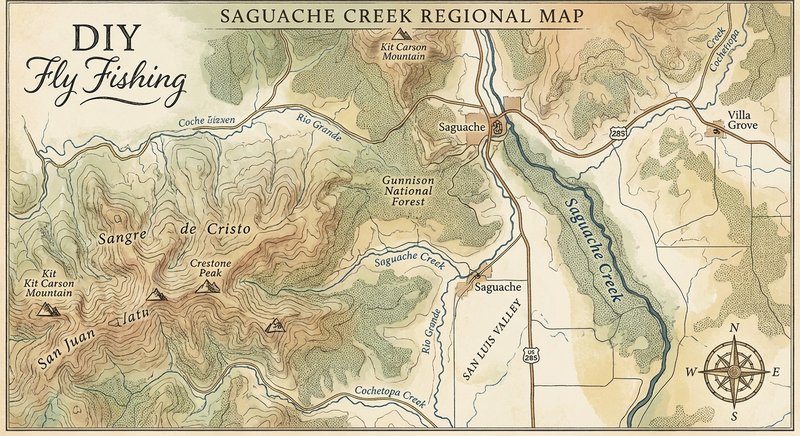
Saguache Creek
Fly fishing in Colorado · Beginner · Best seasons: Summer, Fall
Target Species
Brown Trout, Rainbow Trout
About This Water
San Luis Valley stream with wild brown trout. Less crowded alternative in southern Colorado.
Fishing Recommendations
As an expert guide who has spent considerable time navigating the high-desert and mountain transitions of the San Luis Valley, I can tell you that Saguache Creek is one of Colorado’s best-kept secrets. It is a classic "meander" stream that offers a quintessential small-water fly fishing experience away from the crowds of the nearby Arkansas or Rio Grande rivers.
🎣 Location Overview
Saguache Creek (pronounced Suh-watch) is a high-altitude tributary that flows out of the La Garita Mountains and winds through the San Luis Valley. What makes this water special is its character: it is a masterpiece of oxbows, undercut banks, and willow-lined pockets.
The creek transitions from a tumbling mountain stream in its upper reaches (within the Rio Grande National Forest) to a slow-moving, meadow-style stream as it approaches the town of Saguache. Anglers love it because it rewards stealth and precision rather than long-distance casting. It feels intimate, wild, and largely untouched by the heavy commercial pressure found elsewhere in the state.
🐟 Target Species & Behavior
- Brown Trout: The dominant species in the lower meadow sections. These fish are notorious for hiding deep under the overhanging willows and undercut banks. They are opportunistic but spooky.
- Rainbow Trout: More prevalent in the upper, faster-moving sections where oxygen levels are higher. They tend to hold in the riffles and at the heads of pools.
- Behavior: These fish are "structure-oriented." Because the creek is relatively narrow, the trout use the undercut banks as their primary protection. They will dart out to grab a terrestrial or a nymph and retreat instantly. You won't see many fish "rised" in the middle of the channel; look for them inches from the grass line.
📅 Best Times to Fish
- Summer (Late June – August): This is the prime window. Once the spring runoff subsides (usually by mid-June), the creek settles into a perfect flow. This is the era of terrestrial fishing—grasshoppers are abundant in the surrounding hay meadows.
- Fall (September – October): My personal favorite. The Brown trout become aggressive as they prepare for the spawn. The cottonwoods and willows turn gold, and the water becomes crystal clear.
- Best Time of Day: During mid-summer, early morning and late evening are best to avoid the midday sun, which can make fish lethargic in the shallower meadow stretches. In the Fall, the "bank-slapping" hopper action is best from 10:00 AM to 4:00 PM once the air warms up.
🪰 Recommended Flies & Techniques
Top Fly Patterns
- Dry Flies:
- Terrestrials: Amy’s Ant (size 10-14), Joe’s Hopper (12), and Black Foam Beetles (14-16).
- Attractors: Royal Wulff, Stimulators (Orange or Yellow, size 14), and Parachute Adams for the evening hatch.
- Nymphs:
- Bead-head Pheasant Tails (16-18), Hare’s Ear (16), and Pat’s Rubber Legs (small, size 12) for the deeper holes.
- Streamers:
- Small Wooly Buggers (Black or Olive, size 10-12) or a Sculpzilla.
Effective Techniques
- The "Hopper-Dropper": This is the bread and butter of Saguache Creek. Use a high-floating foam hopper as your indicator and hang a small Pheasant Tail or Copper John about 18–24 inches below it.
- Dapping/Stealth Casting: Because the banks are often undercut, you frequently don't even need a full cast. Crouching low and "dapping" your fly right against the grass will often trigger a strike from a Brown trout you couldn't see.
- Tight-Line Nymphing: In the upper canyon sections, short-leash nymphing through the plunge pools is highly effective.
💡 Pro Tips & Local Knowledge
- The "Vibration" Factor: The ground along the meadow sections is often soft and peat-like. Heavy footsteps send vibrations through the water that will shut down a pool before you even cast. Walk softly and stay back from the bank.
- Look for the "Cut": On every bend, the water carves out a deep pocket on the outside of the curve. If your fly isn't within two inches of that dirt bank, you’re out of the strike zone.
- Focus on Public Pockets: Use an app like OnX or Gaia GPS. Saguache Creek has a "checkerboard" of public and private land. Focus on the sections within the Rio Grande National Forest or the designated State Wildlife Areas (SWA). The stretch along County Road 42 offers several excellent public access points.
⚠️ Important Information
- Access: Much of the best fishing is accessed via Highway 114 and County Road 42. Be prepared for washboard dirt roads.
- Regulations: Standard Colorado fishing regulations apply (valid CO fishing license required). However, always check the current CPW Fishing Brochure for any emergency drought closures or specific gear restrictions (though most of Saguache is open to bait, lures, and flies, "Fly and Lure Only" is the ethical standard for preserving the fishery).
- Safety: This is remote country. Cell service is spotty to non-existent once you head up the drainage. Carry a spare tire, plenty of water, and bear spray, as black bears and mountain lions frequent the riparian corridors.
- Cattle: You are in ranching country. If you pass through a gate, leave it exactly as you found it (open or closed). Respect private property boundaries strictly to ensure continued access for the angling community.
Bug Hatches & Matching Flies
| Hatch | Type | Peak months | Time of day | Hook sizes | Matching flies |
|---|---|---|---|---|---|
| Midges Chironomidae | midge | March, April, October, November | All Day | #18-24 | Zebra Midge #18-22, Griffith's Gnat #20-22, Morgan's Midge #20-24 |
| Blue Winged Olive Baetis spp. | mayfly | April, May, September, October | Mid-day/Afternoon | #18-22 | RS2 #18-22, Parachute Adams #18-22, Pheasant Tail Nymph #18-20 |
| Pale Morning Dun Ephemerella dorothea | mayfly | July, August | Morning/Mid-day | #14-18 | PMD Sparkle Dun #16-18, Quill Gordon #14-16, Chocolate Foam Wing PMD #16-18 |
| Golden Stonefly Hesperoperla pacifica | stonefly | June, July | Morning/Evening | #8-12 | Pat's Rubber Legs #8-12, Rogue Foam Stone #10-12, 20 Incher #10-14 |
| Spotted Sedge Hydropsyche spp. | caddis | July, August | Evening | #14-16 | Elk Hair Caddis #14-16, LaFontaine's Deep Pupa #14-16, Holy Grail Caddis #14-16 |
| Yellow Sally Isoperla spp. | stonefly | July | Afternoon/Evening | #14-16 | Yellow Sally Stimulator #14-16, Iron Sally #14-16 |
| Grasshoppers Acrididae | terrestrial | August, September | Late Morning/Afternoon | #10-14 | Joe's Hopper #10-12, Amy's Ant #12-14, Parachute Hopper #12-14 |
| Tricos Tricorythodes spp. | mayfly | August, September | Morning | #20-24 | Trico Spinner #20-24, CDC Trico Emerger #22-24 |
| Black Ants Formicidae | terrestrial | July, August | All Day | #14-18 | Cinnamon Ant #16-18, Black Foam Ant #14-16 |