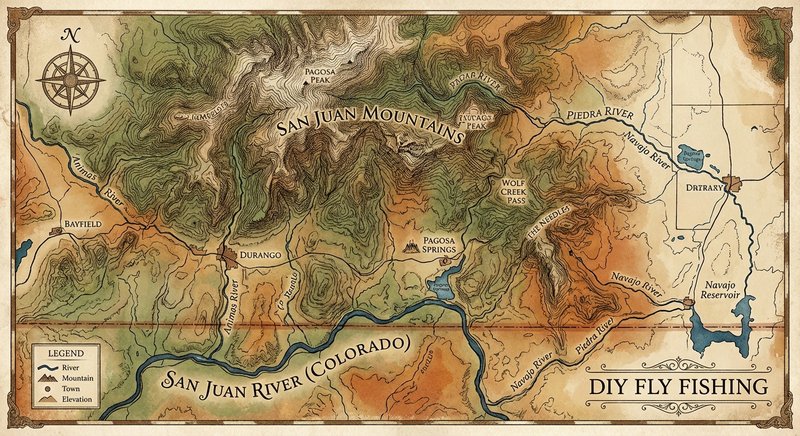
San Juan River (Colorado)
Fly fishing in Colorado · Beginner · Best seasons: Summer, Fall
Target Species
Rainbow Trout, Brown Trout
About This Water
Headwaters near Pagosa Springs with wild trout. Source of famous New Mexico tailwater.
Fishing Recommendations
While most fly anglers immediately think of the famous "Quality Waters" below Navajo Dam in New Mexico, the Upper San Juan River in Colorado—specifically around Pagosa Springs—is a premier freestone destination that offers a completely different experience. As an expert guide, I can tell you that this section is a classic mountain river: rugged, beautiful, and full of spirited trout.
Here is your comprehensive guide to fly fishing the San Juan River in Colorado.
🎣 Location Overview
The San Juan River in Colorado is a classic Western freestone river, born from the snowpack of the high San Juan Mountains. Unlike the tailwater section in New Mexico, the Colorado stretch is subject to the natural whims of the seasons, including a heavy spring runoff.
Anglers love this water for its diversity. You have the East and West Forks for high-alpine small water, the main stem above town for "pocket water" canyon fishing, and the Town Stretch in Pagosa Springs, which is remarkably productive due to river restoration and the presence of deep, oxygenated holes created by the whitewater park. It is a scenic masterpiece, surrounded by massive peaks, ponderosa pines, and golden aspens.
🐟 Target Species & Behavior
- Rainbow Trout: These are the primary residents of the town stretch and the riffles. They are opportunistic and often hold in the faster, highly oxygenated water (especially near the whitewater features). They are known for their aerial acrobatics when hooked.
- Brown Trout: The "wild" heart of the river. Browns prefer structure—look for them under undercut banks, behind large boulders, or in the deep, slower pools of the canyon stretches. During the fall, they become aggressive and territorial as they prepare to spawn.
Behavior Note: Because this is a freestone river with a shorter growing season than a tailwater, these fish are generally less "picky" than their cousins downstream in New Mexico. However, they are wary of poor wading techniques and heavy shadows.
📅 Best Times to Fish
Optimal Seasons
- Summer (July – August): This is the prime window once the spring runoff subsides (usually by late June). The water clears, the insects emerge, and the "hopper-dropper" season begins.
- Fall (September – October): My personal favorite. The crowds thin out, the water levels are low and clear, and the Brown Trout are moving. The scenery is world-class during the aspen change.
Best Times of Day
- Summer: Early mornings (6 AM – 10 AM) and late evenings (6 PM – Dark). Mid-day can be slow due to the high sun and heat.
- Fall: The "banker’s hours" window (10 AM – 4 PM) as the water needs a little sun to activate the bugs.
Prime Conditions
Look for "cloudy but bright" days for the best dry fly action. A slight bump in turbidity after a light afternoon rain can also trigger a massive streamer bite.
🪰 Recommended Flies & Techniques
Top Fly Patterns
- Dries: Chubby Chernobyl (Size 8-12) in orange or tan, Elk Hair Caddis (14-16), Parachute Adams (14-18), and Amy’s Ant.
- Nymphs: Pat’s Rubber Legs (the "stonefly" staple here), Prince Nymphs, Pheasant Tails (14-18), and San Juan Worms (especially after rain).
- Streamers: Gold or Black Woolly Buggers, Near Nuff Sculpins, and Sparkle Minnows.
Effective Techniques
- Hopper-Dropper: This is the bread and butter of the San Juan in summer. Use a buoyant terrestrial (like a Chubby) as your indicator and hang a bead-head nymph 2–3 feet below it.
- High-Stick Nymphing: In the canyon stretches, the water is "choppy." Using a tight-line or Euro-style approach to keep your line off the conflicting currents will yield the best drifts.
- Streamer Stripping: In the fall, swing streamers through the deep pools or "strip-pause" them along the banks to entice the big Browns.
💡 Pro Tips & Local Knowledge
- The "Town Stretch" Secret: Don't overlook the water right in downtown Pagosa Springs. The city has spent millions on river restoration. The deep pools behind the "j-hook" rock structures hold massive fish that feed on the leftovers of tubers and tourists. Fish the "tail-outs" of these pools at dusk.
- The West Fork: if the main stem is running a bit muddy, check the West Fork. It often clears faster and offers a more intimate, small-stream experience for those willing to hike a bit.
- Watch the "Flows": For the Colorado section, look for flows between 150 and 400 CFS (Cubic Feet per Second) for the best wading conditions. If it’s over 800 CFS, it’s generally too dangerous and murky to fish effectively.
- Stealth Matters: In the clear water of autumn, the fish can see you from a distance. Wear earthy tones and avoid "crunching" the gravel as you approach the bank.
⚠️ Important Information
- Access: Much of the San Juan River is bordered by private land. However, the Pagosa Springs Town Park provides over 2 miles of public access. Upstream, look for San Juan National Forest access points along Highway 160 and the East Fork Road.
- Regulations:
- A valid Colorado Fishing License is required.
- Specific sections (like the Town Stretch) may have "Catch and Release" or "Artificial Fly and Lure Only" regulations. Always check the current Colorado Parks and Wildlife (CPW) brochure before casting.
- Safety: The San Juan is a cold mountain river. Even in summer, wading boots with felt or studs are recommended because the rocks are notoriously "greasy" with algae. Watch for sudden afternoon thunderstorms, which are common in the San Juans.
Guide’s Final Word: The San Juan in Colorado is about the experience. It’s not just about the numbers; it’s about the crisp air, the sound of the water, and the thrill of a wild trout taking a dry fly in one of the most beautiful mountain ranges in the world. Tight lines!
Bug Hatches & Matching Flies
| Hatch | Type | Peak months | Time of day | Hook sizes | Matching flies |
|---|---|---|---|---|---|
| Midges Chironomidae | midge | January, February, March, December | All day/Late morning | #18-24 | Zebra Midge #18-22, Griffith's Gnat #20-24, Morgan's Midge #20-22 |
| Blue Winged Olive Baetis | mayfly | April, May, September, October | Late morning/Afternoon | #18-22 | RS2 #20-22, Parachute Adams #18-22, Pheasant Tail Nymph #18-20 |
| Pale Morning Dun Ephemerella | mayfly | June, July, August | Morning/Early afternoon | #14-18 | PMD Sparkle Dun #16-18, Frenchie #14-16, Barr's PMD Emerger #16-18 |
| Golden Stonefly Hesperoperla pacifica | stonefly | June, July | Morning/Evening | #8-12 | Pat's Rubber Leg #8-12, Chubby Chernobyl #10-12, Golden Twenty Incher #10-14 |
| Caddis Brachycentrus / Hydropsyche | caddis | May, June, July | Evening/Afternoon | #14-18 | Elk Hair Caddis #14-18, LaFontaine's Deep Sparkle Pupa #14-16, Holy Grail #16-18 |
| Yellow Sally Isoperla | stonefly | June, July, August | Afternoon/Evening | #14-16 | Yellow Sally Foam Dry #14-16, Iron Lotus #16, Little Yellow Sloan #14-16 |
| Terrestrials Formicidae / Acrididae | terrestrial | July, August, September | All day | #10-16 | Amy's Ant #12-14, Morrish Hopper #10-12, Black Foam Beetle #14-16 |
| Trico Tricorythodes | mayfly | August, September | Early Morning | #20-24 | Trico Spinner #20-24, Sunken Trico #22, CDC Trico #20-22 |