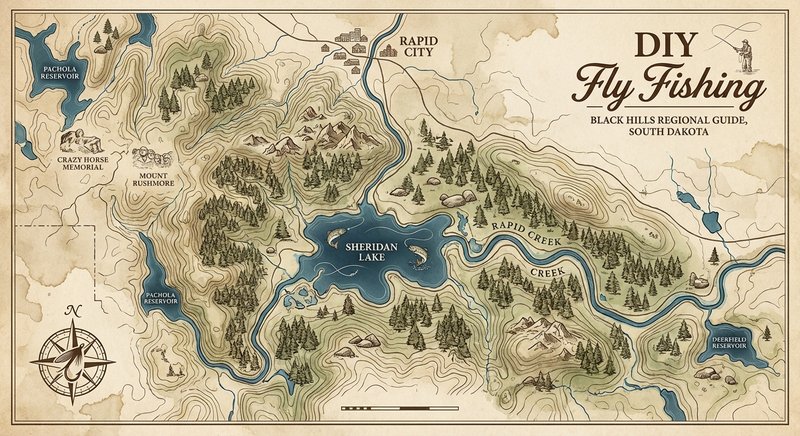
Sheridan Lake
Fly fishing in South Dakota · beginner · Best seasons: spring, summer, fall
Target Species
Rainbow Trout
About This Water
Black Hills reservoir with stocked trout. Popular family fishing destination.
Fishing Recommendations
Welcome to the Black Hills of South Dakota. As a guide in this region, I can tell you that Sheridan Lake is often overlooked by fly anglers who get distracted by the famous Rapid Creek tailwaters. That is a mistake.
Sheridan is a premier stillwater fishery located about 15 miles southwest of Rapid City. At roughly 380 acres, it offers a diverse ecosystem where the "Black Hills strain" Rainbow Trout grow fat and energetic.
🎣 Location Overview
Sheridan Lake is a high-mountain reservoir managed by the US Forest Service. What makes it special for the fly angler is its dual personality: it features deep, cool basins that hold fish during the heat of summer, but it is ringed with shallow, weed-choked flats and rocky points that provide incredible sight-fishing opportunities.
The water is generally clear to slightly stained. Unlike the sterile alpine lakes you might find in the Rockies, Sheridan is incredibly productive biologically. It has massive hatches of midges and damselflies, making it a "thinking person's" stillwater where matching the hatch is just as important as it is on a river.
🐟 Target Species & Behavior
While there are Northern Pike, Largemouth Bass, and Perch in these waters, the Rainbow Trout are the stars for fly fishers.
- Behavior: These aren't your average "stockers." South Dakota Game, Fish & Parks stocks heavily, but many fish carry over and become "holdovers" that behave like wild fish.
- Holding Zones: In the spring and fall, look for rainbows in the littoral zones (3–10 feet of water). They cruise the edges of the weed beds looking for scuds and damselfly nymphs. In the summer, they retreat to the thermocline (deeper water near the dam or the old creek channel), moving into the shallows only during the low-light hours of dawn and dusk.
- Diet: Their primary diet consists of chironomids (midges), scuds (freshwater shrimp), damselfly nymphs, callibaetis mayflies, and small baitfish (fathead minnows).
📅 Best Times to Fish
Optimal Seasons
- Spring (Ice-out to June): This is the prime window. As the ice recedes, trout are hungry and move into the shallows where the water warms first. The damselfly migration in late June is legendary.
- Summer (July - August): Fishing becomes a "low light" game. Focus on the first two hours of light and the last two hours.
- Fall (September - November): As water temperatures drop, trout go on a feeding frenzy to prepare for winter. The shoreline "bite" returns in force.
Best Times of Day
- Early Morning: The water is calmest, allowing you to see "cruisers" pushing wakes in the shallows.
- Cloudy Days: This is the secret weapon for Sheridan. Overcast skies keep the trout in shallow water all day long and reduce their wariness.
🪰 Recommended Flies & Techniques
Top Fly Patterns
- Chironomids: Zebra Midges (Red or Black, size 14–18), Ice Buddies (size 12–14).
- Nymphs: Balanced Leeches (Olive or Maroon, size 10–12), Gold-ribbed Hare’s Ear (size 14–16), and the "Dirty Hippie" scud pattern.
- Dries: Parachute Adams (size 16), Griffith’s Gnat (size 18–20) for midge clusters.
- Streamers: Pine Squirrel Leeches (Olive), Wooly Buggers (Black/White), and small Clouser Minnows to mimic perch fry.
Effective Techniques
- The "Indicator Hang": Suspend a Balanced Leech or a Zebra Midge under a slip indicator. Set the depth so your fly is roughly 12–18 inches off the bottom or just above the weed tops.
- The Intermediate Strip: Using an intermediate sinking line, cast a damselfly nymph or a small streamer over the weed beds and use a "slow-slow-twitch" retrieve.
- Dry-Dropper: Along the rocky shorelines, use a high-visibility foam hopper or beetle with a small scud dropped 24 inches below it.
💡 Pro Tips & Local Knowledge
- Focus on the "Spring Arm": The north end of the lake (where Spring Creek enters) is a hotspot. The moving water brings in oxygen and food. This is often the most consistent spot for fly anglers.
- The "Perch Fry" Window: In mid-summer, thousands of tiny yellow perch hatch. If you see trout "boiling" on the surface, they aren't taking bugs—they are smashing perch fry. Use a small, sparse white/chartreuse streamer and strip it fast.
- The Float Tube Advantage: While you can fish from the shore (especially near the dams and the North Harbor), a float tube or kayak is a game-changer here. It allows you to stay 30 feet off the weed edge and cast back toward the shore, which is exactly how the big holdovers cruise.
- Watch the Wind: Sheridan can get breezy. Use the wind to your advantage by fishing the "windward" shore where insects are being pushed against the rocks.
⚠️ Important Information
- Access: There are two main access points: North Shore (easiest for the Spring Creek inlet) and South Shore (better for deeper water and the dam). Both have well-maintained boat ramps and parking.
- Permits: A South Dakota fishing license is required. If you are staying in the US Forest Service campgrounds, there is a daily parking fee (or use an Interagency/America the Beautiful pass).
- Regulations: Sheridan is under general statewide regulations for trout (5 fish limit), but I strongly encourage Catch and Release for the larger holdover rainbows to maintain the quality of the fishery.
- Safety: The Black Hills can experience rapid weather changes. If you see dark clouds over the limestone cliffs to the west, get off the water immediately—lightning moves fast in this canyon.
Tight lines, and enjoy the beauty of the Black Hills!
Bug Hatches & Matching Flies
| Hatch | Type | Peak months | Time of day | Hook sizes | Matching flies |
|---|---|---|---|---|---|
| Chironomids Chironomidae | midge | April, May, September, October | All Day | #12-22 | Zebra Midge #16-20, Ice Cream Cone #12-16, Griffith's Gnat #18-22 |
| Callibaetis (Speckled Duns) Callibaetis ferrugineus | mayfly | June, July, August | Late Morning/Early Afternoon | #12-16 | Callibaetis Spinner #14-16, Hares Ear Nymph #14-16, Parachute Adams #12-16 |
| Damselflies Enallagma | terrestrial | June, July | Late Morning/Afternoon | #10-14 | Marabou Damsel #10-12, Adult Damsel #12-14 |
| Freshwater Shrimp (Scuds) Gammarus lacustris | terrestrial | March, April, October, November | All Day | #12-18 | Ray Charles #14-18, Flashback Scud #12-16 |
| Traveling Sedge Hesperophylax | caddis | July, August | Evening/Dusk | #8-12 | Goddard Caddis #10-12, Mikulak Sedge #8-10 |
| Water Boatmen Corixidae | terrestrial | September, October | Afternoon | #14-18 | Water Boatman #14-16, Prince Nymph #14-18 |
| Black Ants Formicidae | terrestrial | July, August, September | Afternoon | #14-20 | Cinnamon Ant #16-18, Black Foam Ant #14-18 |
| Grasshoppers Acrididae | terrestrial | August, September | Afternoon | #8-12 | Dave's Hopper #10-12, Morrish Hopper #8-12 |