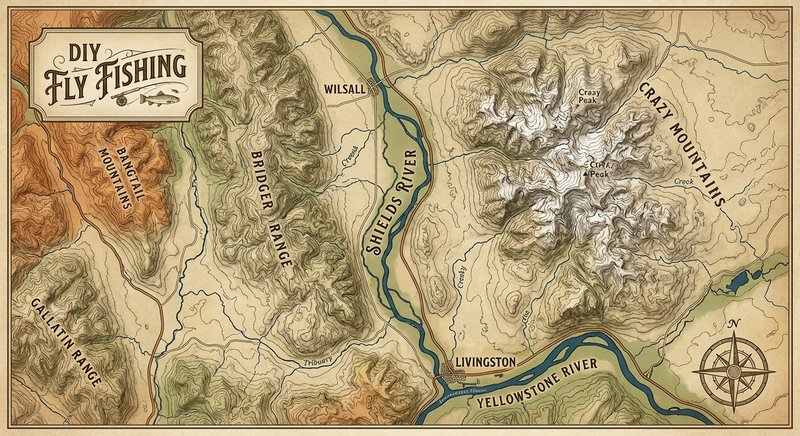
Shields River
Fly fishing in Montana · Beginner · Best seasons: Summer, Fall
Target Species
Brown Trout, Rainbow Trout
About This Water
Tributary of the Yellowstone near Livingston. Wild brown and rainbow trout with good access.
Fishing Recommendations
The Shields River is one of Montana’s best-kept secrets. Flowing through a stunning valley between the Crazy Mountains to the east and the Bridger Mountains to the west, it eventually joins the Yellowstone River near Livingston. Unlike its famous neighbor, the Yellowstone, the Shields is intimate, winding, and heavily characterized by its "meandering" nature through private ranchlands. It is a technical fishery that rewards patience and precise casting.
🎣 Location Overview
The Shields River is a classic "prairie stream" that feels more like a large creek than a major river. It is defined by its tight bends, deep undercut banks, and extensive willow lining.
What makes it special is the solitude. While the Yellowstone is packed with drift boats, the Shields is primarily a walk-and-wade fishery. Because it flows through soft soil, the water can be sensitive to rain (turning muddy quickly), but when it’s clear, it offers some of the finest dry-fly fishing for wild trout in the state. The substrate is mostly gravel and silt, creating a rich habitat for aquatic insects and terrestrial life.
🐟 Target Species & Behavior
While there are native Yellowstone Cutthroat in the upper reaches, the main stem is dominated by Brown Trout and Rainbow Trout.
- Brown Trout: These are the kings of the Shields. They are notorious for hugging the undercut banks and hiding beneath overhanging willow sweeps. They are opportunistic but wary; they prefer structure and will often dart out from a dark hole to smash a hopper or a streamer.
- Rainbow Trout: Found more frequently in the swifter riffles and at the heads of pools. They tend to be more active during hatches and are often found in the "soft" water just off the main current.
- Behavior: These fish are easily spooked. Because the river is narrow, your shadow or a heavy footfall on the bank can shut down a hole for an hour. Approach with stealth—crawling on your knees is not uncommon here.
📅 Best Times to Fish
Optimal Seasons
- Summer (Late June – August): This is the prime window. Once the spring runoff subsides (usually by late June), the river clears and the legendary terrestrial fishing begins.
- Fall (September – October): A favorite for local guides. The Brown trout become aggressive as they prepare for the spawn. The crowds (which are already thin) disappear completely, and the cottonwoods turn a brilliant gold.
Best Times of Day
- Summer: Early mornings for nymphing; 11:00 AM to 4:00 PM for hoppers and terrestrials.
- Fall: Mid-day is best. The water needs to warm up slightly to get the bugs moving. 10:00 AM to 3:00 PM is the "sweet spot."
🪰 Recommended Flies & Techniques
Top Fly Patterns
- Dry Flies: Chubby Chernobyl (Size 10-14), Morrish Hopper (Tan/Pink), PMDs (Size 16-18), and Parachute Adams. In late summer, don't forget Ants and Beetles (Size 16-18)—they are deadly here.
- Nymphs: Pheasant Tail (Size 16-18), Zebra Midge (Red or Black, Size 18-20), and Pat’s Rubber Legs (Tan/Brown) to mimic the prolific stoneflies.
- Streamers: Sculpzilla or Black/Olive Wooly Buggers. Keep them medium-sized; you don't need massive articulated flies on this water.
Effective Techniques
- The "Hopper-Dropper": This is the bread and butter of the Shields. Use a high-visibility foam hopper as your indicator and hang a small weighted nymph 18–24 inches below it.
- Bank Picking: Cast as close to the grass as possible. If your fly isn't within 2 inches of the dirt, you're often out of the strike zone.
- Tight-Line Nymphing: In the deeper bends, a standard indicator rig can be tricky due to complex currents. High-sticking through the deep slots is very effective.
💡 Pro Tips & Local Knowledge
- The "Silt Factor": The Shields can blow out after a single afternoon thunderstorm in the Crazies. Always check the USGS gauge or call a shop in Livingston before driving out. If it looks like chocolate milk, head to the Yellowstone instead.
- Watch Your Backcast: The willows on the Shields are "fly eaters." You will spend more time in the bushes than the water if you aren't careful. Practice a steep steeple cast or a roll cast.
- Stay Low: The fish in this river look "up" constantly. If you stand tall on a high bank, the fish will see your silhouette against the sky and vanish.
- Focus on the Lower River: The lower sections near Wilsall and down toward the mouth have the largest Brown trout, though access is more limited.
⚠️ Important Information
Access
Montana has excellent stream access laws, but the Shields is almost entirely surrounded by private land. You must enter at bridge right-of-ways or designated FWP (Fish, Wildlife & Parks) Fishing Access Sites (FAS).
- Key Access Points: Todd’s East River Road, Convict Grade, and various bridges near Wilsall and Clyde Park.
- Note: Once you are in the river (below the ordinary high-water mark), you can walk the banks, but respect the landowners and don't hop fences.
Regulations & Permits
- A valid Montana Fishing License and Conservation License are required.
- Check the current FWP regulations for "Hoot Owl" restrictions in late summer (mandatory 2:00 PM closures if water temperatures get too high).
Gear Recommendations
- Rod: A 4-weight or 5-weight (8'6" to 9') is perfect. You need something with enough backbone to throw a hopper into the wind but enough delicacy for small dries.
- Leader: 9-foot 4X or 5X fluorocarbon for nymphs; 9-foot 4X nylon for dries.
Guide’s Final Word: The Shields isn't about high fish counts; it's about the quality of the hunt. It is a rewarding, scenic, and quiet alternative to the high-pressure rivers of Big Sky Country. Respect the willows, stay low, and watch those banks!
Bug Hatches & Matching Flies
| Hatch | Type | Peak months | Time of day | Hook sizes | Matching flies |
|---|---|---|---|---|---|
| Blue Winged Olive Baetis spp. | mayfly | April, May, September, October | Late Morning/Afternoon | #18-22 | Parachute Adams #18-22, RS2 #20-22, Pheasant Tail #18-20 |
| Mother's Day Caddis Brachycentrus occidentalis | caddis | May | All Day | #14-16 | Elk Hair Caddis #14-16, Peacock Caddis #14-16, LaFontaine's Deep Sparkle Pupa #14-16 |
| Pale Morning Dun Ephemerella excrucians | mayfly | June, July | Morning/Early Afternoon | #16-18 | PMD Sparkle Dun #16-18, Split Case PMD #16-18, Quigley Cripple #16-18 |
| Golden Stonefly Hesperoperla pacifica | stonefly | June, July | Morning/Afternoon | #8-12 | Chubby Chernobyl #8-12, Pat's Rubber Leg #8-12 |
| Yellow Sally Isoperla spp. | stonefly | June, July | Afternoon/Evening | #14-16 | Yellow Sally Foamstone #14-16, Little Yellow Sloan #14-16 |
| Trico Tricorythodes spp. | mayfly | August, September | Early Morning | #20-24 | Trico Spinner #22-24, Sunken Trico Spinner #22-24 |
| Grasshoppers Orthoptera | terrestrial | August, September | Late Morning/Afternoon | #8-12 | Morrish Hopper #10-12, Pink Pookie #12, Letort Hopper #12-14 |
| Midges Chironomidae | midge | March, April, October, November | Late Morning | #18-24 | Zebra Midge #18-22, Griffith's Gnat #20-22, Palomino Midge #20-22 |