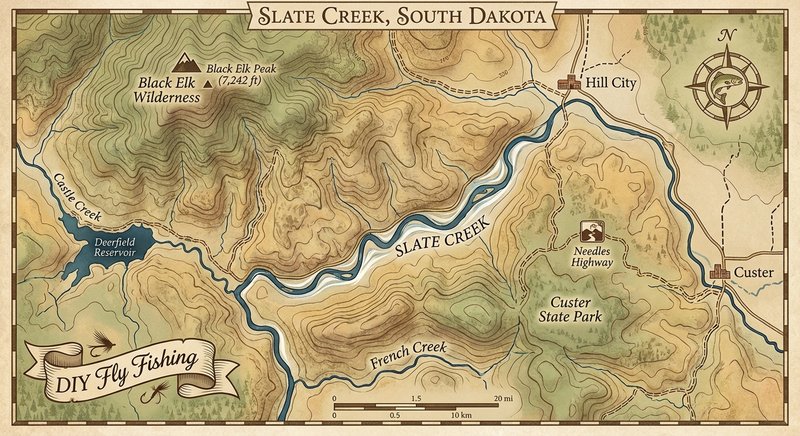
Slate Creek
Fly fishing in South Dakota · advanced · Best seasons: summer
Target Species
Brook Trout
About This Water
Black Hills tributary with wild brook trout. Remote small stream fishing.
Fishing Recommendations
Welcome to one of the hidden gems of the Black Hills. Slate Creek is a quintessential small-stream fly fishing destination. While many anglers flock to the larger Rapid Creek or Spearfish Creek, Slate Creek offers a more intimate, rugged, and rewarding experience for those looking to chase wild, vibrant Brook Trout in a stunning South Dakota mountain setting.
🎣 Location Overview
Slate Creek, located in the central Black Hills near Hill City, is a high-elevation tributary that eventually feeds into Pactola Reservoir. It is characterized by its diversity: you’ll find tight, brushy "tunnel" fishing, open meadow sections, and slow-moving beaver ponds.
What makes Slate Creek special is its wildness. Unlike the tailwaters in the region, Slate Creek feels remote. The water is crystalline and cold, filtered by high-altitude forests and granite formations. It is classic "blue line" fishing where the rewards aren't measured in inches, but in the incredible colors of the fish and the solitude of the canyon.
🐟 Target Species & Behavior
The primary resident is the Wild Brook Trout. While you may find an occasional Brown Trout in the lower reaches near the reservoir, the upper sections are Brookie territory.
- Behavior: These fish are opportunistic but highly "spooky." Because the water is clear and shallow, they are acutely aware of overhead shadows and bank vibrations.
- Holding Patterns: Look for them in the "kitchen"—the head of the pools where oxygen and food are highest. They also love heavy cover; look for undercut banks, submerged logs, and the deep centers of beaver ponds.
- Feeding: In the summer, they are looking up. They have a short growing season and need to pack on calories, making them aggressive toward dry flies if you don't scare them first.
📅 Best Times to Fish
- Optimal Months: June through August is the prime window. By June, the spring runoff has subsided, and by July/August, the terrestrial activity is at its peak.
- Time of Day:
- Morning (8 AM – 11 AM): Great for nymphing and early midge hatches.
- Mid-Day: Actually quite productive in shaded canyon stretches due to terrestrial falls (ants/beetles).
- Evening (6 PM – Dark): The "magic hour" for caddis hatches and frantic dry fly action.
- Prime Conditions: Overcast days are a gift here. Clouds cut the glare on the water and make the Brookies much less skittish.
🪰 Recommended Flies & Techniques
Top Fly Patterns
- Dry Flies:
- Parachute Adams (#16-20): The gold standard.
- Elk Hair Caddis (#14-18): Tan or Olive; great for skittering across the surface.
- Hi-Vis Ant or Foam Beetle (#14-16): Essential for summer.
- Royal Wulff (#14-16): High buoyancy and easy to see in bubbly water.
- Nymphs:
- Bead-head Pheasant Tail (#16-18): Mimics almost everything.
- Gold-ribbed Hare’s Ear (#16): Great for the deeper beaver ponds.
- Streamers:
- Small Wooly Bugger (Black or Olive, #10-12): Use these in the beaver ponds for the larger "resident" Brookies.
Effective Techniques
- Dry-Dropper: This is the most effective summer rig. Use a buoyant dry (like a Stimulator) with a small unweighted nymph dropped 12-18 inches below.
- The Bow-and-Arrow Cast: Many stretches are overgrown with willows and pines. Mastering this "short game" cast is essential to reach the best pockets.
- Dapping: Sometimes the brush is so thick you can't cast. Simply poke your rod tip through the brush and drop the fly on the water.
💡 Pro Tips & Local Knowledge
- Focus on the Beaver Ponds: Above Slate Creek Dam, you will find several beaver pond complexes. These hold the largest Brookies in the system. Approach them like a ninja—crawl on your knees if you have to. If you see the "V" wake of a fish swimming away, you've already lost that pool.
- The "One-Cast" Rule: In small water like this, your first cast is your best chance. Accuracy is more important than distance.
- Rod Choice: Leave the 9-foot 5-weight at home. A 7-foot to 7.5-foot 3-weight or 4-weight is the perfect tool for these tight quarters.
- Stealth is Everything: Wear earthy colors (greens and browns). Avoid white hats or shiny watches that flash in the sun.
⚠️ Important Information
- Access: Much of Slate Creek is within the Black Hills National Forest, providing excellent public access. Access points can be found off Slate Creek Road (FSR 231).
- Regulations: A valid South Dakota fishing license is required. Always check the current South Dakota Game, Fish & Parks regulations for any seasonal closures or specific creel limits.
- Wading: The creek is small enough that you can often fish from the bank, but lightweight wading boots or wet-wading gear are recommended for crossing.
- Wildlife: This is mountain lion and northern forest country. Be aware of your surroundings. Also, watch for cattle, as some areas are open for grazing.
Guide’s Final Word: Slate Creek isn't about trophy hunting; it’s about the soul of fly fishing. Take your time, admire the "marbling" on every Brookie you catch, and enjoy the silence of the Black Hills. Tight lines!
Bug Hatches & Matching Flies
| Hatch | Type | Peak months | Time of day | Hook sizes | Matching flies |
|---|---|---|---|---|---|
| Blue-Winged Olive Baetis | mayfly | March, April, September, October | Late Morning/Afternoon | #18-22 | RS2 #18-22, Parachute Adams #18-22, Pheasant Tail Nymph #18-20 |
| Pale Morning Dun Ephemerella | mayfly | June, July | Morning/Early Afternoon | #14-18 | PMD Sparkle Dun #16-18, Hare's Ear Nymph #14-16, Trigger Finger PMD #16-18 |
| Little Brown Stonefly Nemoura | stonefly | March, April | Late Morning | #14-16 | Pats Rubber Legs #14-16, Little Brown Stone #16, Copper John #14-16 |
| Grannom Caddis Brachycentrus | caddis | April, May | Afternoon/Evening | #14-16 | Elk Hair Caddis #14-16, Peacock Caddis Larva #14-16, Soft Hackle Hare's Ear #14-16 |
| Little Yellow Stonefly Isoperla | stonefly | June, July | Evening | #14-16 | Yellow Sally #14-16, Iron Lotus #16, Yellow stimulator #14-16 |
| Trico Tricorythodes | mayfly | August, September | Early Morning | #20-24 | Trico Spinner #20-24, Sunken Trico Spinner #20-22, Griffith's Gnat #20-22 |
| Midges Chironomidae | midge | January, February, March, December | All Day | #18-24 | Zebra Midge #18-22, Morgan's Midge #20-22, Top Secret Midge #20-22 |
| Terrestrials Formicidae / Orthoptera | terrestrial | July, August, September | Afternoon | #10-16 | Dave's Hopper #10-14, Cinnamon Ant #16-18, Black Foam Beetle #14-16 |
| Spotted Sedge Hydropsyche | caddis | July, August | Evening | #14-18 | LaFontaine's Deep Sparkle Pupa #14-16, X-Caddis #16-18, Birds Nest #14-18 |