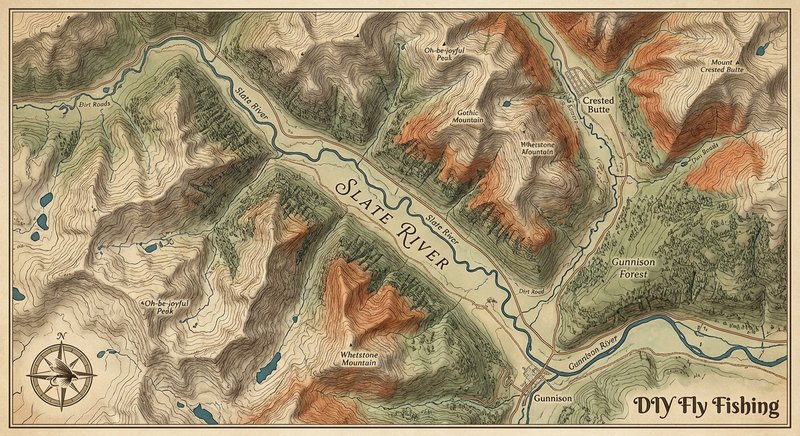
Slate River
Fly fishing in Colorado · Beginner · Best seasons: Summer, Fall
Target Species
Brook Trout, Rainbow Trout
About This Water
Near Crested Butte with wild brook and rainbow trout. High altitude fishing in gorgeous mountain meadows.
Fishing Recommendations
The Slate River is one of the gems of the Gunnison Valley, flowing through the heart of Crested Butte, Colorado. While often overshadowed by the larger Taylor or Gunnison Rivers, the Slate offers a more intimate, technical, and visually stunning high-country experience.
Here is your comprehensive guide to fishing the Slate River.
🎣 Location Overview
The Slate River is a classic high-alpine freestone stream that meanders through lush glacial valleys, willow-lined banks, and dramatic canyons. What makes it special is the diversity of water: it transitions from a tumbling mountain creek in its upper reaches to a slow, winding "meander" section through the valley floor.
Anglers love the Slate for its untamed character. Unlike the dam-controlled Taylor River nearby, the Slate is entirely dependent on snowmelt. It offers spectacular views of Paradise Divide and Mt. Crested Butte, providing a "quintessential Colorado" backdrop. The water is crystal clear, cold, and requires a stealthy approach, making it a favorite for those who prefer small-stream tactics over heavy-duty wading.
🐟 Target Species & Behavior
- Brook Trout: These are the primary residents of the upper stretches and the smaller tributaries. They are aggressive but spooky. Expect them to hold in the deepest parts of small plunge pools and tucked tight under overhanging willows.
- Rainbow Trout: Found more frequently in the middle and lower sections, especially where the river deepens. They are often found in the "riffle-run-pool" transitions.
- Brown Trout: While you mentioned Brookies and Rainbows, be aware that the lower Slate (near the confluence with the East River) holds some very respectable Brown trout that migrate up from the larger systems.
Behavior: Because the growing season is short at 9,000+ feet, these fish are opportunistic. However, the water is clear; if they see your shadow or your fly line slaps the water, the pool is "done" for the next hour.
📅 Best Times to Fish
Optimal Seasons
- Summer (Late June – August): This is the prime window. Once the spring runoff subsides (usually by late June), the river becomes fishable. July is the peak for dry fly action.
- Fall (September – October): This is the "magic hour" for the Slate. The crowds vanish, the aspens turn gold, and the Brook trout move into their vibrant spawning colors. The water is low and technical, but the fish are hungry before winter.
Best Times of Day
- Summer: 9:00 AM to 3:00 PM. High sun helps you spot fish, and the insect activity peaks during the warmth of the day.
- Fall: 11:00 AM to 4:00 PM. Wait for the water to warm up slightly to trigger insect hatches (like Blue Winged Olives).
🪰 Recommended Flies & Techniques
Top Fly Patterns
- Dry Flies:
- Parachute Adams (Size 14-18) – The ultimate searcher.
- Chubby Chernobyl (Size 10-14) – Great for the "Hopper-Dropper" rig in August.
- Elk Hair Caddis (Size 14-16) – Perfect for the swifter riffles.
- Amy’s Ant (Size 12) – Very effective in the meadow sections.
- Nymphs:
- Pheasant Tail (Size 16-20) – Standard fare for the Slate.
- Copper John (Size 16-18) – Use as a dropper to get down in deeper holes.
- Bead-head Zebra Midge (Size 18-22) – Essential for the slower meanders.
- Streamers:
- Wooly Bugger (Black or Olive, Size 10-12) – Effective in the deeper canyon pools during low light.
Presentation & Techniques
- The "Hopper-Dropper": This is the bread and butter of the Slate. Use a buoyant dry fly (like a foam ant or beetle) and hang a small nymph 18-24 inches below it.
- Stealth Approach: Use a 7.5ft to 9ft 3-weight or 4-weight rod. Crouch low when approaching the bank, especially in the flat meadow sections.
- Short Casts: You rarely need to cast more than 20-30 feet. Accuracy and a soft landing are more important than distance.
💡 Pro Tips & Local Knowledge
- The "Meander" Section: The area between the Gunsight Bridge and the town of Crested Butte is famous for its "S-curves." Look for "undercut banks." The biggest fish stay hidden deep under the grassy banks during the day. Drift your fly as close to the grass as possible—if you aren't occasionally snagging grass, you aren't close enough.
- Upper Slate (Oh-Be-Joyful area): If you want high-volume Brook trout action, head up toward the Oh-Be-Joyful campground. The fish are smaller, but they will hit almost any well-presented dry fly.
- The "Crested Butte Twitch": In the slower meadow water, if a fish refuses your dry fly, give it a tiny, microscopic twitch. Sometimes the movement mimics a terrestrial insect trying to escape the surface film, triggering a strike.
⚠️ Important Information
Access
- Public vs. Private: This is critical on the Slate. Much of the river flows through private ranch land.
- Gunsight Bridge is a popular public access point.
- The Recreation Path area near town offers some access, but always look for "Private Property" signs.
- Floating: The Slate is popular for paddleboarding and floating in early summer. If you are wading, be courteous to floaters. Note that floating through private land is legal as long as you do not touch the riverbed or banks.
Regulations & Permits
- License: A valid Colorado Fishing License is required.
- Standard Rules: Generally falls under Western Colorado standard regulations (4-trout limit), but Catch and Release is highly encouraged to preserve the fragile high-altitude ecosystem.
- Waders: In mid-summer, the Slate is perfect for "wet wading" (boots and neoprene socks) as the water is refreshing and the hikes between holes can be warm.
Special Considerations
- Moose Safety: The Slate River valley is prime Moose habitat. They are frequently seen in the willows along the river. Give them a wide berth (at least 50 yards); they are much more dangerous than bears.
- Afternoon Thunderstorms: In July and August, lightning is a real threat. If you see clouds building over the peaks, head back to the truck.
Bug Hatches & Matching Flies
| Hatch | Type | Peak months | Time of day | Hook sizes | Matching flies |
|---|---|---|---|---|---|
| Midge Chironomidae | midge | March, April, May | Late Morning | #18-24 | Zebra Midge #18-22, Griffith's Gnat #20-24, Mercury Midge #20-22 |
| Blue Winged Olive Baetis | mayfly | April, May, September, October | Late Morning/Afternoon | #18-22 | RS2 #20-22, Parachute Adams #18-22, JujuBaetis #18-22 |
| Green Drake Drunella doddsii | mayfly | July, August | Midday/Afternoon | #10-12 | Colorado Green Drake #10-12, Hare's Ear Nymph #10-12, Quigley's Green Drake Hackle Stacker #12 |
| Pale Morning Dun Ephemerella | mayfly | July, August | Morning/Early Afternoon | #16-18 | PMD Sparkle Dun #16-18, Pheasant Tail Nymph #16-18, Chocolate Thunder #16-18 |
| Golden Stonefly Hesperoperla pacifica | stonefly | June, July | Morning/Evening | #8-12 | Pats Rubber Legs #8-12, Chubby Chernobyl #10-12, Golden Stone Nymph #10-14 |
| Brachycentrus (Grannom) Caddis Brachycentrus | caddis | June, July | Evening | #14-16 | Elk Hair Caddis #14-16, LaFontaine's Deep Sparkle Pupa #14-16, Graphic Caddis #14-16 |
| Yellow Sally Isoperla | stonefly | July, August | Afternoon/Evening | #14-16 | Yellow Sally Dry #14-16, Little Yellow Sloan #14-16, Stimulator (Yellow) #14-16 |
| Grasshoppers Orthoptera | terrestrial | August, September | Afternoon | #8-12 | Amy's Ant #10-12, Parachute Hopper #10-14, Morrish Hopper #10-12 |