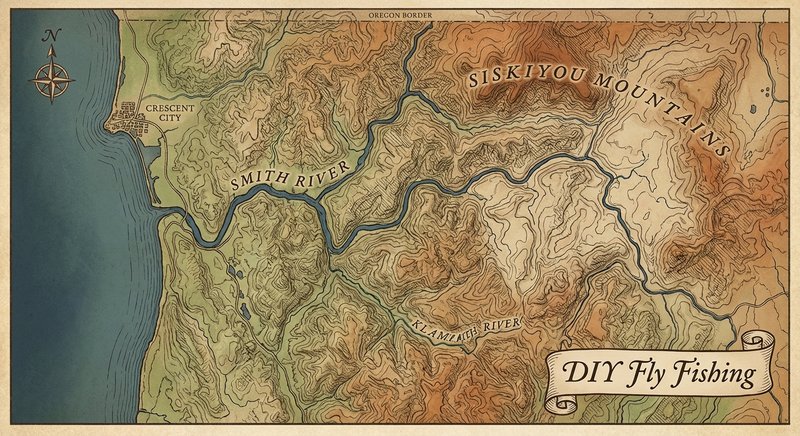
Smith River
Fly fishing in California · Intermediate · Best seasons: Winter, Spring
Target Species
Steelhead, Chinook Salmon
About This Water
Last major undammed river in California. Winter steelhead in pristine redwood setting.
Fishing Recommendations
Fly Fishing Guide: The Smith River, California
The Smith River is the crown jewel of California’s wild rivers. Located in the far northwestern corner of the state near the Oregon border, it is the only major river system in California that remains completely undammed. Known for its breathtaking emerald-green water and rugged scenery, it is the ultimate destination for "big game" fly anglers seeking legendary Steelhead and Chinook Salmon.
🎣 Location Overview
The Smith River is a free-flowing masterpiece. Because there are no dams, its flow is entirely dependent on rainfall. This makes it incredibly dynamic; it can rise ten feet in a day and drop just as quickly.
What makes it special: The Smith is famous for its clarity. Even after a massive storm, the Smith "clears" faster than any other river on the West Coast, often fishable within 24–48 hours while other rivers remain mud-colored. The substrate consists of large boulders and clean cobble, providing a stunning backdrop of turquoise water and lush redwood forests. It is home to the state record Steelhead (27 lbs) and Chinook (over 80 lbs), making it a "bucket list" destination for trophy hunters.
🐟 Target Species & Behavior
Steelhead (Winter Run)
The Smith River Steelhead are known for their massive size and incredible power. Unlike "half-pounders" found elsewhere, these are predominantly large, multi-year ocean-run fish.
- Behavior: They are aggressive but migratory. They move quickly through the lower river to reach spawning gravel in the forks (North, Middle, and South).
- Holding: Look for "inside" seams, the heads of pools, and "tail-outs" where the water accelerates before a drop. In high water, they hug the banks to avoid the heavy current.
Chinook (King) Salmon
The Smith produces some of the largest Kings in the lower 48 states.
- Behavior: These fish are fresh from the salt, often still carrying sea lice. They are incredibly strong and will test the limits of 10-weight rods.
- Holding: They congregate in deep, slow-moving "tide water" pools waiting for rain to push them upstream. Once moving, they hold in deep slots and behind large boulders.
📅 Best Times to Fish
- Chinook Salmon: October through December. The "check-in" usually happens after the first major fall rains (The "First Flush").
- Winter Steelhead: Late December through March. Peak fishing usually occurs in January and February.
- Optimal Conditions: The Smith is a "drop and clear" river. The best fishing occurs when the river is receding after a storm. Watch the Jed Smith gauging station; a flow between 7 and 11 feet is generally considered the "sweet spot" for drift boats and shore anglers.
- Time of Day: Low light is your friend. Steelhead are notoriously "light shy" in the Smith's crystal-clear water. Overcast days are far superior to bluebird days.
🪰 Recommended Flies & Techniques
Steelhead Techniques
- Swinging (Spey): This is the soul of the Smith. Use a 7 or 8-weight Spey rod with various sink tips (T-11 to T-14).
- Flies: Intruder patterns in black/blue, pink/orange, or "The Nightmare" (black/red/white).
- Nymphing/Indicating: Highly effective in the pocket water of the Middle and North Forks.
- Flies: Glo-bugs (Roe/Oregon Cheese), Rubber Legs Stoneflies, and Beads (8mm to 10mm).
Chinook Techniques
- Stripping Streamers: In the lower river/tidewater.
- Flies: Comets, Clouser Minnows, or "Comet" style flies in chartreuse, orange, or blue/bright pink.
- Heavy Sink Tips: You must get the fly to the fish's level. Use heavy T-17 tips to "dredge" the deep holes.
💡 Pro Tips & Local Knowledge
- Stealth is Mandatory: Because the water is so clear, the fish can see you as easily as you see them. Wear drab clothing, avoid splashing, and keep a low profile on the bank.
- Long Leaders: When the water gets low and clear, extend your leaders to 12–15 feet to prevent scaring Steelhead with your fly line.
- The "Fork" Strategy:
- The Main Stem: Best for drift boats and early-run fish.
- The Middle Fork: Offers the best road-side access along Highway 199 and holds fish later in the season.
- The North Fork: Remote and rugged. Requires a hike but offers some of the most pristine fly fishing water on earth.
- The "Smith River Twitch": When swinging for Steelhead, some locals add a slight rhythmic twitch to the fly to trigger a strike in the clear water.
⚠️ Important Information
- Regulations: The Smith has very specific regulations. It is a Barbless Hook river. Always check the CDFW Freshwater Regulations before heading out, as "Low Flow Closures" can occur during dry spells to protect the fish.
- Access: Much of the river is bordered by Jedediah Smith Redwoods State Park and Six Rivers National Forest, offering excellent public access. However, please respect private property markers in the lower river sections.
- Safety: The Smith is powerful. If you are wading, use a wading staff and a belt. The "rocks are round and the water is fast."
- Permits: A valid California Fishing License and a Steelhead Report Card are mandatory. If fishing for Salmon, ensure you have the appropriate validations.
Guide’s Final Word: The Smith is not a river of numbers; it is a river of giants. You might fish for three days for one grab, but that one grab could be the fish of a lifetime. Respect the water, watch the weather gauges, and bring your heaviest rain gear.
Bug Hatches & Matching Flies
| Hatch | Type | Peak months | Time of day | Hook sizes | Matching flies |
|---|---|---|---|---|---|
| Blue Winged Olive Baetis spp. | mayfly | March, April, October, November | Mid-day/Afternoon | #18-22 | RS2 #18-22, Parachute Adams #18-20, BWO Emerger #18-22 |
| October Caddis Dicosmoecus gilvipes | caddis | September, October, November | Evening | #8-12 | Stimulator (Orange) #8-12, Peeping Caddis #10-12, Morrish October Caddis #10 |
| Golden Stonefly Hesperoperla pacifica | stonefly | May, June | All Day | #6-12 | Pats Rubber Legs #6-10, Golden Rogue Stone #8-10, 20 Incher Stone #8-12 |
| March Brown Rhithrogena morrisoni | mayfly | March, April | Mid-day | #12-14 | March Brown Wet #12-14, Western March Brown Parachute #12-14, Hare's Ear Nymph #12-14 |
| Salmonfly Pteronarcys californica | stonefly | May, June | Afternoon | #4-8 | Chubby Chernobyl #6-8, Kaufmann's Stone (Black) #4-8 |
| Spotted Sedge Hydropsyche | caddis | June, July, August | Evening | #14-16 | Elk Hair Caddis #14-16, Hydropsyche Larva #14-16, LaFontaine's Deep Sparkle Pupa #14-16 |
| Pale Morning Dun Ephemerella spp. | mayfly | June, July | Morning/Early Afternoon | #16-18 | PMD Parachute #16-18, Pheasant Tail Nymph #16-18, Split Case PMD #16-18 |
| Midge Chironomidae | midge | January, February, December | Mid-day | #20-24 | Zebra Midge #18-24, Griffith's Gnat #20-22, Palomino Midge #20-22 |