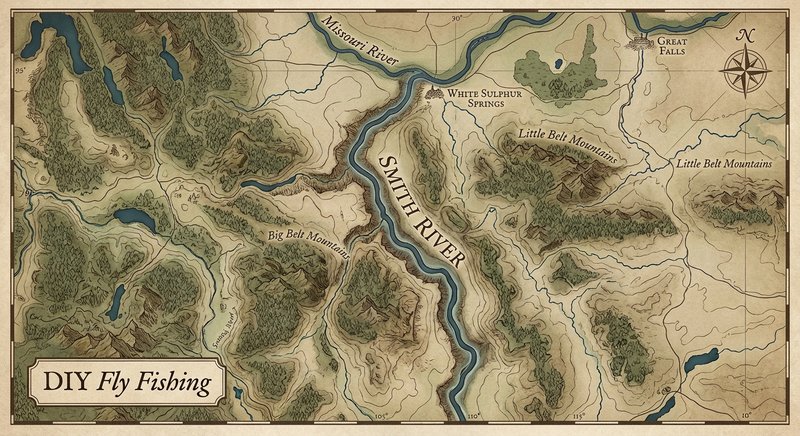
Smith River
Fly fishing in Montana · Intermediate · Best seasons: Spring, Summer
Target Species
Brown Trout, Rainbow Trout
About This Water
A permit-only float trip through limestone canyons. Multi-day adventures with excellent fishing for brown and rainbow trout in pristine wilderness.
Fishing Recommendations
Welcome to the Smith River, Montana’s most coveted fly fishing experience. As a guide, I can tell you that the Smith is less about "catching a personal best" and more about the "journey of a lifetime." It is a 59-mile, permit-only float through a spectacular limestone canyon that remains one of the last truly remote fishing experiences in the lower 48.
🎣 Location Overview
The Smith River flows through a deep, twisting canyon between the Big Belt and Little Belt Mountains in central Montana. What makes it special is the geology and the solitude. Towering 1,000-foot limestone cliffs line the river, creating a "cathedral-like" atmosphere.
Because the river is strictly regulated by a lottery system, you won't see crowds. Once you launch at Camp Baker, you are committed to a 5-day drift to Eden Bridge. The water is generally a "freestone" character but influenced by limestone springs, making it incredibly productive for aquatic insects and crustaceans.
🐟 Target Species & Behavior
The Smith is primarily a Brown and Rainbow Trout fishery.
- Brown Trout: These are the kings of the canyon. They favor the deep "bucket" holes, the undercut limestone walls, and the massive log jams. They are predatory and often prefer a large meal (streamers or stoneflies) over small midges.
- Rainbow Trout: Found more frequently in the riffles, fast-moving "seams," and the bubbly water at the head of pools. They are acrobatic and particularly aggressive during the Salmonfly and Golden Stone hatches.
- Behavior: During high water (Spring), fish move toward the banks to escape heavy current. In the heat of Summer, they retreat to the oxygenated riffles and deeper slots near the cliff faces.
📅 Best Times to Fish
The Smith is a "window" river—its fishability is entirely dependent on water flow.
- Spring (May – Early June): This is streamer and nymph season. The water is often "big" and carries some color. This is the best time to hook a trophy Brown Trout on a large articulated streamer.
- Summer (Mid-June – Early July): The Prime Window. This coincides with the legendary Salmonfly hatch. If you hit this right, you will experience world-class dry fly fishing.
- Late Summer (July – August): The river often drops too low for drift boats by mid-July. If flows hold, the fishing shifts to "hopper-dropper" rigs. Note: "Hoot Owl" restrictions (fishing closures due to high water temps) are common in August.
🪰 Recommended Flies & Techniques
Top Fly Patterns
- Dries:
- Salmonflies: Rogue Foam Salmonfly, Cat Puke (size 4-6).
- Golden Stones: Chubby Chernobyl (Gold/Orange), Water Walker.
- Attractors: Royal Wulff, Stimulators (size 12-16).
- Terrestrials: Morrish Hopper, Panty Dropper Hopper.
- Nymphs:
- Pat’s Rubber Legs: (Black/Tan or Coffee) – The absolute staple here.
- Scuds/Sowbugs: Ray Charles or Firebead Soft Hackle (Pink or Grey).
- General: Prince Nymphs, Flashback Pheasant Tails.
- Streamers:
- The JJ Special: (Yellow/Brown) – A Smith River legend.
- Sparkle Minnow: (Sculpin or Gold).
Techniques
- Pounding the Banks: From a moving boat, your goal is to land your fly within 2 inches of the limestone walls or grass banks.
- The "Hopper-Dropper": A high-buoyancy foam fly (Chubby) with a heavy Pat's Rubber Legs suspended 3 feet below it.
- Slow-Strip Streamers: In the deep canyon pools, cast a sinking tip line toward the cliff, let it sink, and use a slow, erratic strip to mimic a wounded sculpin.
💡 Pro Tips & Local Knowledge
- The "Sheep Creek" Indicator: Sheep Creek is the major tributary. If Sheep Creek is blowing out (muddy), the Smith will likely be off-color for several miles below the confluence. If the water is murky, switch to dark, high-profile streamers or black rubber legs.
- Fish the "Inner Bends": Everyone casts to the deep limestone walls on the outside of bends. Don't ignore the shallow, gravelly "inner bends"—Rainbows often sit there looking for nymphs being pushed across the shelf.
- The Wind Factor: The canyon acts as a wind tunnel. Bring a 6-weight rod with a stout side-wind taper line to punch big flies through the afternoon gusts.
- Night Fishing: If you are camping (which you will be), don't put the rod away at dusk. Large Browns move into the shallows near camp to hunt. A mouse pattern cast into the darkness can produce the fish of the trip.
⚠️ Important Information
- The Lottery: You must apply for a permit through Montana Fish, Wildlife & Parks (FWP) in February. Private permits are hard to get; alternatively, you can book with a licensed outfitter.
- Regulations: The Smith is generally under "Central District" regulations. Always check the current Montana FWP Fishing Regulations for any seasonal "Hoot Owl" alerts or emergency closures.
- Logistics: There is no cell service. You must pack out all trash and human waste (a "Groover" or portable toilet system is required).
- Water Levels: Monitor the USGS Gauge at Camp Baker. You want at least 250-300 CFS to float a raft, and 400+ for a drift boat without destroying your hull.
Guide’s Final Word: Respect the canyon. The Smith is a fragile ecosystem. Catch and release is highly encouraged to keep this wild population thriving for the next generation of canyon drifters.
Bug Hatches & Matching Flies
| Hatch | Type | Peak months | Time of day | Hook sizes | Matching flies |
|---|---|---|---|---|---|
| Salmonfly Pteronarcys californica | stonefly | May, June | All Day | #4-8 | Rogue River Stone #4-6, Pat's Rubber Leg #4-8, Cat Puke #6 |
| Golden Stonefly Hesperoperla pacifica | stonefly | June, July | Morning/Evening | #8-12 | Chubby Chernobyl (Gold) #8-12, Golden Twenty Incher #10-12, Fluttering Stone #10 |
| Mother's Day Caddis Brachycentrus occidentalis | caddis | May | Afternoon/Evening | #14-16 | LaFontaine's Deep Sparkle Pupa #14-16, Elk Hair Caddis (Olive) #14-16, Holy Grail #14-16 |
| Pale Morning Dun (PMD) Ephemerella excrucians | mayfly | June, July | Late Morning/Early Afternoon | #16-18 | Sparkle Dun #16-18, Split Case PMD #16-18, RS2 (Yellow) #16-18 |
| Blue Winged Olive (BWO) Baetis | mayfly | April, May, September, October | Mid-day | #18-22 | Parachute Adams #18-22, Pheasant Tail #18-20, BWO CDC Limp #20-22 |
| Spotted Sedge Hydropsyche | caddis | June, July, August | Evening | #12-16 | Goddard Caddis #14-16, Soft Hackle Hare's Ear #14-16, Caddistrophic Pupa #14-16 |
| Yellow Sally Isoperla | stonefly | June, July | Afternoon/Evening | #14-16 | Yellow Sally Foam Stone #14-16, Iron Lotus #14-16, Little Yellow Sloan #14 |
| Grasshoppers Orthoptera | terrestrial | July, August, September | Late Morning/Afternoon | #8-12 | Morrish Hopper #8-12, Rainy's Grand Hopper #10, Parachute Hopper #12 |