Soda Butte Creek
Fly fishing in Montana · Beginner · Best seasons: Summer, Fall
Target Species
Brook Trout, Cutthroat Trout
About This Water
Near Cooke City with wild brook and cutthroat trout. Gateway to the Beartooth wilderness.
Fishing Recommendations
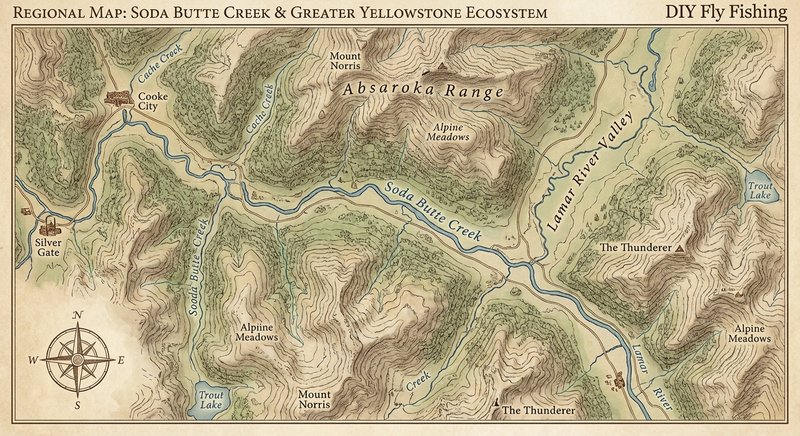
Soda Butte Creek is widely considered one of the crown jewels of the Greater Yellowstone Ecosystem. Spanning the border of Montana and Wyoming, this high-mountain stream flows through the stunning Silver Gate area before entering Yellowstone National Park and eventually joining the Lamar River.
As your guide, here is everything you need to know to successfully fish Soda Butte Creek.
🎣 Location Overview
Soda Butte Creek is the definition of "classic Western trout water." It transitions from a tumbling, high-gradient mountain stream in its upper reaches near Cooke City, MT, into a meandering, meadow-style stream once it enters the Lamar Valley of Yellowstone National Park.
What makes it special is the accessibility paired with world-class scenery. You are fishing beneath the towering peaks of the Absaroka Range, often with bison, elk, or even grizzly bears in sight. The water is gin-clear, making it a "sight-fisher’s" paradise, but also demanding a stealthy approach. The creek is famous for its "Soda Butte" (a large conical travertine formation) and its ability to produce large Yellowstone Cutthroat in a relatively small stream environment.
🐟 Target Species & Behavior
- Yellowstone Cutthroat Trout: This is the primary draw. These fish are beautiful, hardy, and known for their willingness to rise to a dry fly. In Soda Butte, they typically range from 10 to 18 inches, with some "monsters" pushing 20 inches. They are opportunistic but can become selective during heavy hatches.
- Brook Trout: Found more frequently in the upper reaches outside the Park boundary (near Silver Gate and Cooke City). They are vibrant, aggressive, and prefer the colder, swifter water and woody debris of the canyon sections.
- Behavior: During the summer, these fish hold in the "seams" between fast and slow water, at the heads of deep pools, and tucked tight against undercut banks. Because the water is so clear, they are easily spooked by shadows or heavy wading.
📅 Best Times to Fish
- Summer (Late June – August): This is prime time. After the spring runoff subsides (usually by late June or early July), the dry fly action begins.
- July is famous for Green Drake and Pale Morning Dun (PMD) hatches.
- August is the "Golden Age" of terrestrials.
- Fall (September – October): This is many guides' favorite time. The crowds thin out, the bison are in the rut (be careful!), and the fish are aggressively feeding before winter.
- Best Time of Day:
- Morning (9 AM - 12 PM): Nymphing or small dries as the water warms.
- Afternoon (1 PM - 5 PM): Peak terrestrial activity; look for wind to blow hoppers into the water.
- Evening: Spinner falls and caddis activity.
🪰 Recommended Flies & Techniques
Top Fly Patterns
- Terrestrials: Hopper patterns (size 8-12) like the Pink Pookie, Morrish Hopper, or Fat Albert. Also, never overlook a size 16 Black Ant or a Beetle pattern with a high-vis spot.
- Mayflies: Green Drakes (size 10-12) in early July. Parachute Adams (14-18) and Purple Haze are year-round staples.
- Nymphs: Pheasant Tail (14-18), Prince Nymph, and Copper John.
- Attractors: Royal Wulff or Trude patterns work wonders in the swifter water.
Effective Techniques
- The "Hopper-Dropper": This is the gold standard on Soda Butte. Tie on a buoyant foam grasshopper and hang a small beaded nymph (like a Pheasant Tail) 18–24 inches below it.
- Sight Fishing: Before you step into the water, stand back and observe. You will often see the orange throat slash of a Cutthroat holding in the current.
- Dry Fly Dead Drift: Use a long leader (9-12 feet) tapering to 4X or 5X tippet. A drag-free drift is essential; if your fly "skates," the fish will often refuse it.
💡 Pro Tips & Local Knowledge
- The "Walk-In" Advantage: Most anglers fish within 200 yards of the road pullouts. If you walk just half a mile upstream or downstream away from the bridges, you will find much less pressured fish.
- The Pebble Beach Stretch: The lower meadow reaches have many gravel bars. Fish the "inside" of the bends where the water slows down—big Cutthroats love to cruise these shallow edges looking for nymphs.
- Upper vs. Lower: If the Lamar River is muddy from a rainstorm, Soda Butte often clears up faster. Check the confluence; if the Lamar is "blown out," head up Soda Butte for clearer water.
- Stealth is Key: Wear drab clothing (greens/browns) to blend into the meadow. Crouch low when approaching the bank. If you can see the fish, they can likely see you.
⚠️ Important Information
- Permits:
- If fishing inside Yellowstone National Park, you must have a specific Yellowstone National Park Fishing Permit. A Montana or Wyoming state license is not valid inside the park.
- If fishing outside the park near Cooke City, you need a Montana State Fishing License.
- Regulations:
- Catch and Release ONLY for all Cutthroat trout.
- Barbless hooks are required inside the Park.
- No lead weights or lead-core tackle.
- Bear Safety: This is high-density Grizzly country. Always carry bear spray where it is easily accessible (not in your backpack) and know how to use it. Fish with a partner when possible and make noise.
- Wading: Be careful of the "Lamar Valley Muck" in some of the slower meadow sections; it can be surprisingly deep and sticky.
Soda Butte Creek offers one of the most aesthetic fly fishing experiences in the world. Respect the fish, keep them in the water during photos, and enjoy the silence of the Montana/Wyoming wilderness. Tight lines!
Bug Hatches & Matching Flies
| Hatch | Type | Peak months | Time of day | Hook sizes | Matching flies |
|---|---|---|---|---|---|
| Green Drake Drunella doddsii | mayfly | July, August | Afternoon | #10-12 | Parachute Green Drake #10-12, Drunella Nymph #12 |
| Pale Morning Olive (PMD) Ephemerella excrucians | mayfly | July, August | Morning/Afternoon | #16-18 | Sparkle Dun #16-18, Pheasant Tail #16-18, PMD Emerger #16-18 |
| Grasshoppers Orthoptera | terrestrial | August, September | All Day | #8-12 | Chubby Chernobyl #8-12, Dave's Hopper #10-12, Morrish Hopper #10 |
| Blue Winged Olive (BWO) Baetis spp. | mayfly | June, September, October | Mid-day | #18-22 | Parachute Adams #18-22, RS2 #20-22 |
| Golden Stonefly Hesperoperla pacifica | stonefly | July | Morning/Evening | #8-12 | Rogue Foam Stone #8-10, Pat's Rubber Legs #8-12 |
| Spotted Sedge Hydropsyche | caddis | July, August | Evening | #14-16 | Elk Hair Caddis #14-16, LaFontaine's Sparkle Pupa #14-16 |
| Salmonfly Pteronarcys californica | stonefly | June, July | All Day | #4-8 | Sofa Pillow #6-8, Cat Puke #6 |
| Flav / Lesser Green Drake Drunella flavilinea | mayfly | August | Afternoon | #14-16 | Mercer's Pupa #14-16, Flav Parachute #14 |
| Ants and Beetles Formicidae / Coleoptera | terrestrial | July, August, September | All Day | #12-18 | Cinnamon Ant #14-16, Black Foam Beetle #12-14 |