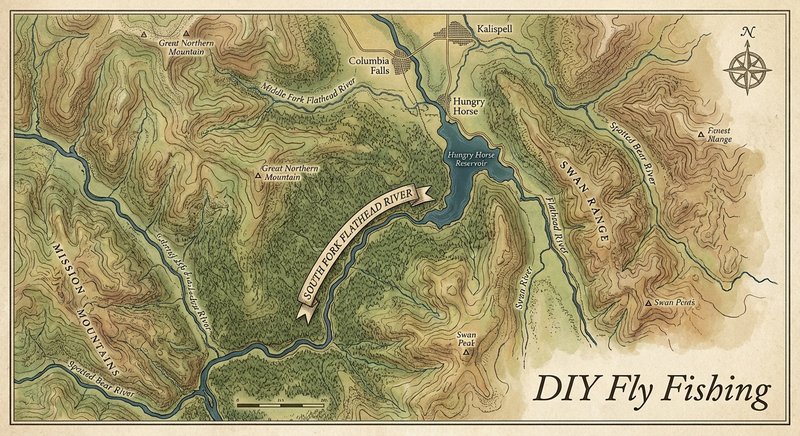
South Fork Flathead River
Fly fishing in Montana · Advanced · Best seasons: Summer, Fall
Target Species
Cutthroat Trout, Bull Trout
About This Water
Flows from the Bob Marshall Wilderness. Excellent backcountry fishing for native cutthroat and bull trout.
Fishing Recommendations
The South Fork of the Flathead River is arguably the crown jewel of Montana’s wilderness fly fishing. Flowing through the heart of the 1.5 million-acre Bob Marshall Wilderness, this is one of the most remote and pristine river systems in the lower 48. It is a place where "civilization" is measured in miles of trail, and the fishing remains as raw and wild as it was a century ago.
🎣 Location Overview
The South Fork is famous for being the stronghold of the Westslope Cutthroat Trout. Because the river is dammed by the Hungry Horse Reservoir, the upper reaches are protected from invasive species (like Rainbow or Brown trout), creating a pure, native sanctuary.
The water is remarkably clear, often taking on a vibrant turquoise or emerald hue due to "glacial flour" and the pristine substrate. The river character changes from high-alpine meadows and braided channels in the upper reaches to dramatic, deep limestone canyons further downstream. This is a "bucket list" destination for anglers who value solitude, rugged scenery, and fish that have rarely, if ever, seen a synthetic fly.
🐟 Target Species & Behavior
Westslope Cutthroat Trout
These are the stars of the show. They are opportunistic, beautiful, and known for their willingness to rise to a dry fly.
- Behavior: In this nutrient-poor wilderness environment, they can’t afford to be picky. They hold in classic spots: the tail-outs of pools, behind large boulders, and in the "soft" water adjacent to fast current.
- Feeding: They focus heavily on terrestrial insects (grasshoppers, ants, beetles) and seasonal hatches of stoneflies and mayflies.
Bull Trout
The South Fork is one of the few places in the U.S. where you can legally target Bull Trout (catch and release only). These are the apex predators of the river.
- Behavior: They are "piscivorous" (fish-eaters). They hang out in the deepest, darkest holes or at the base of major log jams. They are known for "trout-snapping"—attacking a Cutthroat you are currently reeling in.
- Feeding: They want high-calorie meals. They feed on smaller mountain whitefish and cutthroat trout.
📅 Best Times to Fish
Optimal Seasons: July to September
- July (Post-Runoff): This is the prime window. As the water drops and clears (usually early to mid-July), the fish are hungry after a long winter and aggressive.
- August: The "Dog Days" are actually fantastic here. This is peak terrestrial season. The water is low, and fish concentrate in deeper pools.
- September: The crowds (already thin) disappear. The Cutthroats are looking to bulk up for winter, and the Bull Trout begin their spawning migrations, making them more active.
Best Times of Day
- 10:00 AM – 4:00 PM: Unlike many Montana rivers that get too hot in the afternoon, the South Fork stays cool. The best dry fly action usually happens during the heat of the day when insects are most active.
🪰 Recommended Flies & Techniques
Dry Flies (The Bread & Butter)
Because these fish are opportunistic, you don't need 500 patterns. You need high-visibility, high-buoyancy flies.
- Patterns: Chubby Chernobyl (Size 8-12) in Gold, Royal, or Purple; Amy’s Ant; Parachute Adams (Size 12-16); Purple Haze; Stimulators (Orange or Yellow).
- Technique: "Splat" the fly. A slightly heavy landing often triggers a strike from a Cutthroat thinking a large insect just fell off a willow.
Streamers (For Bull Trout)
- Patterns: Big, articulated flies. Sex Dungeon, Game Changer, or large white/olive Zonkers.
- Technique: Use a sinking tip line. Cast into the deepest part of the pool and strip slowly and deeply. Be prepared for a violent strike.
Nymphing
- Usually unnecessary unless there is a cold front. If needed, a bead-head Pheasant Tail or Pat’s Rubber Leg dropped 2 feet below a Chubby Chernobyl (Dry-Dropper) is lethal.
💡 Pro Tips & Local Knowledge
- The "Bob" Tax: Accessing the South Fork requires a multi-day pack trip (horseback or hiking) or a flight into a wilderness airstrip (like Meadow Creek). Do not underestimate the physical toll or the logistics.
- Look for the "Ledges": The South Fork has unique underwater rock ledges. Cutthroats will tuck right under the lip of these ledges. Cast your fly so it drifts inches from the rock face.
- Bull Trout "Catch Card": If you intend to target Bull Trout, you MUST have the specific Bull Trout Catch Card (free but required).
- Don't overthink the fly: If you aren't getting hits, it’s usually your drift, not the fly. Ensure no drag is pulling your dry fly.
⚠️ Important Information
Access
- Meadow Creek Trailhead: The primary entry point for those heading into the wilderness.
- Pack-in/Pack-out: This is a strictly "Leave No Trace" area.
Regulations
- Catch and Release: Most of the river is catch and release only for native trout.
- Gear: Barbless hooks are highly recommended to protect the delicate mouths of the Cutthroat.
- License: A valid Montana fishing license and a Conservation License are required.
Special Considerations
- Grizzly Bear Country: You are in the heart of Griz country. Carry bear spray on your person (not in your pack) at all times. Hang your food and follow all wilderness storage regulations.
- Wet Wading: In July and August, the water is comfortable enough for wet wading, which saves weight on your pack by leaving waders at home. Good wading boots with studs/felt are still essential as the rocks are incredibly slick.
Bug Hatches & Matching Flies
| Hatch | Type | Peak months | Time of day | Hook sizes | Matching flies |
|---|---|---|---|---|---|
| Salmonfly Pteronarcys californica | stonefly | June, July | All day | #4-8 | Rogue River Stone #4-6, Pats Rubber Legs #6-8, Cat Puke #6 |
| Golden Stonefly Hesperoperla pacifica | stonefly | July | Morning/Evening | #8-12 | Chubby Chernobyl (Gold) #8-10, Golden 20-Incher #10-12, Water Walker #10 |
| Green Drake Drunella doddsii | mayfly | July, August | Afternoon | #10-12 | Hairy Wing Drake #10-12, Quigley Cripple #12, Olive Hare's Ear #10-12 |
| Pale Morning Dun (PMD) Ephemerella excrucians | mayfly | July, August | Morning/Afternoon | #16-18 | Sparkle Dun #16-18, Pheasant Tail #16-18, RS2 #18 |
| Yellow Sally Isoperla spp. | stonefly | July, August | Afternoon/Evening | #14-16 | Yellow Sally Foamstone #14-16, Kush's Sally #14, Iron Lotus #16 |
| Spotted Sedge Hydropsyche | caddis | July, August, September | Evening | #14-18 | Elk Hair Caddis (Tan) #14-16, LaFontaine Sparkle Pupa #16, Godzilla Caddis #14 |
| Blue Winged Olive (BWO) Baetis spp. | mayfly | May, September, October | Afternoon | #18-22 | Parachute Adams #18-22, BWO CDC Limp #20, JujuBaetis #20 |
| Grasshoppers Orthoptera | terrestrial | August, September | Late Morning/Afternoon | #8-12 | Morrish Hopper #8-10, Rainy's Grand Hopper #10, Dave's Hopper #12 |
| Spruce Moth Choristoneura occidentalis | terrestrial | August | Morning/Afternoon | #12-14 | Spruce Moth #12-14, Para-Spruce Moth #14, Indicator Spruce Moth #12 |