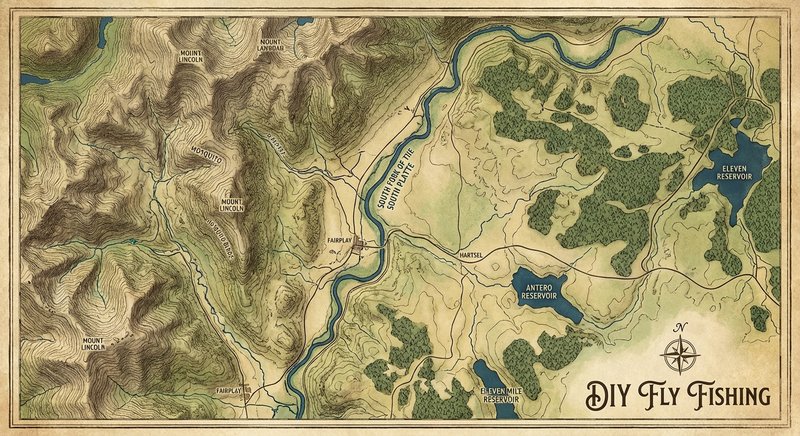
South Fork of the South Platte
Fly fishing in Colorado · Intermediate · Best seasons: Spring, Summer, Fall
Target Species
Brown Trout, Rainbow Trout
About This Water
Eleven Mile Canyon section offers excellent Gold Medal fishing. Wild brown and rainbow trout.
Fishing Recommendations
The South Fork of the South Platte is the "quiet sibling" of the more famous sections like the Dream Stream or Cheesman Canyon. Located in the high-altitude meadow of South Park near Fairplay and Hartsel, it offers a classic "meandering meadow" experience. It is technical, rewarding, and offers some of the most scenic fly fishing in the Rocky Mountains.
🎣 Location Overview
The South Fork is characterized by its tight "S" curves, deep undercut banks, and slow-moving crystalline water. Unlike the brawling canyon stretches of the South Platte, the South Fork is a pastoral stream flowing through high-altitude grasslands.
What makes it special is the stealth required. Because the water is often clear and flat, the fish are incredibly wary. It is a "pure" fly fishing experience—you aren't just casting; you are hunting. Anglers love it because it lacks the crushing crowds of the main stem but still holds surprisingly large fish in small, intimate water.
🐟 Target Species & Behavior
- Brown Trout: The primary resident. These are wild, buttery fish that live for the undercut banks. They are predatory and highly territorial. They are "spooky"—a heavy footstep on the bank will send them darting for cover.
- Rainbow Trout: Found mostly in the swifter riffles and at the heads of deep pools. Many are residents, but you may find some larger "bows" moving through during the spring.
Behavior: These fish are opportunistic but cautious. In the summer, they look toward the banks for terrestrials. In the shoulder seasons, they hunker down in the deepest bends and feed on tiny midges and mayfly nymphs.
📅 Best Times to Fish
- Spring (April – Late May): Before the snowmelt hits, the midge and Blue Winged Olive (BWO) hatches can be prolific. This is the best time to catch the river before the grasses get high and the bugs get big.
- Summer (July – August): This is Terrestrial Season. While the sun is high, the fish move toward the banks to eat grasshoppers, ants, and beetles. This is the most fun time for dry-fly enthusiasts.
- Fall (September – October): The Brown Trout begin to move and become aggressive before the spawn. The low water makes them even more skittish, but the cooler temperatures trigger a strong feeding response.
Prime Window: Early morning and late evening are best to avoid the high-altitude sun, which can "shut down" the fish in such shallow, clear water. However, a windy afternoon in August is perfect for hopper fishing.
🪰 Recommended Flies & Techniques
Top Fly Patterns
- Dries: Hippie Stomper (Size 12-16), Parachute Adams (18-22), Elk Hair Caddis (14-18), Amy’s Ant (12-14), and various Foam Hoppers.
- Nymphs: RS2 (Grey/Black, 20-22), Pheasant Tail (18-22), Zebra Midge (20-24), Juju Baetis (20-22).
- Streamers: Thin Mint, Black or Olive Wooly Buggers (Size 10-12). Small and "buggy" works better than large and flashy here.
Techniques
- Hopper-Dropper: This is the bread and butter of the South Fork. Use a buoyant hopper as your "indicator" and hang a small nymph (like an RS2) 18–24 inches below it.
- Stealth Nymphing: If the fish aren't rising, use a very small, clear strike indicator or "high-stick" through the deeper bends.
- The "Slow Strip": In deep bends, cast a small streamer upstream, let it sink, and give it tiny rhythmic twitches as it passes under the cut bank.
💡 Pro Tips & Local Knowledge
- The "Kneel and Cast": The banks are often higher than the water. If you stand on the edge, the fish will see your silhouette against the sky and vanish. Approach the bank on your knees and stay 5–10 feet back from the water’s edge.
- The Wind is Your Friend: South Park is notoriously windy. While it makes casting difficult, a "chop" on the water breaks up your silhouette and blows grasshoppers into the river. If it’s windy, go to a hopper.
- Focus on the Bends: 90% of the fish are in 10% of the water. Look for the "outside" of the river bends where the water has carved out a dark, deep pocket under the grass.
- The Tomahawk Stretch: Focus your efforts on the Buffalo Peaks State Wildlife Area (Tomahawk Unit). It offers miles of public access. The further you walk from the parking lot, the better the fishing gets.
⚠️ Important Information
- Access: Much of the South Fork runs through private ranch land. Stick to the Buffalo Peaks State Wildlife Area (Tomahawk and Badger Basin units). These are clearly marked. Do not trespass; the local ranchers are very protective of their land.
- Regulations: A valid Colorado Fishing License is required. Additionally, if you are fishing a State Wildlife Area (SWA), you must possess a valid SWA hunting or fishing license (this is now standard for CO residents/visitors).
- Special Considerations:
- Weather: Storms roll over the Mosquito Range quickly. Bring a raincoat and watch for lightning; there is zero cover in the meadows.
- False Banks: The "ground" near the river is often just a thick mat of grass over water. Be careful where you step, or you’ll end up waist-deep in a bog.
- Gear: A 8.5ft or 9ft 4-weight rod is the perfect tool for this water. Use long leaders (9-12 feet) to avoid lining the fish.
Bug Hatches & Matching Flies
| Hatch | Type | Peak months | Time of day | Hook sizes | Matching flies |
|---|---|---|---|---|---|
| Midges Chironomidae | midge | January, February, March, December | All Day | #18-24 | Zebra Midge #18-22, Griffith's Gnat #20-24, Top Secret Midge #20-24 |
| Blue Winged Olive (BWO) Baetis | mayfly | April, May, September, October | Late Morning/Afternoon | #18-22 | RS2 #20-22, Parachute Adams #18-22, JujuBaetis #18-22 |
| Pale Morning Dun (PMD) Ephemerella excrucians | mayfly | June, July, August | Late Morning/Early Afternoon | #16-18 | Pheasant Tail Nymph #16-18, Barr Emerger #16-18, PMD Sparkle Dun #16-18 |
| Trico Tricorythodes | mayfly | July, August, September | Early Morning | #20-24 | Trico Spinner #20-24, Suncurry's Trico #20-22, Drowned Trico Spinner #20-24 |
| Green Drake Ephemera guttulata | mayfly | July, August | Afternoon/Evening | #10-14 | Colorado Green Drake #12-14, Hair Wing Drake #10-12, Drake Cripple #12 |
| Spotted Sedge / Grannom Hydropsyche / Brachycentrus | caddis | May, June, July | Evening | #14-18 | Elk Hair Caddis #14-18, LaFontaine's Deep Sparkle Pupa #14-16, Puterbaugh's Foam Caddis #16-18 |
| Yellow Sally Isoperla | stonefly | June, July | Afternoon | #14-16 | Yellow Sally Dropper #14-16, Iron Sally #14-16 |
| Grasshoppers Acrididae | terrestrial | August, September | Late Morning/Afternoon | #8-14 | Amy's Ant #10-14, Hopper Juan #12-14, Parachute Hopper #10-14 |
| Black Ants Formicidae | terrestrial | July, August | All Day | #16-20 | Cinnamon Ant #16-18, Carpenter Ant #14-16 |