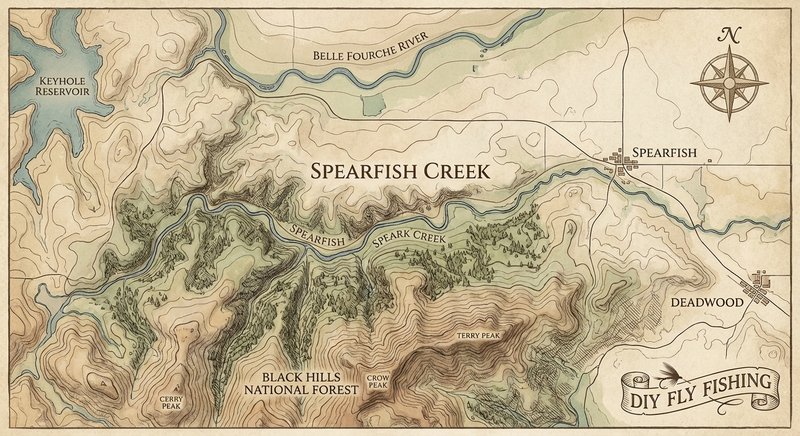
Spearfish Creek
Fly fishing in South Dakota · intermediate · Best seasons: spring, summer, fall
Target Species
Brown Trout, Rainbow Trout
About This Water
Premier Black Hills trout stream through Spearfish Canyon. Excellent wild trout fishing.
Fishing Recommendations
Spearfish Creek is a crown jewel of the Black Hills and one of the most unique fisheries in the American West. As a limestone stream that flows through a spectacular 1,000-foot-deep canyon, it offers a rare combination of consistent water temperatures, incredible scenery, and a high density of wild trout.
Here is your comprehensive guide to fly fishing Spearfish Creek, South Dakota.
🎣 Location Overview
Spearfish Creek is unique because it is a "bottom-up" system; it gains much of its volume from cold, nutrient-rich springs. This limestone influence creates a stable environment where the water rarely freezes in the winter and stays cool throughout the hottest summers.
The creek is divided into three distinct sections:
- The Canyon (Upper): High-gradient, fast-moving water with plunge pools, boulders, and tight pockets.
- The "Office" (Middle): The stretch near the hydro-electric plants where flows are regulated.
- The City (Lower): Flowing through the town of Spearfish, this section features wider runs, manicured banks in parks, and surprisingly large fish.
What makes it special is the sheer volume of fish. It is estimated that some sections hold upwards of 3,000 to 4,000 trout per mile.
🐟 Target Species & Behavior
The creek is home to Wild Brown Trout and Rainbow Trout.
- Brown Trout: These are the dominant species. They are notorious for hugging the undercut limestone banks and sitting in the "soft" water right behind large boulders. They are opportunistic but can be spooked easily by shadows.
- Rainbow Trout: Generally found in the faster, highly oxygenated "bubble curtains" and at the heads of the riffles.
- Behavior: Because the water is exceptionally clear, these fish are "upward-looking." They are very keyed into surface activity during hatches but spend 90% of their time feeding on the bottom due to the creek’s immense biomass of aquatic insects.
📅 Best Times to Fish
Spearfish Creek is one of the few places in the upper Midwest you can fish 365 days a year, but the seasons offer different experiences:
- Spring (March - May): This is the window for Blue Winged Olives (BWO) and Midges. April is fantastic for those who enjoy technical dry fly fishing on cloudy days.
- Summer (June - August): The prime season. Prolific Caddis hatches occur in the evenings. This is also "Terrestrial Time"—ants, beetles, and hoppers are staples here.
- Fall (September - November): My personal favorite. The Brown trout transition into their spawning colors and become more aggressive. The canyon foliage is world-class, and the crowds disappear.
- Optimal Window: Usually 10:00 AM to 4:00 PM in the spring/fall. In the heat of summer, the "Golden Hour" (the last 90 minutes of light) provides the best dry fly action.
🪰 Recommended Flies & Techniques
Top Fly Patterns
- Nymphs:
- Perdigons (Size 14-18) in olive, blue, or violet (perfect for the fast canyon water).
- Zebra Midges (Size 18-22) in red or black.
- Pheasant Tails (Size 14-18) – a classic that never fails here.
- Dry Flies:
- Elk Hair Caddis (Size 14-16) in tan or olive.
- Hippie Stomper (Size 14-16) – an incredible attractor pattern for Spearfish.
- Parachute Adams (Size 16-20).
- Streamers:
- Thin Mints or small Wooly Buggers (Size 8-12). Spearfish trout prefer smaller, jiggy streamers over giant articulated patterns.
Effective Techniques
- Euro Nymphing (Tight-Line): This is arguably the most effective way to fish the Canyon. The fast, turbulent water makes traditional indicator fishing difficult. A heavy tungsten bead nymph dropped into the pocket water will yield high numbers.
- Dry-Dropper: A high-visibility dry fly (like a Stimulator) with a small Pheasant Tail dropped 18 inches below it is the "go-to" rig for summer afternoons.
- Stealth Presentations: Because the water is clear, use 6X fluorocarbon tippet for nymphs and 6X nylon for dries.
💡 Pro Tips & Local Knowledge
- The "Shadow" Rule: The limestone walls create deep shadows early in the day. Fish will often hold in the seam between the sun and the shade. Be careful not to cast your own shadow over a pool, or the fish will bolt.
- Roughlock Falls Area: The area near Roughlock Falls is catch-and-release and holds some of the prettiest wild trout in the system. It is highly photogenic but can be technical.
- Fish the "Urban" Water: Don't overlook the stretch through the City Park and near the D.C. Booth Historic National Fish Hatchery. Some of the largest Brown trout in the creek live in the deeper holes within city limits.
- The "Spearfish Twitch": When fishing caddis dries in the evening, don't be afraid to give the fly a tiny skitter or twitch. The wild rainbows here often react to movement.
⚠️ Important Information
- Access: Most of the canyon is within the Black Hills National Forest, meaning public access is excellent. Look for pull-outs along Highway 14A.
- Regulations:
- A South Dakota fishing license is required.
- Special Management: Note that certain sections (like the area near the Savoy/Roughlock Falls) may have specific "catch and release" or "artificial lures only" regulations. Always check the current SD Game, Fish & Parks handbook.
- Wading: The rocks in Spearfish Creek are notoriously slippery (limestone slime). Felt soles or studs are highly recommended.
- Wildlife: You are in Mountain Lion and Bighorn Sheep country. Keep your eyes peeled; it’s not uncommon to see Bighorn rams drinking from the creek while you fish.
Guide’s Final Word: Spearfish Creek isn't about trophy size (though 18-inchers exist); it’s about the quality of the experience. Bring a 3-weight or 4-weight rod, be stealthy, and enjoy one of the most consistent trout streams in the United States.
Bug Hatches & Matching Flies
| Hatch | Type | Peak months | Time of day | Hook sizes | Matching flies |
|---|---|---|---|---|---|
| Blue-Winged Olive (BWO) Baetis spp. | mayfly | March, April, September, October | Late Morning/Afternoon | #18-22 | Parachute Adams #18-22, RS2 #20-22, Pheasant Tail Nymph #18-20 |
| Mother's Day Caddis Brachycentrus occidentalis | caddis | April, May | Late Afternoon/Evening | #14-16 | Elk Hair Caddis (Dark) #14-16, Peacock Caddis Larva #14-16, Deep Sparkle Pupa #14-16 |
| Pale Morning Dun (PMD) Ephemerella excrucians | mayfly | June, July | Morning/Afternoon | #16-18 | PMD Sparkle Dun #16-18, Split Case PMD #16-18, Quigley Cripple #16-18 |
| Midges Chironomidae | midge | December, January, February, March | All Day | #20-26 | Zebra Midge #20-24, Griffith's Gnat #20-22, Morgan's Midge #22-24 |
| Little Black Stonefly Capniidae | stonefly | February, March | Midday | #16-20 | Black Stimulator #16-18, Little Black Sloan #18-20, Pats Rubber Legs (Small) #16 |
| Tan Caddis Hydropsyche | caddis | June, July, August | Evening | #14-18 | Elk Hair Caddis (Tan) #14-18, LaFontaine's Emerger #16, Copper John #14-18 |
| Trico Tricorythodes | mayfly | August, September | Early Morning | #22-26 | Trico Spinner #22-26, Trico Drown #22-24 |
| Terrestrials Orthoptera/Formicidae | terrestrial | July, August, September | All Day | #10-18 | Parachute Hopper #10-14, Cinnamon Ant #16-18, Black Beetle #14-16 |
| Golden Stonefly Hesperoperla pacifica | stonefly | June, July | Morning/Evening | #8-12 | Pats Rubber Legs (Gold/Tan) #8-12, Golden Rogue Stone #10-12 |
| Yellow Sallies Isoperla spp. | stonefly | June, July | Afternoon/Evening | #14-16 | Yellow Stimulator #14-16, Little Yellow Sloan #14-16 |