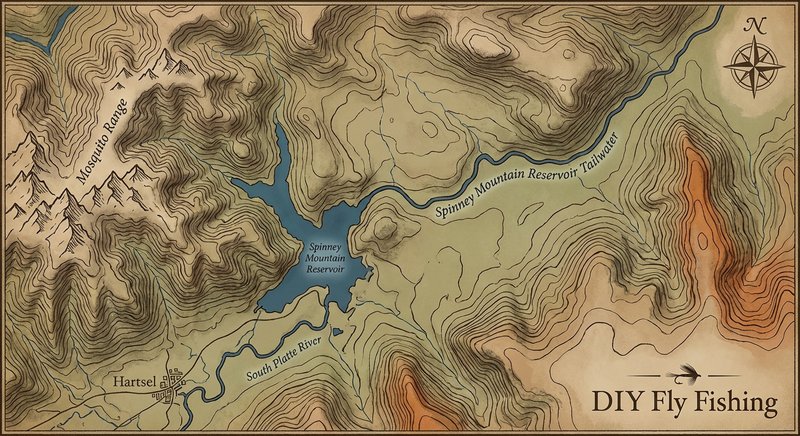
Spinney Mountain Reservoir Tailwater
Fly fishing in Colorado · Advanced · Best seasons: Spring, Fall
Target Species
Brown Trout, Rainbow Trout, Cutthroat Trout
About This Water
Below Spinney Mountain Reservoir with trophy trout. Known for large fish in challenging conditions.
Fishing Recommendations
Welcome to the "Dream Stream." The section of the South Platte River between Spinney Mountain Reservoir and Eleven Mile Reservoir is one of the most storied stretches of water in the Western United States. As your guide, I’m here to tell you that while it can be frustratingly technical, it offers the chance at the fish of a lifetime.
🎣 Location Overview
The Spinney Mountain Reservoir Tailwater, famously known as the "Dream Stream," is a three-mile stretch of meandering, meadow-style river located in the high-altitude plateau of South Park, Colorado.
What makes this water legendary is its role as a corridor. While there are resident trout, the "Dream" is defined by the massive lake-run fish that migrate out of Eleven Mile Reservoir to spawn. The river itself is characterized by deep undercut banks, slow-moving glass-calm pools, and classic riffle-run-pool sequences. It is wide open, entirely treeless, and sits at over 8,000 feet, meaning you are at the mercy of the legendary South Park winds.
🐟 Target Species & Behavior
- Rainbow Trout: These are the stars of the Spring. Large, chrome-bright rainbows push up from Eleven Mile to spawn. They are powerful and can often exceed 20–24 inches.
- Brown Trout: The kings of the Fall. These fish move into the river in September and October. They are notoriously aggressive but highly wary.
- Cutthroat Trout/Cutbows: Frequent visitors during the spring run. Look for the vivid red slashes and incredible spotting.
- Behavior: Resident fish are extremely "educated" and leader-shy. Migratory fish are more focused on the spawn; they hold in deeper pools to rest and move into the shallow gravel (redds) to spawn. Note: Ethical anglers do not fish for trout actively sitting on redds.
📅 Best Times to Fish
Spring (Late March – May)
This is the Rainbow and Cutbow run. As the ice melts on the reservoirs, fish begin their push.
- Conditions: Can be brutal (snow, wind, and freezing spray).
- Window: Mid-morning to late afternoon as the water temperature rises a few degrees, activating the fish.
Fall (September – early November)
The Brown trout run is the main event.
- Conditions: Crisp mornings, golden grasses, and slightly more predictable weather than spring.
- Window: Low-light periods (dawn and dusk) are prime for finding big browns moving out from under the banks.
🪰 Recommended Flies & Techniques
Techniques
- Sight Nymphing: This is the primary game. Use high-quality polarized glasses. If you aren't seeing the fish, you're just casting at shadows.
- The "Dry-Dropper": In the summer or early fall, a large terrestrial (Hopper) with a tiny midge or mayfly dropper can be lethal along the undercut banks.
- Light Streamer Stripping: On overcast days, swinging a small leech or streamer through deep bends can trigger an aggressive strike from a territorial Brown.
Top Fly Patterns
- Nymphs:
- The "Egg": Otter’s Soft Milking Egg (Orange or Pink) – Essential during the runs.
- Midges: Black Beauty, Top Secret Midge, Manhattan Midge (Sizes 20–24).
- Mayflies: RS2 (Grey or Black), Pheasant Tail (Size 18–22).
- Attractors: Rainbow Warriors, San Juan Worms (Red or Wine).
- Dries:
- Trico Parachute (Size 22-24) for summer mornings.
- BWO Sparkle Dun (Size 20-22) for cloudy spring/fall days.
- Streamers:
- Pine Squirrel Leech (Black or Olive).
- Mini-Dungeon (White or Natural).
💡 Pro Tips & Local Knowledge
- The Stealth Factor: Because the banks are high and the water is clear, fish can see your silhouette from 30 feet away. Crouch down. Keep a low profile and avoid "herding" the fish by walking too close to the bank.
- Light Tippet/Long Leaders: Use 5X or 6X Fluorocarbon. These fish have seen every fly in the catalog; a natural drift on a thin line is the only way to fool the big ones.
- The Wind is Your Friend: While annoying to cast in, a "South Park chop" on the water breaks up the surface tension, making the fish less spooky and hiding your leader.
- Focus on the Bends: Most beginners fish the straightaways. The biggest fish reside in the deep "buckets" found at the apex of the river's many horseshoe bends.
⚠️ Important Information
- Access: Managed by Colorado Parks and Wildlife (CPW). There are four main parking areas (A, B, C, and D) between the reservoirs. A State Wildlife Area (SWA) pass or a valid fishing license is required to park.
- Regulations:
- Gold Medal Water.
- Catch and release only.
- Fishing is restricted to artificial flies and lures only.
- Redd Awareness: Please do not walk on or fish over "redds" (bright, clean gravel patches). These are spawning beds. Disturbing them kills the next generation of trout.
- Safety: This is a high-altitude environment. Bring plenty of water, wear sunscreen, and be prepared for a snowstorm to move in even if the morning starts at 60°F.
Guide’s Final Word: The Dream Stream is a "chess match" river. You might only get three or four chances at a fish in a day, but when one of those 5-pounders hits your size 22 midge, you'll understand why we keep coming back. Tight lines!
Bug Hatches & Matching Flies
| Hatch | Type | Peak months | Time of day | Hook sizes | Matching flies |
|---|---|---|---|---|---|
| Midge Chironomidae | midge | January, February, March, December | All Day | #18-24 | Zebra Midge #20-22, Top Secret Midge #22-24, Griffith's Gnat #20-24 |
| Blue Winged Olive (BWO) Baetis | mayfly | April, May, September, October | Late Morning/Afternoon | #18-22 | JujuBaetis #20-22, RS2 #18-22, Parachute Adams #18-22 |
| Pale Morning Dun (PMD) Ephemerella | mayfly | June, July, August | Late Morning/Afternoon | #16-18 | Barr's PMD Emerger #16-18, Pheasant Tail #16-18, PMD Sparkle Dun #16-18 |
| Trico Tricorythodes | mayfly | July, August, September | Early Morning | #20-24 | Sunray Trico #20-24, Trico Spinner #20-22, Black Beauty #20-22 |
| Caddis Brachycentrus/Hydropsyche | caddis | June, July | Evening | #14-18 | Elk Hair Caddis #14-18, LaFontaine's Sparkle Pupa #16-18, Graphic Caddis #16-18 |
| Damselfly Enallagma | terrestrial | June, July, August | Late Morning/Afternoon | #10-14 | Swimming Damsel #12-14, Marabou Damsel #10-12, Blue Damsel Dry #12 |
| Hopper Orthoptera | terrestrial | August, September | Afternoon | #8-12 | Amy's Ant #10-12, Fat Albert #8-12, Chubby Chernobyl #10-14 |
| Crane Fly Tipulidae | terrestrial | August, September | Afternoon/Evening | #10-14 | Crane Fly Larva #10-12, Daddy Long Legs #12-14 |