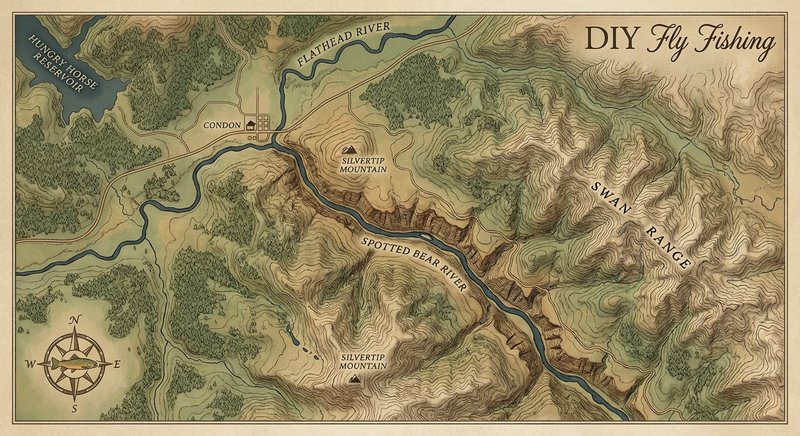
Spotted Bear River
Fly fishing in Montana · Advanced · Best seasons: Summer, Fall
Target Species
Cutthroat Trout, Bull Trout
About This Water
Bob Marshall Wilderness tributary with native cutthroat and bull trout. True wilderness fishing.
Fishing Recommendations
The Spotted Bear River is one of Montana’s true crown jewels. Tucked away at the edge of the Bob Marshall Wilderness at the head of the South Fork of the Flathead River drainage, it offers some of the most pristine, remote, and rewarding walk-and-wade fishing in the Lower 48. This is a place for the angler who values wild scenery and native fish over manicured banks and easy access.
🎣 Location Overview
The Spotted Bear River is a classic mountain freestone river characterized by gin-clear water, massive colorful boulders, and deep, turquoise pools. It flows through a rugged landscape of lodgepole pine and dramatic canyon walls before joining the South Fork of the Flathead.
What makes this water special is its remoteness. Located roughly 55 miles down a gravel road from Hungry Horse, it serves as the gateway to "The Bob." The fish here are almost entirely wild, native Westslope Cutthroat trout that are famously "uneducated" and willing to rise to a dry fly. It is a high-gradient system with plenty of oxygen, making it a sanctuary for cold-water species.
🐟 Target Species & Behavior
Westslope Cutthroat Trout
These are the primary residents. They are opportunistic feeders because the growing season in these high-altitude waters is short.
- Behavior: They are not typically "selective" about fly patterns, but they are wary of shadows and heavy splashing.
- Holding Water: Look for them in the "soft" water—the seams between fast and slow currents, the eddies behind large boulders, and the tail-outs of deep pools.
Bull Trout
The Spotted Bear is a critical spawning tributary for migratory Bull Trout coming up from Hungry Horse Reservoir and the South Fork.
- Behavior: These are the "river wolves." They are apex predators that feed on smaller mountain whitefish and cutthroat. They stay deep in the coldest, darkest holes or under submerged log jams during the day.
- Note: Bull Trout are a protected species. While you can target them in specific sections of the South Fork Flathead drainage with a Catch and Release mentality, you must follow strict FWP regulations (see Important Information).
📅 Best Times to Fish
- Optimal Months: July, August, and September.
- July: Post-runoff (usually early to mid-July). This is the prime window for "Golden Stonefly" hatches.
- August: The height of dry fly season. Water levels drop, and fish concentrate in predictable holes.
- September: Cooler nights trigger the Bull Trout migration and excellent terrestrial fishing for Cutthroats.
- Best Time of Day: Unlike lower-elevation rivers, you don't need to be on the water at dawn. The water is cold; the best fishing usually begins around 10:00 AM once the sun hits the water and insects become active, lasting until dusk.
🪰 Recommended Flies & Techniques
Dry Flies (The Bread & Butter)
The Cutthroats here love a high-floating, visible dry fly.
- Chubby Chernobyl (Size 8-12): Royal, Purple, or Gold. This is the gold standard for the area.
- Stimulators (Size 10-14): Orange or Yellow.
- Purple Haze (Size 12-16): A Montana staple that works when fish get slightly more selective.
- Royal Wulff: A classic attractor that mimics nothing and everything.
Nymphing
Usually unnecessary unless it's a cold front, but if you must go deep:
- Pat’s Rubber Legs (Black/Tan)
- Prince Nymphs or Copper Johns (Size 14-16)
Streamers (For Bull Trout)
- Dolly Llama: Black/White or Olive/White. These heavy, articulated flies are essential for reaching the bottom of deep pools.
- Sex Dungeon: White or Tan.
Presentation Tips
- The "Splat": Don't be afraid to let your hopper or Chubby land with a little "splat." It gets the attention of Cutthroats in the fast water.
- Short Leashes: If fishing a dropper, keep the tippet to the nymph short (18-24 inches) to avoid snagging on the many boulders.
💡 Pro Tips & Local Knowledge
- The "Purple" Factor: For reasons unknown to science, Westslope Cutthroats in the Flathead drainage have a legendary obsession with the color purple. Always carry Purple Hazes and Purple Chubby Chernobyls.
- Move Quickly: Don't spend an hour in one hole. These fish are aggressive; if they are there, they will usually eat within the first five casts. If you don't get a rise, move 50 yards upstream to the next pocket.
- Stealth Matters: The water is incredibly clear. If you stand on a high rock overlooking a pool, the fish will see you before you see them. Stay low and cast from a distance.
- The Gorge Stretches: Some areas of the Spotted Bear flow through tight canyons. These require some light rock scrambling but often hold the largest Cutthroats because they receive the least pressure.
⚠️ Important Information
- Bear Safety: This is Grizzly Country. You are in the heart of one of the densest grizzly populations in the world. Carry Bear Spray on your person (not in your pack) and know how to use it. Make noise while walking to the river.
- Access: The road from Hungry Horse (East Side Road #38) is long, dusty, and can be rough. Ensure you have a full tank of gas and a spare tire. There are no services once you leave Hungry Horse.
- Regulations:
- A Montana Fishing License is required.
- The South Fork Flathead drainage has specific rules. Check the current FWP regulations regarding Bull Trout. Usually, a "Catch and Release" permit (the Bull Trout Catch Card) is required if you intend to target them.
- Many stretches are Catch and Release ONLY for Cutthroat trout.
- Gear: A 9-foot 5-weight rod is perfect for Cutthroats. If you are specifically chasing Bulls, bring an 8-weight with a sink-tip line.
Guide’s Final Word: The Spotted Bear isn't about counting fish or trophy sizes; it’s about the experience of being in a wild place where the mountains are big and the water is pure. Respect the resource, pack out your trash, and enjoy some of the finest dry-fly fishing on the planet.
Bug Hatches & Matching Flies
| Hatch | Type | Peak months | Time of day | Hook sizes | Matching flies |
|---|---|---|---|---|---|
| Salmonfly Pteronarcys californica | stonefly | June, July | All Day | #4-8 | Chubby Chernobyl #6-10, Cat Puke #4-8, Pats Rubber Legs #6-8 |
| Golden Stonefly Hesperoperla pacifica | stonefly | July | Morning/Afternoon | #8-12 | Golden Rogue Stone #8-10, Yellow Stimulator #10-12, Golden Stone Nymph #8-12 |
| Western Green Drake Drunella doddsii | mayfly | July | Afternoon | #10-12 | Green Drake Sparkle Dun #10-12, Quigley Cripple #12, Hares Ear #10-12 |
| Pale Morning Dun (PMD) Ephemerella excrucians | mayfly | July, August | Late Morning/Afternoon | #14-18 | PMD Sparkle Dun #16-18, RS2 #16-18, Pheasant Tail #14-18 |
| Yellow Sally Isoperla spp. | stonefly | July, August | Afternoon/Evening | #14-16 | Little Yellow Sloan #14-16, Yellow Sally Klinkhammer #16, Iron Lotus #16 |
| Spotted Sedge Hydropsyche | caddis | July, August, September | Evening | #14-16 | Elk Hair Caddis #14-16, LaFontaine’s Deep Sparkle Pupa #14-16, X-Caddis #14-16 |
| October Caddis Dicosmoecus gilvipes | caddis | September, October | Afternoon | #8-10 | Orange Stimulator #8-10, Morrish October Caddis Pupa #8-10, Mikulak Sedge #8-10 |
| Grasshoppers Orthoptera | terrestrial | August, September | Late Morning/Afternoon | #8-12 | Morrish Hopper #10-12, Rainy's Grand Hopper #8-12, Parachute Hopper #12 |