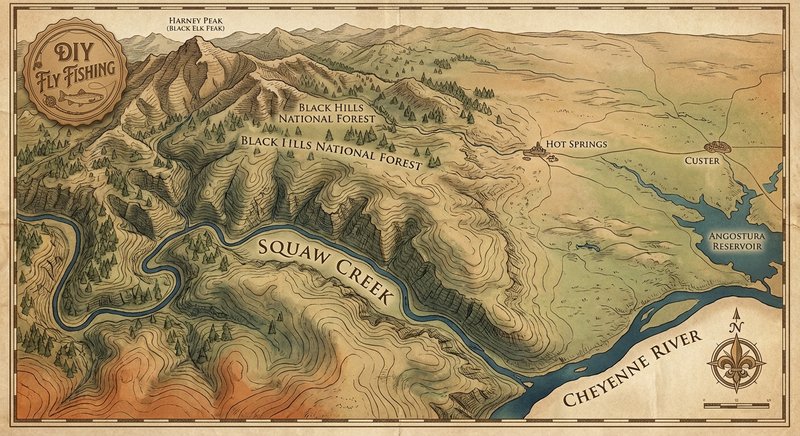
Squaw Creek
Fly fishing in South Dakota · intermediate · Best seasons: spring, summer, fall
Target Species
Brown Trout
About This Water
Black Hills tributary with wild brown trout. Scenic valley setting.
Fishing Recommendations
Welcome to the Black Hills of South Dakota. As your guide, I’m excited to walk you through one of the most technical and rewarding streams in the region.
Note on Naming: While many still refer to it as Squaw Creek, the official name on modern maps and within Custer State Park is Grace Coolidge Creek. It is a premier "walk-in" fishery that offers a true wilderness experience just minutes from the road.
🎣 Location Overview
Grace Coolidge Creek (Squaw Creek) is a jewel of Custer State Park. What makes this water special is the Grace Coolidge Walk-In Area, a six-mile stretch of pristine water that is closed to motorized vehicles. This creates a serene, quiet atmosphere where the only sound is the water and the wind in the ponderosa pines.
The creek is a small, spring-fed mountain stream characterized by gin-clear water, tight canyons, and a series of man-made rock low-head dams. These dams have created deep, emerald-green plunge pools separated by thin riffles and runs. It is widely considered one of the most technical "small stream" fisheries in the United States due to the extreme clarity of the water and the wariness of its inhabitants.
🐟 Target Species & Behavior
The primary prize here is the Wild Brown Trout. While you may find the occasional Brook Trout in the higher reaches or a Rainbow that has drifted down from Center Lake, the Browns rule this water.
- Behavior: These fish are notoriously "spooky." Because the water is so clear and the stream is relatively small, they have highly developed survival instincts. If you can see the fish, they have likely already seen you.
- Holding Patterns: Browns here love the undercut banks and the deep shadows near the rock dams. In the riffles, look for the "seams" where fast water meets slow water. During the heat of the day, they will retreat deep into the plunge pools or under submerged logs.
- Feeding: They are opportunistic but cautious. They feed heavily on midges, small mayflies, and—most importantly—terrestrials that fall from the dense bank vegetation.
📅 Best Times to Fish
Optimal Seasons
- Spring (Late April – Early June): This is the best time for nymphing. As the ice melts and the water warms, the fish become active. Look for Blue Winged Olive (BWO) hatches on overcast days.
- Summer (July – August): This is "Terrestrial Heaven." While the water levels drop, the trout focus on the banks for grasshoppers, ants, and beetles.
- Fall (September – October): My personal favorite time. The Brown Trout become aggressive as they prepare for the spawn. The colors of the Black Hills are stunning, and the "PhD" fish are slightly more willing to chase a well-presented fly.
Prime Windows
- Low Light is Key: The best fishing usually occurs at first light or during the "golden hour" before dusk. The high canyon walls provide extra shade, which extends these prime windows.
- Cloudy Days: A light drizzle or overcast sky is an angler’s best friend here, as it breaks up the surface glare and makes the trout feel less exposed to predators.
🪰 Recommended Flies & Techniques
Top Fly Patterns
- Dry Flies: Parachute Adams (#18-22), Elk Hair Caddis (#14-18), and BWO Sparkle Dun (#18-22).
- Terrestrials: Fat Albert (#10-14), Dave’s Hopper (#12), Cinnamon Ants (#16-18), and Black Foam Beetles (#14-16).
- Nymphs: Zebra Midges (Black or Red, #18-22), Pheasant Tail (#16-20), and Gold-Ribbed Hare’s Ear (#16-18).
- Streamers: Small Wooly Buggers (Black or Olive, #10-12) worked deep in the plunge pools.
Effective Techniques
- The "Dry-Dropper": This is the bread and butter of this creek. Use a high-visibility dry (like a Hopper or a Stimulator) and hang a small nymph 12–18 inches below it.
- Stealth Approach: You must stay low. Often, I recommend my clients crawl on their knees when approaching a pool. Avoid wearing bright colors; earth tones (camo, tan, olive) are essential.
- The Bow-and-Arrow Cast: Because the vegetation is thick, a traditional backcast is often impossible. Mastering the bow-and-arrow cast will allow you to reach fish in tight spots under overhanging branches.
💡 Pro Tips & Local Knowledge
- Manage Your Shadow: Because of the canyon walls, the sun creates sharp shadows. If your shadow falls across a pool, the fishing in that pool is over for the next hour. Always fish with the sun in your face when possible.
- Work Upstream: Always fish moving upstream. Trout face into the current; if you approach from behind them, you have a much better chance of staying undetected.
- The "One-Cast" Rule: In the clearest pools, you often only get one shot. Make sure your first cast counts. Repeatedly casting over a wild Brown in this creek will only cause them to "lock jaw."
- Focus on the Walk-In: The first half-mile of the creek near the parking lot gets the most pressure. Hike in at least 1.5 to 2 miles; the fish there see far fewer flies and are much more likely to rise to a dry fly.
⚠️ Important Information
- Access: Access is via the Grace Coolidge Picnic Area on Hwy 16A inside Custer State Park.
- Permits: You will need a South Dakota Fishing License AND a Custer State Park Entrance License (daily or annual) for your vehicle.
- Regulations: The Walk-In Area is a special regulation stretch. It is typically Catch and Release Only and restricted to Artificial Lures/Flies Only. Always check the most current South Dakota Game, Fish & Parks (SDGFP) handbook before casting.
- Wildlife: You are in buffalo and mountain lion country. Keep your eyes peeled. If a bison is near the creek, give it a wide berth—they have the right of way!
- Gear: I recommend a 3-weight or 4-weight rod (7.5 to 8.5 feet). Use long leaders (9–12 feet) tapering down to 6x or 7x tippet. The light tippet is non-negotiable for these savvy fish.
Tight lines, and enjoy the silence of the canyon!
Bug Hatches & Matching Flies
| Hatch | Type | Peak months | Time of day | Hook sizes | Matching flies |
|---|---|---|---|---|---|
| Blue Winged Olive Baetis spp. | mayfly | April, May, September, October | Midday | #18-22 | RS2 #20-22, Parachute Adams #18-22, WD-40 #20-22 |
| Pale Morning Dun Ephemerella excrucians | mayfly | June, July | Late Morning/Afternoon | #14-18 | PMD Sparkle Dun #16-18, Pheasant Tail #14-18, Split Case PMD #16-18 |
| Little Western Black Stonefly Capnia spp. | stonefly | March, April | Midday | #16-20 | Little Black Sloan #18, Zebra Midge #18-20, Black Copper John #16-18 |
| Grannom Caddis Brachycentrus occidentalis | caddis | April, May | Afternoon/Evening | #14-16 | Elk Hair Caddis #14-16, Holy Grail Caddis #14-16, Peacock Caddis #16 |
| Trico Tricorythodes | mayfly | August, September | Early Morning | #20-24 | Trico Spinner #20-24, Sunken Trico Spinner #22, Trico Dun #20-22 |
| Grasshoppers Orthoptera | terrestrial | July, August, September | All Day | #8-12 | Dave's Hopper #10-12, Morrish Hopper #8-12, Joe's Hopper #10-14 |
| Midges Chironomidae | midge | January, February, March, December | Midday | #18-24 | Griffith's Gnat #18-22, Zebra Midge #18-24, Morgan's Midge #20-22 |
| Yellow Sally Isoperla spp. | stonefly | June, July | Evening | #14-16 | Yellow Sally #14-16, Little Yellow Stimulator #14-16, Iron Sally #14-16 |