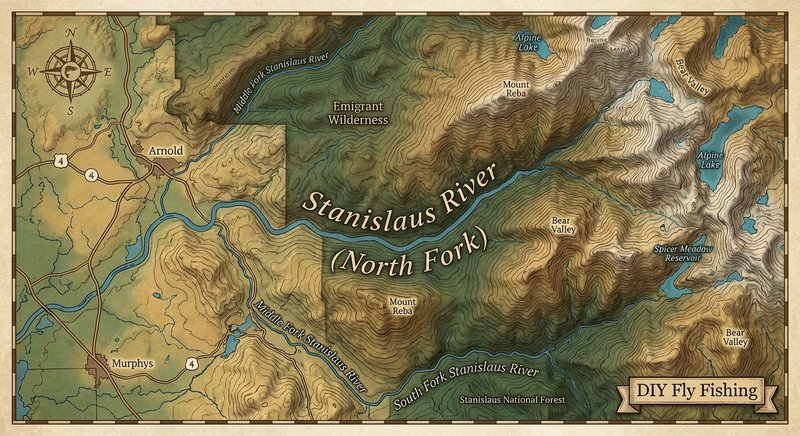
Stanislaus River (North Fork)
Fly fishing in California · Intermediate · Best seasons: Spring, Summer, Fall
Target Species
Rainbow Trout, Brown Trout
About This Water
Sierra foothill stream with wild rainbow trout. Scenic gold country fishing.
Fishing Recommendations
The North Fork of the Stanislaus River (often called the "North Fork Stan") is a quintessential Sierra Nevada freestone stream. Tumbling through granite canyons and thick forests of cedar and pine, it offers a classic "pocket water" fly fishing experience. Unlike the more tailwater-regulated sections of the main stem, the North Fork maintains a rugged, wild character that rewards those willing to hike and read water carefully.
🎣 Location Overview
The North Fork Stanislaus is a high-gradient river characterized by dramatic elevation drops, massive granite boulders, and crystal-clear oxygenated water. What makes it special is the diversity of the water: you’ll find everything from roaring plunges and deep emerald pools to "stair-step" pocket water.
Anglers love the North Fork because it offers a true mountain fishing experience. It is less crowded than the nearby Truckee or Lower Sacramento rivers, providing a sense of solitude. The scenery is spectacular, particularly around Calaveras Big Trees State Park and the Sourgrass area, where the river feels ancient and untouched.
🐟 Target Species & Behavior
- Rainbow Trout: These are the primary residents. In the upper reaches and within the state park, you will find many wild rainbows in the 8–12 inch range, though larger "holdover" fish are common. They are opportunistic, fast-moving, and love highly oxygenated water.
- Brown Trout: While less common than rainbows, the North Fork holds some "ghost" browns, particularly in the deeper, slower pools and near undercut banks or large woody debris. They are more nocturnal and predatory, often requiring a bit more stealth and larger offerings.
Behavior: Because the water moves quickly and the growing season is short, these fish are not usually "picky" about exact imitations, but they are very wary of shadows and heavy footsteps. They hold in the "cushion" in front of rocks, the seams between fast and slow water, and the tail-outs of pools in the evening.
📅 Best Times to Fish
- Spring (Late May – June): This is dependent on snowmelt. In high snow years, the river is dangerous and unfishable until June. Once the flow stabilizes (post-runoff), the fishing is electric as trout are hungry after a long winter.
- Summer (July – August): The prime window. Flows are manageable for wading, and the dry fly action is at its peak. This is "High Sierra" fishing at its finest.
- Fall (September – October): My favorite time. Water temperatures drop, the browns get aggressive before spawning, and the crowds vanish. The "October Caddis" hatch is a legendary event here.
Time of Day: In mid-summer, the "Golden Hour" (last two hours of light) is vital. During the heat of the day, focus on the heaviest whitewater where oxygen levels are highest.
🪰 Recommended Flies & Techniques
Top Fly Patterns
- Dry Flies:
- Stimulators (Orange or Yellow, size 8-12) – Mimics large stoneflies and hoppers.
- Parachute Adams (size 14-18) – The ultimate generalist.
- Elk Hair Caddis (Tan or Olive, size 14-16) – Essential for evening rises.
- October Caddis (size 8-10) – Necessary for late September/October.
- Nymphs:
- Pats Rubber Legs (Black/Tan) – The "bread and butter" for deep pockets.
- Bead-head Prince Nymph (size 14-16).
- Perdigons (various colors, size 16) – Great for sinking fast in heavy current.
- Streamers:
- Woolly Bugger (Olive or Black, size 8-10) – Swung through deep pools for browns.
Techniques
- Dry-Dropper: This is the most effective way to fish the North Fork. Use a buoyant dry (like a Stimulator) and hang a weighted nymph (like a Pheasant Tail) 18–24 inches below it.
- High-Sticking/Euro Nymphing: Because the current is complex, keeping your fly line off the water is crucial to avoid drag.
- Pocket Picking: Don't spend too much time in one spot. Give a pocket 5–10 good drifts; if nobody’s home, move to the next boulder.
💡 Pro Tips & Local Knowledge
- Stealth is Key: The water is incredibly clear. If you stand on top of a boulder overlooking a pool, the fish will see you before you see them. Stay low and cast from a distance.
- Focus on the "Sourgrass" Area: The stretch near the Sourgrass bridge and the Boards Crossing area offers excellent access and a great mix of water types.
- The "Big Trees" Secret: Fishing within Calaveras Big Trees State Park requires a park fee, but it often sees less fishing pressure than the easily accessible forest service land downstream.
- Watch the Temps: In late August, the water can get warm. If the water hits 68°F, give the fish a break and head to higher elevations.
⚠️ Important Information
- Access: Access points include Sourgrass Bridge, Boards Crossing, and the Calaveras Big Trees State Park. Many areas require a high-clearance vehicle if you plan to explore the deeper forest service roads (4N09 or 5N02).
- Regulations: Always check the current California Department of Fish and Wildlife (CDFW) regulations. Sections of the Stanislaus have different rules regarding barbless hooks and catch-and-release. A standard California fishing license is required.
- Wading Safety: This is a dangerous river to wade during high flows. The granite is slick as ice. Use felt soles or studded boots, and a wading staff is highly recommended.
- Wildlife: This is Black Bear and Mountain Lion country. Practice proper food storage and be aware of your surroundings.
Guide’s Final Word: The North Fork Stan isn't where you go to catch a 25-inch trophy; it’s where you go to catch beautiful, wild fish in one of the most scenic canyons in the Sierras. Bring a 4-weight or 5-weight rod, a box of bushy dries, and your hiking boots.
Bug Hatches & Matching Flies
| Hatch | Type | Peak months | Time of day | Hook sizes | Matching flies |
|---|---|---|---|---|---|
| Golden Stonefly Hesperoperla pacifica | stonefly | June, July | Morning/Evening | #6-10 | Pats Rubber Legs #6-10, Rogue River Stone #8-10, Chubby Chernobyl #8-12 |
| Blue Winged Olive Baetis spp. | mayfly | March, April, October, November | Late Morning/Afternoon | #18-22 | RS2 #18-22, Parachute Adams #18-22, WD-40 #20-22 |
| Pale Morning Dun Ephemerella excrucians | mayfly | June, July | Late Morning/Early Afternoon | #14-18 | Pheasant Tail Nymph #14-18, PMD Sparkle Dun #16-18, Parachute PMD #14-16 |
| Spotted Sedge Hydropsyche spp. | caddis | June, July, August, September | Evening | #14-18 | Elk Hair Caddis #14-18, LaFontaine Sparkle Pupa #14-16, Z-Wing Caddis #14-18 |
| October Caddis Dicosmoecus atripes | caddis | September, October | Afternoon/Evening | #8-12 | Orange Stimulator #8-12, Pecka's October Caddis Pupa #10-12, Morrish October Caddis Adult #8-10 |
| Little Yellow Stonefly Isoperla spp. | stonefly | June, July, August | Afternoon/Evening | #14-16 | Yellow Sally Dry #14-16, Iron Lotus #16, Little Yellow Sloan #14-16 |
| American Grannom Brachycentrus occidentalis | caddis | April, May | Afternoon | #14-16 | Peacock Caddis #14-16, Green Weenie #14-16, Hares Ear Nymph #14-16 |
| Sierra Midges Chironomidae | midge | January, February, March, December | Morning | #20-24 | Zebra Midge #20-22, Griffiths Gnat #20-24, Morgan's Midge #22 |
| Carpenter Ants/Terrestrials Camponotus spp. | terrestrial | July, August | All Day | #12-16 | Black Foam Ant #14-16, Dave's Hopper #10-12, Chernobyl Ant #12-14 |