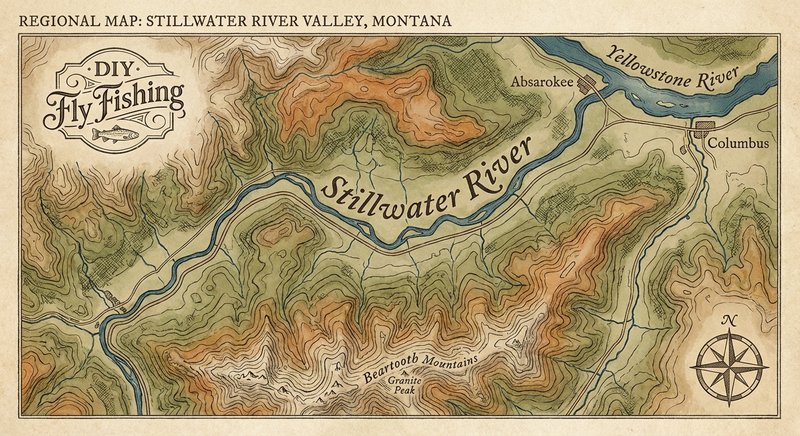
Stillwater River
Fly fishing in Montana · Intermediate · Best seasons: Summer, Fall
Target Species
Rainbow Trout, Brown Trout
About This Water
Absaroka-Beartooth Wilderness gateway. Wild rainbow and brown trout in pristine mountain water.
Fishing Recommendations
The Stillwater River in south-central Montana is one of the most underrated gems in the state. Often overshadowed by its neighbor, the Yellowstone, the Stillwater is a high-gradient, "boulder-garden" freestone river that flows from the Beartooth Mountains into the Yellowstone River at Columbus.
As a guide, I describe the Stillwater as "busy water." It’s fast, technical, and incredibly rewarding for those who can read water well.
🎣 Location Overview
The Stillwater is the quintessential mountain river. Unlike the slow, meandering "spring creek" style rivers, the Stillwater is characterized by its steep drop and massive pocket water. It is a freestone river, meaning its flows are dictated entirely by snowpack and rain.
What makes it special is the lack of crowds and the sheer volume of "fishy" pockets. Because it is so rocky, it is a difficult river to row; drift boats are rare on the upper stretches, and even the lower stretches require an expert hand at the oars. For the wading angler, it offers miles of access to water where trout are opportunistic and willing to rise to a well-placed fly.
🐟 Target Species & Behavior
The river is primarily a Rainbow and Brown Trout fishery, with some Westslope Cutthroat and Mountain Whitefish in the upper reaches.
- Rainbow Trout: These are the "bread and butter" of the Stillwater. They hold in the fast water, right in the bubbles or on the edges of heavy current. They are exceptionally hardy and fight twice as hard as fish in slower rivers.
- Brown Trout: The "pigs" of the Stillwater. Look for the Browns in the deeper, darker holes, under overhanging brush, or in the "soft" water behind the largest boulders. In the fall, they become territorial and aggressive.
- Behavior: Because the water moves so fast, fish here don't have the luxury of "inspecting" a fly for five seconds. They have to make a split-second decision: eat or let it go. This makes them less "match-the-hatch" picky than Missouri River fish, but more "presentation" sensitive.
📅 Best Times to Fish
The Stillwater is a classic Summer/Fall fishery.
- Summer (Late June – August):
- Post-Runoff (The Magic Window): Usually late June or early July. This is when the Salmonflies hatch. It is chaotic, high-energy fishing.
- Mid-Summer: July and August bring the Golden Stones and the start of terrestrial season (Hoppers).
- Time of Day: Start early to beat the heat, but the hopper bite is often best from 11:00 AM to 4:00 PM when the wind picks up.
- Fall (September – October):
- This is arguably the best time for trophy Browns. The water levels drop, the river becomes more wadeable, and the crowds disappear.
- October Caddis and BWO's: Look for hatches on overcast days.
🪰 Recommended Flies & Techniques
Top Fly Patterns
- Dries: Chubby Chernobyl (Gold, Olive, Purple - Sizes 6-12), Purple Haze (Sizes 14-16), Jack Cabe, and Dave’s Hopper.
- Nymphs: Pat’s Rubber Legs (The "Stillwater Special" in Brown/Orange), Copper John (Red/Silver), and Perdigons (for fast sinking in pocket water).
- Streamers: Sparkle Minnow (Gold/Olive), Wooly Bugger (Black), and the Wedge Head.
Effective Techniques
- Hopper-Dropper: This is the primary method on the Stillwater. Use a high-visibility, foam dry fly (like a Chubby) as your indicator and hang a weighted nymph (like a Prince Nymph or Rubber Legs) 2–3 feet below it.
- Pounding the Banks: If you are in a raft or boat, you must land your fly within inches of the bank. The fish hold in the "cushion" created by the bank's friction.
- Tight-Line Nymphing: Because the river is so rocky, traditional indicators often get caught in conflicting currents. Euro-style or tight-line nymphing is devastatingly effective in the boulder gardens.
💡 Pro Tips & Local Knowledge
- The "Stillwater Swing": At the end of your drift, let your flies swing across the current and rise to the surface. Rainbows here often strike at the moment the fly begins to "escape" toward the surface.
- Don't ignore the "Skinny" Water: I see many anglers skip over water that is only 12 inches deep. On the Stillwater, a 16-inch Rainbow will sit in 10 inches of oxygenated water right behind a rock.
- Rowing Warning: If you are bringing a boat, be warned: the Stillwater is a boat eater. There are "rebar" and "sharp rock" hazards, particularly near the Rosebud confluence. If you aren't an expert rower, stick to wading.
- Focus on the "Cushion": When casting to a large boulder, don't just fish the eddy behind it. Fish the "pillow" of water right in front of the rock—fish often sit there to get first dibs on drifting larvae.
⚠️ Important Information
- Access: Montana has excellent stream access laws. You can access the river at any bridge right-of-way or Fishing Access Site (FAS). Notable FAS sites include Buffalo Jump, Castle Rock, and Swinging Bridge.
- Regulations: A valid Montana fishing license is required. The Stillwater generally falls under Central District regulations, but always check the MTFWP Regulations for seasonal closures or "Hoot Owl" (temperature) restrictions in late August.
- Safety: The rocks here are notoriously slippery (Greased Bowling Balls). Use felt soles or studs and a wading staff.
- Bears: You are in Grizzly country. While more common on the upper river (near Nye), they can be anywhere. Carry bear spray and know how to use it.
Guide’s Final Word: The Stillwater is for the angler who loves to move, loves to cast, and enjoys the rugged beauty of a river that feels like it hasn't changed in a hundred years. Tight lines!
Bug Hatches & Matching Flies
| Hatch | Type | Peak months | Time of day | Hook sizes | Matching flies |
|---|---|---|---|---|---|
| Salmonfly Pteronarcys californica | stonefly | June, July | All day | #4-8 | Rogue River Stone #4-6, Pats Rubber Legs #6-8, Cat Puke #6 |
| Golden Stone Hesperoperla pacifica | stonefly | July | Morning/Afternoon | #8-12 | Chubby Chernobyl (Gold) #8-12, Golden Twenty Incher #10-12, Water Walker #10 |
| Mother's Day Caddis Brachycentrus occidentalis | caddis | May | Afternoon/Evening | #14-16 | Elk Hair Caddis #14-16, LaFontaine's Deep Sparkle Pupa #14-16, Peacock Caddis #16 |
| Pale Morning Dun (PMD) Ephemerella spp. | mayfly | July, August | Late Morning/Early Afternoon | #16-18 | RS2 #16-18, Sparkle Dun #16-18, Pheasant Tail #16-18 |
| Yellow Sally Isoperla spp. | stonefly | July, August | Afternoon/Evening | #14-16 | Yellow Sally Foamstone #14-16, Iron Lotus (Yellow) #14-16, Jim's Yellow Sally #14 |
| Blue-Winged Olive (BWO) Baetis spp. | mayfly | April, May, September, October | Mid-day (Cloudy weather) | #18-22 | Parachute Adams #18-22, Baetis Cripple #18-20, WD-40 #20 |
| Grasshoppers Acrididae | terrestrial | August, September | Late Morning through Evening | #8-12 | Morrish Hopper #8-12, Parachute Hopper #10-12, Thunder Thighs Hopper #10 |
| Trico Tricorythodes spp. | mayfly | August, September | Early Morning | #20-24 | Trico Spinner #20-22, Sunken Trico Spinner #20-22 |