Stockade Lake
Fly fishing in South Dakota · beginner · Best seasons: spring, summer, fall
Target Species
Rainbow Trout
About This Water
Custer State Park lake near wildlife loop. Stocked rainbow trout.
Fishing Recommendations
Welcome to the Black Hills of South Dakota. As a guide in this region, I can tell you that Stockade Lake is a crown jewel of Custer State Park. While the Black Hills are famous for their crystalline creeks, Stockade offers a different, more expansive fly fishing experience. It is the largest and deepest of the park's lakes, providing a unique environment where Rainbow Trout can grow larger and stronger than their stream-dwelling cousins.
Here is your guide to mastering the waters of Stockade Lake.
🎣 Location Overview
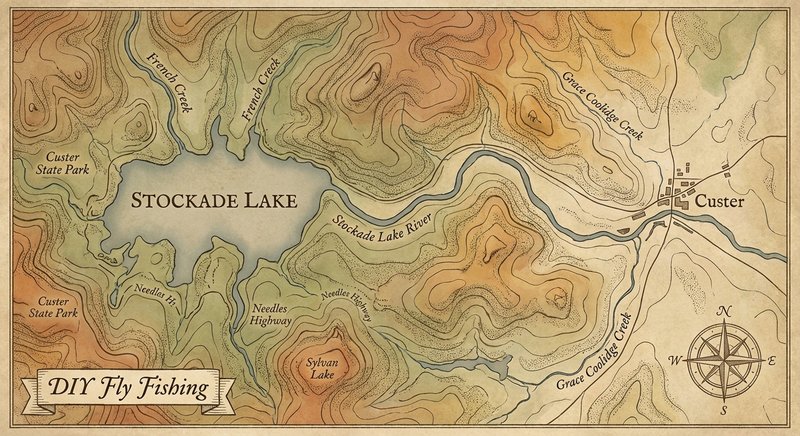
Stockade Lake is located at the western edge of Custer State Park, just a few miles from the town of Custer. Surrounded by towering Ponderosa pines and dramatic granite outcroppings, it is a quintessential Black Hills destination.
What makes Stockade special is its depth and structure. Unlike the shallow "pot-hole" lakes nearby, Stockade has significant depth (reaching nearly 35 feet), which allows trout to survive through the heat of summer and the freeze of winter. The water is generally clear, though it can develop an algae bloom in late August. Anglers love it because it offers both easy shore access and incredible opportunities for float tube or kayak fishing.
🐟 Target Species & Behavior
The primary target for fly anglers is the Rainbow Trout.
- Behavior: These fish are largely "cruisers." Unlike stream trout that sit in a current seam waiting for food, Stockade Rainbows travel along weed lines and drop-offs in search of meals.
- Holding Areas: Early in the season, you’ll find them in the shallows near the boat ramps and the eastern shoreline. As the water warms, they retreat to the "thermocline"—the cooler layer of water usually found 10–15 feet down.
- Diet: Their diet consists heavily of Midges, Scuds, Callibaetis mayflies, and Damselflies. In late summer, they become highly opportunistic, looking for terrestrial insects (grasshoppers and ants) blown off the surrounding hills.
📅 Best Times to Fish
Optimal Seasons
- Spring (May – June): This is the "Golden Era" for Stockade. The trout are in the shallows after the ice-off, feeding aggressively to regain weight.
- Summer (July – August): Fishing remains good, but you must adapt. The fish move deeper during the midday sun.
- Fall (September – October): My personal favorite time. As water temperatures drop, the trout return to the surface and the weed lines. The "Fall Bite" is aggressive as they prepare for winter.
Best Times of Day
- Dawn & Dusk: The "Magic Hour" at Stockade is real. In the hour before sunset, the lake often turns into a mirror, and you will see "rings" everywhere as trout rise for midges.
- Overcast Days: On cloudy days, trout feel less exposed to predators (like ospreys and eagles) and will cruise the shallows all day long.
🪰 Recommended Flies & Techniques
Top Fly Patterns
- Streamers: Olive or Black Woolly Buggers (size 8-12). If the bite is slow, try a "Thin Mint" pattern.
- Nymphs: Gold-Ribbed Hare’s Ear, Pheasant Tails (size 14-16), and Zebra Midges (size 18-22) in red or silver.
- Dries: Parachute Adams (size 14-18) for general hatches, and Elk Hair Caddis.
- Attractors: San Juan Worms (pink or red) are surprisingly effective after a South Dakota thunderstorm washes soil into the lake.
Effective Techniques
- The "Naked" Nymph: Use a long leader (12–15 feet) with a small weighted nymph. Cast it out, let it sink, and retrieve it with an agonizingly slow "figure-eight" hand crawl.
- Indicator Fishing: Suspend a midge or scud 4 to 8 feet below a strike indicator along the weed edges.
- The Damselfly Strip: In June and July, damselfly nymphs migrate toward the shore to hatch. Use an olive damselfly nymph pattern and use short, 2-inch erratic strips near the lily pads.
💡 Pro Tips & Local Knowledge
- Work the Dam: The area near the dam is the deepest part of the lake. In the heat of the summer, this is where the largest holdover trout congregate.
- The West End Inlet: Where the small creek enters the lake on the west end, there is a constant influx of oxygen and nutrients. This is a "fish magnet" in the early spring.
- Get Off the Bank: While you can catch fish from shore, a float tube or kayak is the ultimate game-changer at Stockade. It allows you to fish the "drop-off" (where the shallow shelf suddenly plunges into deep water) which is where the biggest fish patrol.
- Watch the Wind: The wind usually blows from the west. The eastern shore (the "leeward" side) often collects the most surface insects, drawing the trout in.
⚠️ Important Information
- Permits: You need a valid South Dakota Fishing License. If you are entering Custer State Park by vehicle, you also need a Park Entrance License (daily or annual).
- Regulations: Stockade is open to both bait and fly fishing. Be sure to check the current SD Game, Fish & Parks handbook for daily creel limits if you plan to keep fish, though catch-and-release is encouraged for the wilder holdovers.
- Invasive Species: Always "Clean, Drain, and Dry" your gear. The Black Hills are fighting to keep invasive species like Zebra Mussels out of these pristine high-altitude lakes.
- Wildlife: You are in Custer State Park. It is very common to see bison or elk near the lake. Give the bison at least 100 yards of space—they are faster and more temperamental than they look!
Tight lines, and enjoy the serenity of the Black Hills!
Bug Hatches & Matching Flies
| Hatch | Type | Peak months | Time of day | Hook sizes | Matching flies |
|---|---|---|---|---|---|
| Chironomids Chironomidae | midge | April, May, September | All Day | #12-22 | Zebra Midge #16-20, Ice Cream Cone #12-16, Griffith's Gnat #18-22 |
| Callibaetis Callibaetis ferrugineus | mayfly | June, July, August | Morning/Early Afternoon | #12-16 | Callibaetis Spinner #14-16, Hare's Ear Nymph #14-16, Bird's Nest #14-16 |
| Damselfly Enallagma | terrestrial | June, July | Morning/Afternoon | #10-14 | Marabou Damsel #10-12, Adult Damsel Blue #12-14 |
| Traveling Sedge Hesperophylax | caddis | July, August | Evening | #8-12 | Goddard Caddis #10-12, Mikulak Sedge #8-10 |
| Grasshoppers Melanoplus | terrestrial | August, September | Afternoon | #8-12 | Parachute Hopper #10-12, Morrish Hopper #8-12 |
| Tricos Tricorythodes | mayfly | August, September | Early Morning | #20-24 | Trico Spinner #20-22, RS2 #20-22 |
| Cinnamon Ants Formicidae | terrestrial | July, August | All Day | #14-18 | Transparant Ant #16, Chernobyl Ant #12-14 |
| Water Boatmen Corixidae | midge | September, October | Afternoon | #14-16 | Water Boatman #14-16, Prince Nymph #14-16 |