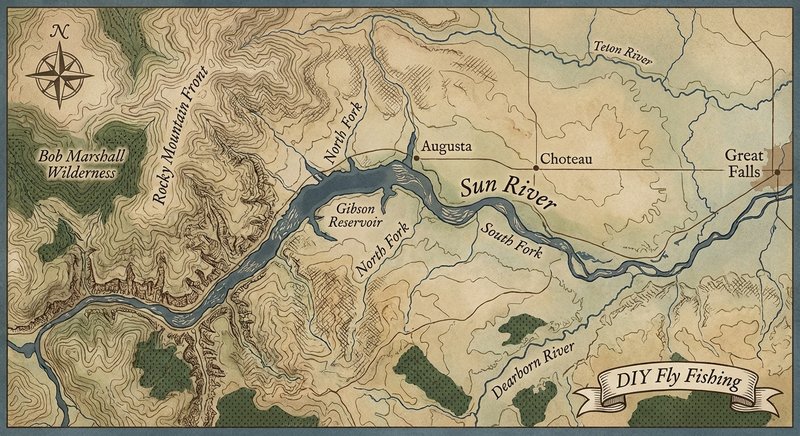
Sun River
Fly fishing in Montana · Intermediate · Best seasons: Summer, Fall
Target Species
Rainbow Trout, Brown Trout
About This Water
Flowing from the Bob Marshall Wilderness. Excellent rainbow trout fishing below Gibson Dam.
Fishing Recommendations
The Sun River, flowing from the Bob Marshall Wilderness through the Rocky Mountain Front and into the Missouri River at Great Falls, is one of Montana’s "hidden in plain sight" gems. While crowds flock to the Missouri or the Blackfoot, the Sun offers a more rugged, solitude-heavy experience with classic Western scenery.
Here is your comprehensive guide to fly fishing the Sun River, Montana.
🎣 Location Overview
The Sun River is a tale of two distinct fisheries. The Upper Sun (above Gibson Reservoir) is a remote, wilderness experience accessible primarily by foot or horseback. The Lower Sun (below Gibson and Diversion Dams) flows through dramatic limestone canyons and eventually transitions into a meandering prairie river.
What makes it special is the transition from high-alpine limestone canyons to high-desert plains. The water is generally clear and cold in the upper reaches, becoming warmer and more nutrient-rich as it moves east. Anglers love it because you can often have miles of river to yourself, framed by the towering "Reefs" of the Rocky Mountain Front.
🐟 Target Species & Behavior
The Sun River is primarily a Rainbow and Brown trout fishery, with some Cutthroat found in the higher elevations.
- Rainbow Trout: These are the dominant species in the faster, oxygenated water. They are known for their aerobatic fights. Look for them in "heavy" water—the heads of pools, riffles, and along current seams.
- Brown Trout: Found more frequently in the lower sections and in deep, undercut banks or under overhanging brush. They are predatory and aggressive, especially during low-light conditions or in the fall.
- Behavior: In the canyon sections, fish are opportunistic due to the shorter growing season. In the lower agricultural stretches, they can be more selective, keying in on specific hatches like Tricos or Hoppers.
📅 Best Times to Fish
Optimal Seasons
- Summer (July – August): This is prime time. After spring runoff (which can be intense and muddy), the river settles. July brings the best dry fly action with Golden Stones and various Mayflies. August is "Hopper Time."
- Fall (September – October): This is arguably the best time for trophy Browns. As the water cools, the Browns become aggressive before their spawn. The cottonwoods turn gold, the crowds vanish, and the streamer fishing is electric.
Prime Windows
- Morning: Best for nymphing and early Trico hatches in late summer.
- Evening: The "Magic Hour" on the Sun can be incredible for caddis blooms and spinner falls.
🪰 Recommended Flies & Techniques
Top Fly Patterns
- Dry Flies:
- Chubby Chernobyl (Size 8-12) in Gold or Royal—the ultimate scout fly.
- Parachute Adams (Size 14-18) for general mayfly hatches.
- Elk Hair Caddis (Size 14-16) for evening rises.
- Morrish Hopper (Size 10-12) during August and September.
- Nymphs:
- Pat’s Rubber Legs (Size 8-10) in Coffee/Black.
- Pheasant Tail (Size 14-18) – a staple for the Sun’s mayfly nymphs.
- Zebra Midge (Size 18-20) for tailwater sections below the dams.
- Streamers:
- Sculpzilla (Olive or Black).
- Woolly Bugger (Size 6-8) in Olive or Thin Mint.
Techniques
- Dry-Dropper: This is the most effective way to fish the Sun in summer. Use a high-floating hopper or Chubby with a 2-foot dropper to a Pheasant Tail or Hare’s Ear.
- Streamer Stripping: In the fall, "pound the banks." Cast close to the shore and use aggressive, erratic strips to trigger a territorial strike from a Brown trout.
- Nymphing: Use a standard indicator rig in the deep pools below the canyon sections during the heat of the day.
💡 Pro Tips & Local Knowledge
- The Canyon Stretch: Focus on the area just below Diversion Dam. The limestone walls provide a cooling effect, and the pocket water here is productive even on hot days.
- Watch the Flows: The Sun River is heavily used for irrigation. Check the USGS flow gauges. If the river drops rapidly due to irrigation demands, the fishing can turn off for 24 hours while the fish adjust.
- The "Sun River Twitch": When fishing hoppers in the late summer, give the fly a tiny twitch every few seconds. On the Sun, the fish often need a little movement to distinguish the fly from the debris.
- Solitude Secret: Most people fish the Missouri nearby. If you want a "private" experience, hike a mile away from any bridge access on the Sun; you will likely be the only person there.
⚠️ Important Information
Access
- Public Access: Montana has excellent stream access laws. You can fish anywhere below the high-water mark, but you must enter through public points (bridges or Fishing Access Sites).
- Sun River Canyon: There are several FAS (Fishing Access Sites) near Augusta and within the canyon.
Regulations & Permits
- A Montana Fishing License and a Conservation License are required. You can purchase these online via the Montana FWP website.
- Check the current FWP Regulations as some sections have specific catch-and-release rules or hook restrictions.
Special Considerations
- Grizzly Bear Country: The Sun River flows out of the Rocky Mountain Front, which has a very high density of Grizzly Bears. Always carry bear spray, know how to use it, and make noise while walking through thick brush.
- Wind: This area of Montana is notoriously windy. Bring a 6-weight rod to help cut through the gusts coming off the Front.
Bug Hatches & Matching Flies
| Hatch | Type | Peak months | Time of day | Hook sizes | Matching flies |
|---|---|---|---|---|---|
| Blue Winged Olive Baetis spp. | mayfly | April, May, September, October | Mid-day/Afternoon | #16-20 | Parachute Adams #16-20, RS2 #18-22, Pheasant Tail #16-20 |
| Salmonfly Pteronarcys californica | stonefly | June | Afternoon | #4-8 | Rogue River Stone #4-8, Pat's Rubber Legs #4-8, Cat Puke #6-8 |
| Pale Morning Dun Ephemerella invaria | mayfly | June, July | Late Morning/Early Afternoon | #14-18 | Sparkle Dun #14-18, PMD Split Case #16-18, Last Chance Cripple #16-18 |
| Spotted Sedge Hydropsyche spp. | caddis | June, July, August | Evening | #14-18 | Elk Hair Caddis #14-18, LaFontaine's Deep Sparkle Pupa #14-16, Iris Caddis #14-18 |
| Golden Stonefly Hesperoperla pacifica | stonefly | June, July | Morning/Afternoon | #8-12 | Chubby Chernobyl #8-12, Golden Stone Nymph #8-12 |
| Trico Tricorythodes spp. | mayfly | August, September | Early Morning | #20-24 | Trico Spinner #20-24, Sunken Trico #22-24 |
| Grasshoppers Orthoptera | terrestrial | August, September | Mid-day/Afternoon | #8-14 | Morrish Hopper #10-12, Thunder Thighs Hopper #8-14 |
| Mother's Day Caddis Brachycentrus occidentalis | caddis | May | Afternoon | #14-16 | Peacock Caddis #14-16, Z-Wing Caddis #14-16 |
| Midges Chironomidae | midge | February, March, April | Late Morning | #18-24 | Zebra Midge #18-22, Griffith's Gnat #18-22, Morgan's Midge #20-22 |