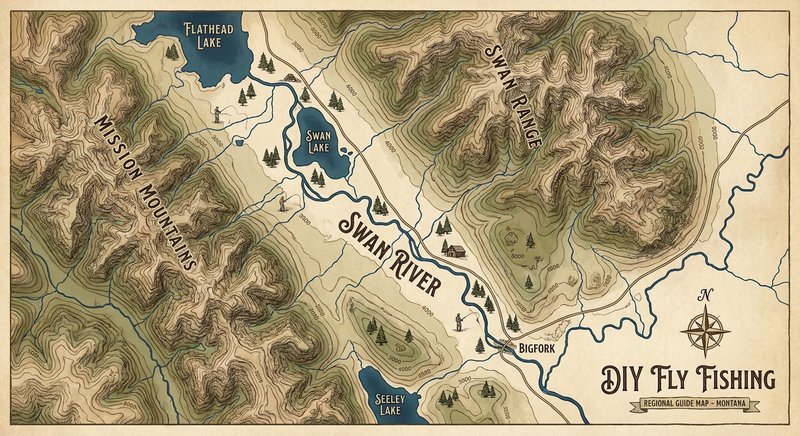
Swan River
Fly fishing in Montana · Beginner · Best seasons: Summer, Fall
Target Species
Cutthroat Trout, Bull Trout, Rainbow Trout
About This Water
Scenic river connecting Swan Lake to Flathead Lake. Wild cutthroat and bull trout in mountain setting.
Fishing Recommendations
The Swan River is one of Montana’s best-kept secrets, often overshadowed by its famous neighbors, the Blackfoot and the Flathead. Tucked between the jagged Mission Mountains to the west and the Swan Range to the east, the "Big Swan" offers a classic Montana freestone experience characterized by crystal-clear water, dense pine forests, and a remarkable sense of solitude.
🎣 Location Overview
The Swan River is a medium-sized tributary of the Flathead Lake system. It flows through a lush, high-elevation valley that feels more like the Pacific Northwest than the high desert of the Rockies.
What makes the Swan special is its structural diversity. The upper river (above Swan Lake) is a winding, intimate stream full of log jams, deep pools, and "braided" channels. Below Swan Lake, the "Wild Mile" near Bigfork turns into a high-gradient, boulder-choked whitewater stretch. Most fly fishing occurs in the upper valley where the current is manageable and the trout are opportunistic. The water carries a slight glacial "teal" tint but remains exceptionally clear, requiring a stealthy approach.
🐟 Target Species & Behavior
- Westslope Cutthroat Trout: The crown jewel of the Swan. These are native, beautiful, and highly opportunistic. They hold in "soft" water—look for them in foam lines, behind log jams, and in the slower glides. They are famous for rising to large dry flies even when no hatch is present.
- Bull Trout: The Swan is a critical stronghold for these native giants. They are apex predators that migrate from Swan Lake into the river to spawn. They are often found in the deepest, coldest holes. Note: Targetting Bull Trout is strictly regulated (see "Important Information").
- Rainbow Trout: Found primarily in the lower sections and near the lake inlets/outlets. They are hard fighters and tend to hold in faster "riffle" water compared to the Cutthroats.
- Brook Trout: Plentiful in the upper reaches and smaller tributaries; they provide great action for light-tackle enthusiasts.
📅 Best Times to Fish
Summer (Late June – August)
This is the prime window. As the spring runoff recedes (usually by late June), the river settles into its classic dry-fly personality.
- July: The peak of the Salmonfly and Golden Stonefly hatches.
- August: The "Spruce Moth" window. This is a unique Swan Valley phenomenon where thousands of moths flutter over the water, triggering aggressive surface takes.
Fall (September – October)
The crowds (already thin) disappear completely.
- September: Excellent terrestrial fishing (grasshoppers/ants) and the beginning of the Mahogany Dun and Hecuba hatches.
- October: As temperatures drop, Blue Winged Olives (BWOs) emerge on cloudy days. This is also when the big Bull Trout are most active in the system.
Best Time of Day: During mid-summer, the "morning-glory" bite is real, but the best dry fly action often occurs from 10:00 AM to 4:00 PM when the sun hits the water and insects become active.
🪰 Recommended Flies & Techniques
Dry Flies (The Main Event)
The Swan is a "dry fly first" river. Because the water is nutrient-poor, fish can't afford to pass up a meal on the surface.
- Attractors: Royal Wulff, H&L Variant, and Purple Haze (Sizes 12–16).
- Stoneflies: Rogue River Salmonfly, Chubby Chernobyl (Orange or Gold, Sizes 8–12).
- Spruce Moths: Elk Hair Caddis (Cream/Tan) or specific Spruce Moth patterns (Sizes 12–14).
- Terrestrials: Morrish Hopper (Pink or Tan), Black Ants.
Nymphing & Streamers
- Nymphs: Pat’s Rubber Legs (Coffee/Black) is the gold standard here. Follow it with a Bead-head Pheasant Tail or a Copper John.
- Streamers: For the larger Rainbows and Bulls, swing or strip Sculpzilla or White Zonkers. Use sink-tips to get down in the deep "log-hole" pockets.
Presentation Tip
The "Log Jam" Twitch: When fishing the heavy timber of the Upper Swan, don't just let your dry fly drift. Give it a tiny "skate" or twitch near the logs. This often triggers a territorial strike from a Cutthroat hiding under the wood.
💡 Pro Tips & Local Knowledge
- Fear the Wood: The Swan is notorious for "sweepers" (downed trees). If you are floating in a raft or drift boat, you must be an expert oarsman. The river can change every year with new log jams.
- The "Cold Creek" Effect: Pay attention to where small, cold tributaries enter the main stem. During the heat of August, fish will stack up in these "thermal refuges" where the water is a few degrees cooler.
- Spruce Moth Mania: If you see white moths fluttering in the pine trees, stop everything and put on a tan Elk Hair Caddis. This is some of the most exciting dry fly fishing in Montana.
- Wading: The riverbed is a mix of silt and "bowling ball" rocks. Felt-soled boots or studs are highly recommended.
⚠️ Important Information
- Access: Much of the Swan Valley is a checkerboard of State Forest, Forest Service, and private land. Use an app like OnX Maps to ensure you are on public ground. Popular access points include Salmon Prairie, Piper Creek, and Cilly Creek.
- Bull Trout Regulations: Strict "No Targeting" rules often apply unless you have a specific permit for Swan Lake. If you accidentally hook a Bull Trout, keep it in the water, release it immediately, and do not take photos out of the water. Check the Montana FWP Region 1 Regulations before heading out.
- Grizzly Bear Country: The Swan Valley has one of the highest densities of Grizzly Bears in the lower 48. Always carry bear spray on your person (not in your pack) and make noise while walking through dense brush to the river.
- Licensing: You need a Montana Fishing License and a Conservation License. These can be purchased online via the Montana FWP website.
Bug Hatches & Matching Flies
| Hatch | Type | Peak months | Time of day | Hook sizes | Matching flies |
|---|---|---|---|---|---|
| Skwala Stonefly Skwala americana | stonefly | March, April | Midday | #8-12 | Skwala Stone #10-12, Pat's Rubber Leg #8-12, Bullet Skwala #12 |
| Blue Winged Olive Baetis | mayfly | April, May, September, October | Afternoon | #16-20 | RS2 #18-20, Parachute Adams #16-20, Pheasant Tail Nymph #16-18 |
| Salmonfly Pteronarcys californica | stonefly | June, July | All Day | #4-8 | Rogue River Stone #4-6, Cat Puke #6, Giant Stone Nymph #4-8 |
| Pale Morning Dun Ephemerella excrucians | mayfly | June, July, August | Late Morning/Afternoon | #14-18 | Sparkle Dun #16, PMD Quigley Emerger #14-16, Split Case PMD #16 |
| Golden Stonefly Hesperoperla pacifica | stonefly | June, July | Morning/Evening | #8-12 | Chubby Chernobyl (Gold) #8-10, Water Walker #10, Iron Lotus #12-14 |
| Spotted Sedge Hydropsyche | caddis | June, July, August | Evening | #14-16 | Elk Hair Caddis #14-16, LaFontaine Sparkle Pupa #14-16, Holy Grail #14-16 |
| October Caddis Dicosmoecus gilvipes | caddis | September, October | Afternoon | #8-12 | Orange Stimulator #8-10, October Caddis Pupa #10, Morrish October Caddis #10 |
| Tricos Tricorythodes | mayfly | August, September | Early Morning | #20-24 | Trico Spinner #20-22, Sunken Trico Spinner #20-22 |
| Grasshoppers Orthoptera | terrestrial | July, August, September | Midday | #8-14 | Morrish Hopper #10-12, Dave's Hopper #10-14, Yeti Hopper #12 |