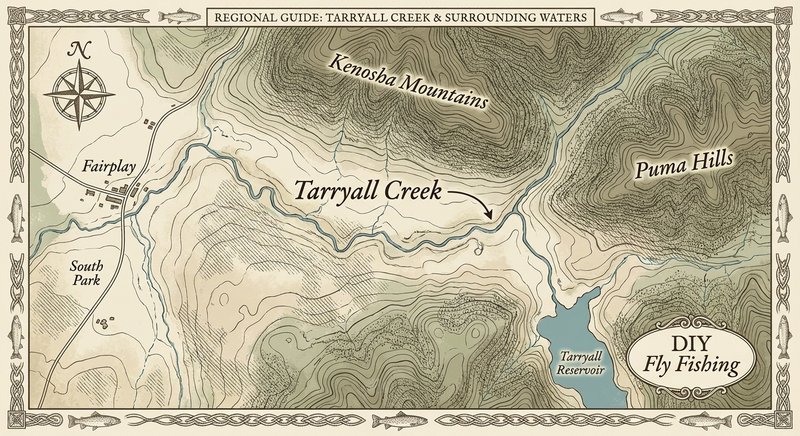
Tarryall Creek
Fly fishing in Colorado · Beginner · Best seasons: Summer, Fall
Target Species
Brown Trout, Rainbow Trout
About This Water
South Park freestone with wild brown trout. Scenic meadow fishing in historic mining country.
Fishing Recommendations
Tarryall Creek is one of Colorado’s "best-kept secrets" that hides in plain sight. Located in the high-altitude basin of South Park, this creek offers a classic meandering meadow experience that contrasts sharply with the nearby, crowded waters of the South Platte’s "Dream Stream."
As your guide, here is the deep dive into mastering Tarryall Creek.
🎣 Location Overview
Tarryall Creek is a high-desert meadow stream that flows through the heart of South Park before entering Tarryall Reservoir and continuing down toward the South Platte River. It is characterized by tight oxbow bends, deep undercut banks, and dense willow lining.
What makes it special is the "small water, big fish" potential. While much of the creek is narrow enough to jump across in spots, the undercut banks provide perfect thermal cover for surprisingly large Brown Trout. It is a technical fishery that rewards stealth, accurate casting, and an understanding of meadow hydraulics.
🐟 Target Species & Behavior
- Brown Trout: The primary residents. They are wild, opportunistic, and highly territorial. They live almost exclusively under the banks or in the deep "buckets" at the apex of river bends.
- Rainbow Trout: Found more frequently near the inlet and outlet of Tarryall Reservoir. These fish tend to hold in the swifter riffles and transition zones where oxygen levels are higher.
Behavior: These fish are spooky. Because the water is often crystal clear and the banks are vibration-sensitive, "lining" a fish or heavy footsteps will shut a hole down instantly. They feed heavily on sub-surface nymphs but become aggressive surface feeders during the hopper season.
📅 Best Times to Fish
Optimal Seasons
- Summer (Late June – August): This is the "Golden Era" on Tarryall. As the hay matures in the surrounding meadows, grasshoppers become the primary food source.
- Fall (September – October): My favorite time. The Brown Trout prepare for the spawn and become hyper-aggressive. The cottonwoods turn gold, the crowds disappear, and the fish will chase streamers with reckless abandon.
Best Times of Day
- Morning (8 AM – 11 AM): Great for nymphing the deeper runs as fish wake up.
- Midday (11 AM – 3 PM): Prime "Hopper-Copper-Dropper" time. The wind usually picks up in South Park during this window, blowing terrestrials into the water.
- Evening: A subtle caddis hatch often occurs, providing excellent dry fly action in the flats.
🪰 Recommended Flies & Techniques
Top Fly Patterns
- Terrestrials: Amy’s Ant (Size 10-14), Hippo Stomper (Size 12), and Joe’s Hopper.
- Nymphs: Flashback Pheasant Tails (Size 16-18), Copper Johns (Red/Copper, Size 16), and San Juan Worms (after a rain).
- Dry Flies: Parachute Adams (Size 16-20) for general hatches; Elk Hair Caddis (Size 14-16).
- Streamers: Black or Olive Woolly Buggers (Size 8-12) or the Pine Squirrel Leech.
Effective Techniques
- The "Plop" Cast: When fishing hoppers, don't worry about a delicate landing. A "plop" on the water mimics a heavy insect falling in and can actually trigger a strike.
- Tight-Line Nymphing: Because the creek is narrow, a long fly line on the water creates drag. Use a short line and keep your rod tip high to navigate the conflicting currents in the bends.
- Streamer Stripping: Cast your streamer tight against the opposite bank and strip it fast back toward the middle. Browns will dart out from the undercuts to ambush it.
💡 Pro Tips & Local Knowledge
- The Stealth Approach: Approach the bank from a crouched position. If you can see the fish, they have likely already seen you. Wear earthy tones (greens/tans) to blend into the willows.
- Focus on the Bends: 90% of the fish live in 10% of the water. Look for the "outside" of a bend where the water has carved a deep pocket under the grass.
- The South Park Wind: South Park is notoriously windy. Instead of fighting it, use it. A 5-weight rod is better than a 3-weight here simply to punch through the gusts. Fish with the wind at your back whenever possible to help "sail" your dries under the overhanging willows.
- Cline Ranch: Check the regulations for the Cline Ranch State Wildlife Area. It offers superb public access but has a limited number of "slots" or sign-in requirements. It is some of the best water on the creek.
⚠️ Important Information
- Access: Much of Tarryall Creek is private property. Respect all "Posted" signs. Public access is available at the Tarryall Reservoir SWA, the Cline Ranch SWA, and various pockets of National Forest land. Use an app like OnX Maps to ensure you are on public ground.
- Regulations:
- A valid Colorado Fishing License is required.
- Many sections are Artificial Fly and Lure Only.
- Check current Colorado Parks & Wildlife (CPW) brochures for specific bag limits, though catch-and-release is highly encouraged to preserve this fragile ecosystem.
- Gear: A 8'6" or 9' 4-weight or 5-weight rod is ideal. 4X or 5X fluorocarbon tippet is necessary for nymphing, while 3X is fine for slapping big hoppers.
Guide’s Final Word: Tarryall Creek is for the angler who prefers solitude and strategy over high fish counts. Slow down, stay low, and fish the banks—you might just find the Brown Trout of a lifetime in a creek you can step across.
Bug Hatches & Matching Flies
| Hatch | Type | Peak months | Time of day | Hook sizes | Matching flies |
|---|---|---|---|---|---|
| Midges Chironomidae | midge | January, February, March, April, December | All Day | #18-24 | Zebra Midge #18-22, Griffith's Gnat #20-24, Top Secret Midge #20-22 |
| Blue Winged Olive (BWO) Baetis | mayfly | April, May, September, October | Late Morning/Afternoon | #18-22 | RS2 #18-22, Parachute Adams #18-22, JujuBaetis #18-22 |
| Pale Morning Dun (PMD) Ephemerella excrucians | mayfly | June, July, August | Late Morning/Early Afternoon | #16-18 | PMD Sparkle Dun #16-18, Pheasant Tail #16-18, Barr's PMD Emerger #16-18 |
| Trico Tricorythodes | mayfly | August, September | Early Morning | #20-24 | Trico Spinner #20-24, Drowned Trico Spinner #20-22 |
| Brachycentrus (Mother's Day Caddis) Brachycentrus occidentalis | caddis | May | All Day/Evening | #14-16 | Peacock Caddis #14-16, Graphic Caddis #14-16, Holy Grail Caddis #14-16 |
| Yellow Sally Isoperla | stonefly | June, July | Afternoon/Evening | #14-16 | Yellow Sally Stone #14-16, Iron Sally #14-16 |
| Grasshoppers Acrididae | terrestrial | July, August, September | Late Morning/Afternoon | #8-14 | Amy's Ant #10-14, Parachute Hopper #8-12, Charlie Boy Hopper #10-14 |
| Red Quill Hesperophlebia | mayfly | July | Afternoon | #12-14 | Red Quill #12-14, Mercer's Missing Link #14 |