Thompson River
Fly fishing in Montana · Beginner · Best seasons: Summer, Fall
Target Species
Rainbow Trout, Brown Trout
About This Water
Freestone river near Thompson Falls with wild rainbow and brown trout. Less crowded alternative.
Fishing Recommendations
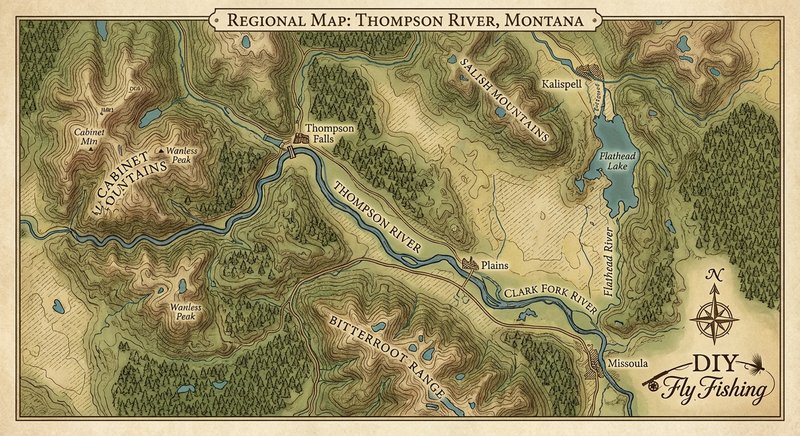
The Thompson River in Northwest Montana is one of the state’s best-kept secrets. Flowing through a scenic corridor between Kalispell and Missoula, it eventually joins the Clark Fork River near the town of Plains. Unlike the high-traffic "Blue Ribbon" rivers of the south, the Thompson offers a rugged, intimate freestone experience characterized by boulder gardens, deep pools, and classic riffle-run sequences.
As your guide, here is the breakdown for tackling this beautiful fishery.
🎣 Location Overview
The Thompson is a classic Western Montana freestone river. It is medium-sized, making it incredibly approachable for wading anglers, though it is often too rocky and shallow for drift boats. What makes it special is its solitude and diversity of water. You’ll find everything from tight, timber-lined canyons to wide-open meadow stretches.
The river is cold, oxygenated, and nutrient-rich, which supports a healthy insect population. Because it isn't as famous as the Madison or the Bitterroot, you won't be fighting for a spot in the parking lot. It’s a river for the angler who loves "pocket water" and reading the nuances of a stream.
🐟 Target Species & Behavior
- Rainbow Trout: These are the primary residents. They are hardy, wild fish that favor the oxygenated "bubble lines" and the heads of riffles. They are notoriously acrobatic when hooked.
- Brown Trout: The Thompson holds some surprisingly large browns, particularly in the lower reaches near the Clark Fork confluence. They are more secretive, holding in deep undercut banks, under submerged logs, or behind the largest boulders.
- Westslope Cutthroat & Brook Trout: While not the primary targets, you will frequently find Cutthroats in the swifter upper sections and Brookies in the smaller tributaries.
Behavior: These fish are opportunistic but can be wary in the crystal-clear summer water. They transition from heavy subsurface feeding in the early summer to aggressive surface takes during the peak hatch and terrestrial seasons.
📅 Best Times to Fish
Summer (Late June – August)
- The Window: This is the prime time. The river usually clears from runoff by late June.
- Conditions: Look for the Salmonfly hatch in late June/early July. It is less chaotic than on other rivers but offers a chance at the biggest fish of the year on dry flies.
- Time of Day: In the heat of July and August, "Hoot Owl" restrictions (closing fishing at 2:00 PM) can occur. Aim for the "Grey Light" start—be on the water at dawn.
Fall (September – October)
- The Window: Many guides consider this the best time. The crowds vanish, and the scenery turns golden.
- Conditions: As water temperatures drop, the Brown Trout become aggressive and territorial ahead of their spawn.
- Time of Day: Midday. You don't need to be there at dawn; wait for the sun to warm the water and trigger the Blue Winged Olive (BWO) hatches.
🪰 Recommended Flies & Techniques
Top Fly Patterns
- Dries:
- Chubby Chernobyl (Size 6-12): The ultimate searcher pattern. Gold, Purple, or Royal.
- Elk Hair Caddis (Size 14-18): A staple for the evening rise.
- Parachute Adams (Size 14-20): For when the fish get picky during Mayfly hatches.
- Morrish Hopper (Size 8-12): Lethal in August and September.
- Nymphs:
- Pat’s Rubber Legs (Size 6-10): The gold standard for stonefly-rich waters like the Thompson.
- Pheasant Tail (Size 14-18): Mimics almost any mayfly nymph.
- Perdigons (Size 16-18): Great for getting deep quickly in fast pocket water.
- Streamers:
- Sculpzilla or Wooly Buggers (Black/Olive): Essential for targeting the larger Browns.
Techniques
- Dry-Dropper: This is the "bread and butter" on the Thompson. Hang a weighted nymph 2-3 feet below a buoyant Chubby Chernobyl. This covers two water columns and acts as your strike indicator.
- Pocket Water Fishing: Don't just cast into the big pools. Cast into the "pockets" of calm water behind large rocks. These are the "feeding stations" for Rainbows.
- High-Sticking: Because the river is rocky, use a high-stick nymphing technique to keep your line off the conflicting currents.
💡 Pro Tips & Local Knowledge
- The "Boulder Hop": Don't stay in one spot for too long. The Thompson rewards the mobile angler. If you don't get a strike in 10-15 minutes, move 50 yards upstream.
- The Lower River: The last few miles before it hits the Clark Fork are known for bigger fish, but the water is slower and more technical. The middle stretches (along Thompson River Road) offer higher fish counts but smaller average sizes.
- Wading Safety: The Thompson is notorious for "greasy" rocks. Wear felt-soled boots or studs, and use a wading staff. The current is deceptively strong in the canyon sections.
- Look for Springs: In the heat of August, look for areas where cold-water springs enter the river. Fish will congregate there for higher oxygen levels.
⚠️ Important Information
- Access: The Thompson River Road (off Hwy 200) follows the river for nearly 30 miles. There are numerous well-marked fishing access sites and pull-offs. Much of the land is Plum Creek/Timber land or State Forest, providing excellent public access.
- Regulations: Always check the current Montana FWP (Fish, Wildlife & Parks) regulations. The Thompson is generally open year-round, but specific catch-and-release rules apply to certain species like Bull Trout (which must be released immediately without being removed from the water).
- Bear Safety: This is Grizzly and Black Bear country. Always carry bear spray on your person (not in your pack) and make noise when walking through thick brush to the river.
- Permits: A valid Montana Fishing License and Conservation License are required. These can be purchased online or at fly shops in Plains or Thompson Falls.
Bug Hatches & Matching Flies
| Hatch | Type | Peak months | Time of day | Hook sizes | Matching flies |
|---|---|---|---|---|---|
| Skwala Stonefly Skwala americana | stonefly | March, April | Midday | #8-12 | Skwala Stone #10-12, Pat's Rubber Leg #8-12, Bullet Skwala #12 |
| Blue Winged Olive Baetis | mayfly | April, May, September, October | Afternoon | #16-20 | Parachute Adams #16-20, RS2 #18-20, Pheasant Tail #16-18 |
| Salmonfly Pteronarcys californica | stonefly | May, June | All Day | #4-8 | Rogue River Stone #4-6, Cat Puke #6-8, Girdle Bug #6-10 |
| Golden Stonefly Hesperoperla pacifica | stonefly | June, July | Morning/Afternoon | #8-12 | Chubby Chernobyl (Gold) #8-12, Water Walker #10, Golden 20-Incher #10-12 |
| Pale Morning Dun (PMD) Ephemerella excrucians | mayfly | June, July, August | Late Morning/Afternoon | #14-18 | Sparkle Dun #16-18, PMD Parachute #14-18, Split Case PMD #16-18 |
| Spotted Sedge (Caddis) Hydropsyche | caddis | June, July, August | Evening | #12-16 | Elk Hair Caddis #14-16, LaFontaine's Deep Sparkle Pupa #14-16, X-Caddis #14-16 |
| Trico Tricorythodes | mayfly | July, August, September | Early Morning | #20-24 | Trico Spinner #20-24, Sunken Trico #22, Griffith's Gnat #20-22 |
| Grasshopper Acrididae | terrestrial | August, September | Afternoon | #8-12 | Morrish Hopper #8-12, Letort Hopper #10-12, Pink Pookie #10-12 |
| October Caddis Dicosmoecus atripes | caddis | September, October | Afternoon/Evening | #8-12 | Orange Stimulator #8-12, October Caddis Pupa #10-12, Peacock Caddis #12 |