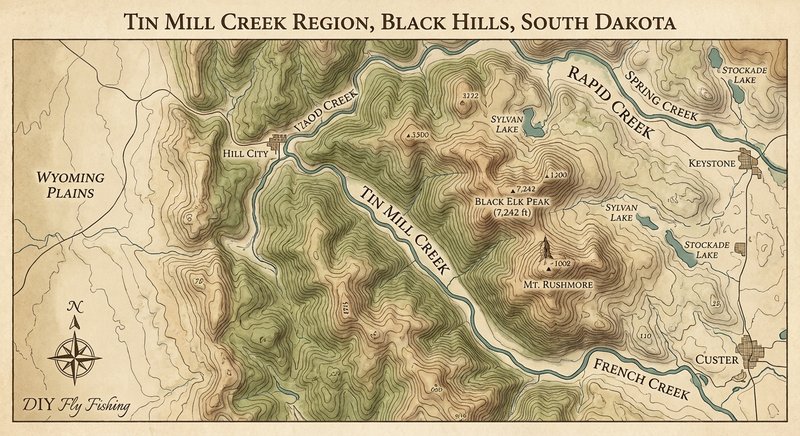
Tin Mill Creek
Fly fishing in South Dakota · advanced · Best seasons: summer
Target Species
Brook Trout
About This Water
Black Hills stream with wild brook trout. Small stream in historic mining district.
Fishing Recommendations
Tin Mill Creek is one of the Black Hills' best-kept secrets for the angler who values solitude and wild, vibrant fish over size and easy access. Located in the central Black Hills near Hill City, this is a quintessential "blue line" stream—small, intimate, and teeming with wild Brook Trout.
Here is your guide to fishing Tin Mill Creek.
🎣 Location Overview
Tin Mill Creek is a small, cold-water tributary that feeds into the Spring Creek drainage. What makes it special is its "high-country" feel despite being at a moderate elevation. The creek is characterized by a dense canopy of ponderosa pine and birch, crystal-clear water, and a series of small plunge pools, mossy undercut banks, and tight pocket water.
Anglers love Tin Mill because it offers a "step back in time" experience. You won’t find crowds here; instead, you’ll find a rugged landscape where the fish are as wild as the scenery. It is a technical creek, not because the fish are picky, but because the tight quarters require precision casting and extreme stealth.
🐟 Target Species & Behavior
The primary resident is the Wild Brook Trout. While they rarely exceed 8–10 inches, they are some of the most beautiful specimens in South Dakota, sporting vivid orange bellies and brilliant halos.
- Behavior: These Brookies are highly opportunistic but extremely "spooky." In water this clear and shallow, they can see an angler from a distance.
- Holding Water: They favor the heads of pools where oxygen is high, tucked deep under overhanging brush, or behind large granite boulders.
- Feeding: Their diet consists heavily of "attractor" style bugs—anything that falls into the creek is fair game. In the summer, they are looking up for terrestrials.
📅 Best Times to Fish
While the Black Hills can be fished year-round, Summer (June through August) is the undisputed prime time for Tin Mill Creek.
- Season: Summer is ideal because the water temperatures remain cool due to the heavy canopy and spring-fed nature of the drainage, even when larger rivers like the Rapid or lower Spring Creek get too warm.
- Time of Day: Early morning (6:00 AM – 10:00 AM) and late evening (6:00 PM – Dusk). However, because the creek is so heavily shaded, you can often find a consistent dry fly bite throughout the afternoon.
- Conditions: Overcast days are a gift here; they reduce shadows and make the fish less wary.
🪰 Recommended Flies & Techniques
You don't need a massive fly box for Tin Mill, but you do need the right tools for tight quarters.
Top Fly Patterns
- Dry Flies:
- Elk Hair Caddis (Size 14-18): The gold standard. High visibility and floats well in turbulent plunge pools.
- Parachute Adams (Size 16-20): Great for when the fish are being slightly more selective.
- Foam Ants & Beetles (Size 14-16): Essential for summer. A "splat" on the water often triggers a strike.
- Royal Wulff: A classic attractor that Brookies find hard to resist.
- Nymphs:
- Bead-head Pheasant Tail (Size 16-18): Use this as a dropper off a dry fly.
- Zebra Midge (Size 18-22): For the deeper, slower holes.
Techniques & Presentation
- The "Bow-and-Arrow" Cast: This is your most important skill. In many spots, there is no room for a backcast.
- Short Leaders: Use a shorter leader (7.5 feet) tapered to 5X or 6X. A 9-foot leader is often too long for these tight corridors.
- Stealthy Approach: Always fish upstream. If you walk downstream, the silt and your shadow will alert the fish before you ever see them. Stay low, crouch, and move slowly.
💡 Pro Tips & Local Knowledge
- Rod Choice: Leave the 5-weight at home. This is 1-weight to 3-weight territory. A short glass rod (under 7'6") is perfect for the soul of this creek.
- The "One-Cast" Rule: In these small pools, you usually get one chance. If you slap the water or snag a branch, the pool is "blown" for 20 minutes. Move to the next one.
- Focus on the Headwaters: As you move higher up the drainage, the fish may get smaller, but the pressure drops to zero.
- Ditch the Waders: In mid-summer, wet wading is the way to go. It allows for more agility when climbing over deadfall and keeps you cooler.
⚠️ Important Information
- Access: Much of Tin Mill Creek runs through Black Hills National Forest land, but there are pockets of private property. Always check a map (like OnX or a Forest Service map) to ensure you are on public ground.
- Regulations: A valid South Dakota fishing license is required. Check current SD Game, Fish & Parks regulations for any seasonal creek closures or specific creel limits (though Catch and Release is highly recommended for these wild populations).
- Safety: This is mountain lion and northern forest country. While rare to see one, stay aware of your surroundings. Also, bring plenty of bug spray—the mosquitoes in the shaded gulches can be relentless in July.
- Tread Lightly: The banks of Tin Mill are fragile. Try to walk in the stream bed on the rocks or on established game trails to prevent erosion.
Tin Mill Creek is a masterclass in small-stream fly fishing. If you approach it with patience and a light touch, it will reward you with some of the most colorful trout in the American West.
Bug Hatches & Matching Flies
| Hatch | Type | Peak months | Time of day | Hook sizes | Matching flies |
|---|---|---|---|---|---|
| Blue Winged Olive Baetis | mayfly | April, May, September, October | Mid-day/Afternoon | #18-22 | Parachute Adams #18-22, RS2 #20-22, Pheasant Tail #18-22 |
| Pale Morning Dun Ephemerella | mayfly | June, July | Late Morning/Early Afternoon | #14-18 | PMD Sparkle Dun #16-18, Frenchie #14-16, PMD Emerger #16-18 |
| Little Tan Caddis Hydropsyche | caddis | May, June, July | Evening | #14-18 | Elk Hair Caddis #14-18, LaFontaine's Deep Sparkle Pupa #14-16, Peacock Caddis #16 |
| Trico Tricorythodes | mayfly | August, September | Early Morning | #20-24 | Trico Spinner #20-24, Zebra Midge #20-22 |
| Yellow Sally Isoperla | stonefly | June, July | Afternoon/Evening | #14-16 | Yellow Sally Dry #14-16, Little Yellow Sloan #14-16 |
| Midges Chironomidae | midge | January, February, March, December | All Day | #18-26 | Zebra Midge #18-22, Griffith's Gnat #20-22, Top Secret Midge #20-24 |
| Grasshoppers Orthoptera | terrestrial | August, September | Afternoon | #8-14 | Morrish Hopper #10-14, Joe's Hopper #8-12 |
| Cinnamon Ant Formicidae | terrestrial | July, August | All Day | #16-20 | Cinnamon Ant #16-18, Transparant #16-20 |