Tongue River
Fly fishing in Montana · Beginner · Best seasons: Summer, Fall
Target Species
Smallmouth Bass, Walleye, Channel Catfish
About This Water
Southeastern Montana with smallmouth bass, walleye, and catfish. Warm water fishery.
Fishing Recommendations
The Tongue River in Southeastern Montana is a hidden gem that stands in stark contrast to the famous blue-ribbon trout streams of the west. This is "Prairie Water"—a winding, warm-water fishery that flows through dramatic sandstone bluffs, cottonwood bottoms, and deep rimrock canyons. While trout junkies bypass this region, warm-water fly anglers find a paradise of aggressive Smallmouth Bass and elusive "Gold" (Walleye).
🎣 Location Overview
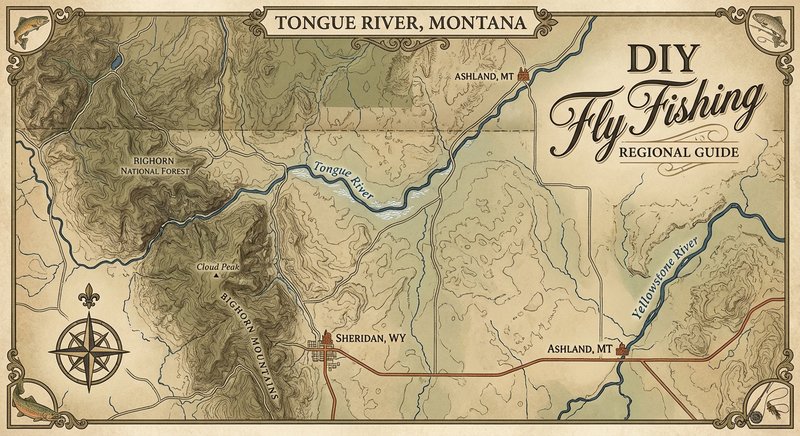
The Tongue River originates in the Bighorn Mountains of Wyoming and flows north into Montana, eventually meeting the Yellowstone River at Miles City. The character of the river changes significantly at the Tongue River Reservoir.
The stretch below the dam (the tailwater) and the miles leading down to the Yellowstone offer some of the best warm-water fly fishing in the state. The water is often tea-colored or turbid, characterized by deep holes, sandstone ledges, and submerged timber. It is a slow-moving, intimate river that feels prehistoric and wild.
🐟 Target Species & Behavior
Smallmouth Bass
The "Bronzebacks" are the stars here. They are exceptionally hardy and aggressive.
- Behavior: They hold near rocky outcroppings, submerged boulders, and "rip-rap" along the banks.
- Feeding: They focus on crayfish and emerald shiners. In the summer, they become highly opportunistic, looking toward the surface for terrestrial insects and frogs.
Walleye & Sauger
Often considered "fly rod unicorns," the Tongue has a healthy population, especially below the dam.
- Behavior: They are light-sensitive. During the day, they sit in deep, dark holes or under cutbanks. In the evening, they move to the heads of pools to hunt.
- Feeding: Almost exclusively piscivorous (fish-eaters). They want high-protein meals like fathead minnows and shiners.
Channel Catfish
The Tongue River holds massive cats that are surprisingly sporting on a fly rod.
- Behavior: They congregate in deep, slow-moving bends with woody debris ("snags").
- Feeding: While they use scent, they are active predators. They will crush a large, dark streamer swung deep through a hole.
📅 Best Times to Fish
Summer (July – August)
This is prime time for Smallmouth Bass.
- Conditions: Water levels stabilize after spring runoff. The water warms, spiking the metabolism of the bass.
- Time of Day: Early morning and late evening for topwater action. Mid-day is best for dredging deep with crayfish patterns.
Fall (September – October)
The best window for Walleye and Trophy Smallmouth.
- Conditions: As water temperatures drop, fish begin a feeding frenzy to prepare for winter. The river usually clears up, improving visibility.
- Time of Day: Walleye action peaks at "Golden Hour"—the 30 minutes before and after sunset.
🪰 Recommended Flies & Techniques
For Smallmouth Bass
- Topwater: BoogleBugs or Clouser Sandbar Podoppers in yellow, olive, or black. Pop them near the sandstone faces.
- Sub-surface: Near nuff Crawfish (Size 2-6) or Clouser Minnows (Chartreuse/White).
- Technique: Use a 6-weight rod with a weight-forward floating line. Cast tight to the structure and use erratic strips.
For Walleye
- Patterns: Game Changers or Bunny Leech patterns in white, silver, or "firetiger" colors.
- Technique: You must get deep. Use a 7-weight rod with a 200-250 grain sinking tip. Strip slowly and stay close to the bottom. If you aren't ticking the rocks, you aren't in the zone.
For Channel Catfish
- Patterns: Large, black Woolly Buggers or JJ Specials.
- Technique: "Dredging." Cast upstream of a deep hole, let the fly sink to the abyss, and use a slow, rhythmic strip.
💡 Pro Tips & Local Knowledge
- Focus on the "Tailwater": The first few miles below the Tongue River Dam (near Decker, MT) offer more consistent water temperatures and higher fish concentrations.
- The "Yellowstone Confluence": The area where the Tongue meets the Yellowstone near Miles City is a migratory corridor. Big fish move up into the Tongue from the Yellowstone in the fall.
- Read the Sandstone: In this river, rock is king. Any place where a sandstone bluff enters the water creates a "ledge" habitat. Bass will stack up vertically along these walls.
- The "Slow Move": Unlike trout fishing where you might move fast, the Tongue rewards the patient angler. Thoroughly fish every inch of a deep woody snag; the biggest catfish and walleye are often buried deep in the timber.
⚠️ Important Information
Access
- Limited Public Access: Much of the land surrounding the Tongue is private ranch land. Use the Montana FWP Fishing Access Sites (FAS) such as Twelve Mile Dam and T&Y Dam.
- Boating: A canoe, kayak, or small jet boat is ideal. Many stretches are too shallow or snag-heavy for traditional drift boats.
Regulations & Permits
- License: A valid Montana fishing license and Conservation License are required.
- Limits: Check the current Region 7 Montana Fish, Wildlife & Parks regulations, as bag limits for Walleye and Bass can change seasonally.
Special Considerations
- Rattlesnakes: The Tongue River breaks are prime Prairie Rattlesnake habitat. Watch your step when hiking to the water.
- Mud: "Montana Gumbo" is real. If it rains, the dirt roads leading to the river become impassable even for 4x4 vehicles. Check the weather religiously.
Bug Hatches & Matching Flies
| Hatch | Type | Peak months | Time of day | Hook sizes | Matching flies |
|---|---|---|---|---|---|
| Midges Chironomidae | midge | March, April, October | Late Morning | #18-24 | Zebra Midge #18-22, Griffith's Gnat #20-22, Morgan's Midge #20-24 |
| Blue Winged Olive Baetis | mayfly | April, May, September, October | Afternoon | #18-22 | Parachute Adams #18-22, RS2 #20-22, Pheasant Tail #18-20 |
| Mother's Day Caddis Brachycentrus occidentalis | caddis | May | Afternoon/Evening | #14-16 | Elk Hair Caddis #14-16, Peacock Caddis #16, LaFontaine's Deep Pupa #14-16 |
| Pale Morning Dun Ephemerella invaria | mayfly | June, July | Morning | #16-18 | Sparkle Dun #16-18, PMD Emerger #16-18, Split Case PMD #16 |
| Yellow Sally Isoperla | stonefly | June, July | Afternoon/Evening | #14-16 | Yellow Stimulator #14-16, Little Yellow Sloan #14-16 |
| Trico Tricorythodes | mayfly | August, September | Early Morning | #20-24 | Trico Spinner #20-24, Sunray Trico #22 |
| Grasshoppers Acrididae | terrestrial | August, September | Mid-day/Afternoon | #8-12 | Chubby Chernobyl #8-12, Morrish Hopper #10-12, Joe's Hopper #10-14 |
| Spotted Sedge Hydropsyche | caddis | July, August | Evening | #14-18 | X-Caddis #16-18, Holy Grail Caddis #14-16 |
| Craneflies Tipulidae | terrestrial | August | Afternoon | #10-14 | Daddy Long Legs #10-12, Golly Whopper #12 |