Trinity River
Fly fishing in California · Intermediate · Best seasons: Fall, Winter, Spring
Target Species
Steelhead, Chinook Salmon, Rainbow Trout
About This Water
Northern California steelhead and salmon fishery. Excellent fly water in scenic canyon.
Fishing Recommendations
Welcome to the Trinity River, one of the crown jewels of Northern California fly fishing. As your guide, I can tell you that the Trinity is arguably the most consistent steelhead producer in the state. Flowing from the Trinity Alps through rugged canyons, it offers a classic "steelheading" experience with the added benefit of being a tailwater fishery, which keeps water temperatures stable when other coastal rivers are blown out or too warm.
🎣 Location Overview
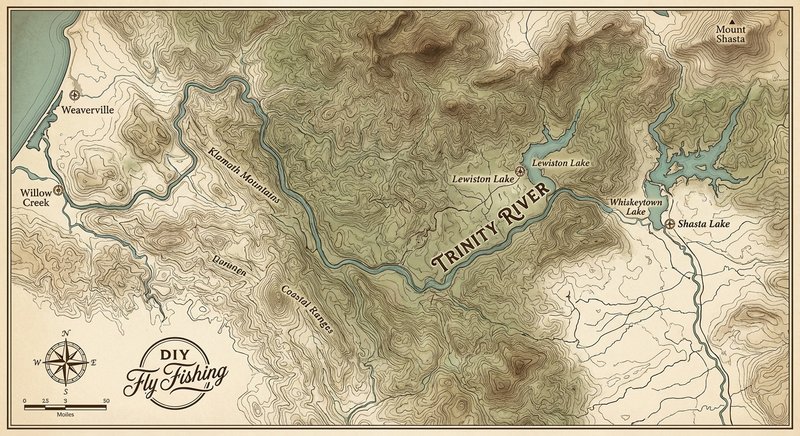
The Trinity River is a major tributary of the Klamath River. The most popular fly fishing section is the "Upper Trinity," stretching from the Lewiston Dam downstream to Helena.
What makes it special is its accessibility and diversity. You can find everything from wide, gravel-bottomed flats perfect for swinging a Spey rod to tight, technical pocket water ideal for indicator nymphing. Because it is a tailwater (the water is released from the bottom of Lewiston Lake), the river stays cold and clear through the summer and fall, providing a sanctuary for migrating salmonids. It is a scenic, wild river where you are as likely to see a bald eagle or a black bear as you are another angler.
🐟 Target Species & Behavior
- Steelhead (Summer/Fall & Winter Runs): These are the stars of the show.
- Half-Pounders: Smaller steelhead (12–16 inches) that return after only a few months at sea. They are aggressive and travel in schools.
- Adults: Ranging from 4 to 12+ lbs. They hold in "seams" where fast water meets slow water, and in the "tailouts" of pools during low light.
- Chinook Salmon (King Salmon): Arriving in the fall (Sept–Nov), these giants can exceed 30 lbs. While fly anglers often target them, they are more important for the "egg bite" they create, which feeds the trout and steelhead behind them.
- Resident Rainbow Trout: Found primarily in the upper 10 miles below the dam. They behave like classic tailwater trout, feeding on midges and mayflies year-round.
📅 Best Times to Fish
- Fall (September – November): Peak Season. This is the "Trinity Trifecta" time. The weather is beautiful, the Chinook are spawning, and the steelhead are moving in high numbers.
- Winter (December – February): This is for the hardy angler. The crowds disappear, and the largest "winter-run" steelhead enter the system. The fishing is slower, but the fish are often much bigger.
- Spring (March – April): "Downrunners" or kelts (fish that have spawned and are heading back to the ocean) are hungry and aggressive. It can be very productive for those looking for high numbers of strikes.
- Best Time of Day: During the fall, the "Golden Hour" (first and last light) is best for swinging flies. During winter, wait for the water to warm slightly—10:00 AM to 3:00 PM is often the sweet spot.
🪰 Recommended Flies & Techniques
1. Indicator Nymphing (Most Productive)
This is the most effective way to put fish in the net on the Trinity.
- Technique: Use a 9ft 7wt or 8wt rod with a floating line and a large indicator. You need to get your flies deep and fast.
- Flies:
- Rubber Legs (Stonefly nymphs): Size 4–8 in black or brown.
- Glo-Bugs / Beads: Size 8–10 in "Oregon Cheese," "Pink," or "Roe." Essential when salmon are present.
- Psycho Prince: Size 12–16.
- Copper Johns: Size 14 (Red or Blue).
2. Swinging (Spey or Switch)
For the purist, there is nothing like the "tug" of a steelhead on a swung fly.
- Technique: Use a 6wt or 7wt Spey rod with a Skagit head and various T-series sink tips.
- Flies:
- Intruders: Pink/Purple or Black/Blue.
- Hoh Bo Spey: Pink or Orange.
- Zirdles: A combination of a Zonker and a Rubber Leg Stonefly.
3. Streamer Stripping
Often overlooked, but effective in the lower river for aggressive "Half-Pounders."
- Flies: Black Leeches or Olive Wooly Buggers.
💡 Pro Tips & Local Knowledge
- The "Egg Bite": In October and November, find a salmon "redd" (nest). Do not fish directly on the salmon, but fish the deeper slot 10–20 feet behind them. Steelhead sit there eating the loose eggs drifting downstream.
- Stealth Matters: The Trinity can be very clear. If you’re wading, move slowly. Long leaders (10–12 feet) can help prevent spooking fish in the shallower tailouts.
- Watch the Tributaries: After a heavy rain, tributaries like Canyon Creek or the North Fork can "blow out" (become muddy). If this happens, move upstream above those confluences to find clear water.
- The "Trinity Twitch": When nymphing, give your rod tip a tiny jiggle every few feet of the drift. Sometimes that slight movement of a rubber-legged fly triggers a strike from a stagnant fish.
⚠️ Important Information
- Regulations: The Trinity has very specific rules.
- Barbless hooks only.
- Steelhead Report Card: You must have a California Steelhead Report Card in your possession and fill it out immediately upon catching a fish.
- Hatchery vs. Wild: You may keep hatchery fish (clipped adipose fin), but Wild fish (intact adipose fin) must be released immediately.
- Access: There are many public access points (Bureau of Land Management and Forest Service). Popular spots include the Old Weir, Douglas City, and Steel Bridge.
- Safety: The Trinity is a "drift boat" river. If you are wading, be careful; the rocks are notoriously slick. Studded boots and a wading staff are highly recommended.
Guide’s Final Word: The Trinity is a river of patience. You might go four hours without a bump and then have the most explosive 20 minutes of your life. Keep your fly in the water, stay warm, and enjoy the scenery of the Trinity Alps!
Bug Hatches & Matching Flies
| Hatch | Type | Peak months | Time of day | Hook sizes | Matching flies |
|---|---|---|---|---|---|
| October Caddis Dicosmoecus gilvipes | caddis | September, October, November | All day/Evening | #8-12 | Morrish Adult October Caddis #8-10, Pupa-tator #10-12, Pecka's October Caddis #10 |
| Blue Winged Olive Baetis spp. | mayfly | March, April, October, November | Late morning/Afternoon | #18-22 | RS2 #20-22, Sparkle Dun #18-20, Pheasant Tail Nymph #18-22 |
| Golden Stonefly Calineuria californica | stonefly | June, July | All day/Late Evening | #6-10 | Pats Rubber Legs #6-10, Chubby Chernobyl (Gold) #8-10, Golden Rogue Stone #8 |
| Mother's Day Caddis Brachycentrus occidentalis | caddis | April, May | Afternoon/Evening | #14-16 | Peacock Caddis #14-16, Deep Sparkle Pupa #14-16, Holy Grail #14-16 |
| Pale Morning Dun Ephemerella dorothea infrequens | mayfly | June, July, August | Morning/Mid-day | #16-18 | PMD Quigley Cripple #16-18, Hacklestacker PMD #16-18, Military Mayfly #16-18 |
| Salmonfly Pteronarcys californica | stonefly | May, June | Afternoon/Evening | #4-8 | Clark's Stone #6-8, Kaufmann's Stone #4-8, Fluttering Salmonfly #6 |
| Midges Chironomidae | midge | December, January, February | Morning/Late Afternoon | #18-24 | Zebra Midge #18-22, Griffith's Gnat #20-24, Mercury Midge #20-22 |
| Yellow Sally Isoperla spp. | stonefly | June, July, August | Late Afternoon/Evening | #14-16 | Little Yellow Sloan #14-16, Yellow Sally Nymph #14-16, Stimulator (Yellow) #14-16 |
| Little Black Stonefly Capniidae | stonefly | February, March | Mid-day | #16-18 | Prince Nymph #16-18, Little Black Sloan #16-18, Copper John (Black) #16-18 |