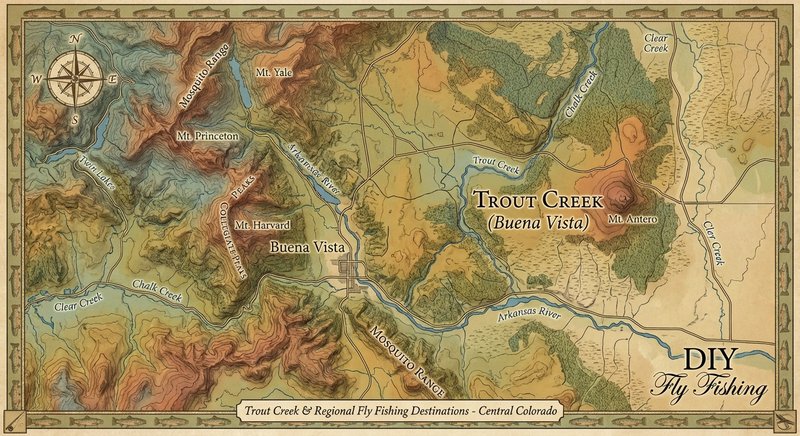
Trout Creek (Buena Vista)
Fly fishing in Colorado · Beginner · Best seasons: Summer, Fall
Target Species
Brown Trout
About This Water
Near Buena Vista with wild brown trout. Scenic fishing in the Arkansas Valley.
Fishing Recommendations
Welcome to the heart of the Rockies. As a guide in the Arkansas River Valley, I often see anglers rush past Trout Creek in their hurry to hit the big water of the "Ark." That is their mistake and your opportunity.
Trout Creek is a quintessential high-country tributary that flows from the heights of South Park down through a rugged canyon before joining the Arkansas River near Johnson Village. It is a technical, intimate, and highly rewarding fishery for those who appreciate wild fish in a stunning setting.
🎣 Location Overview
Trout Creek is a tale of two waters. The upper reaches meander through high-altitude meadows and willow carrs, offering classic "S-curve" meadow fishing. As it nears Buena Vista, the gradient increases, and the creek transforms into a pocket-water paradise filled with granite boulders, plunge pools, and tight overhead canopy.
What makes it special is the solitude and the wildness. While the Arkansas River can feel crowded during the soup-bowl hatches, Trout Creek offers a "blue-line" experience where you can spend an entire day picking apart pockets without seeing another soul. The water is crystal clear and remains cooler than the main stem Arkansas during the heat of July, making it a vital refuge for trout.
🐟 Target Species & Behavior
The dominant resident here is the Wild Brown Trout. You will also find the occasional opportunistic Rainbow or a stray Cutthroat in the higher elevations.
- Behavior: These are wild, spooky fish. They aren't "trophy" sized in the traditional sense (expect 8–14 inches), but they fight with incredible tenacity.
- Holding Patterns: In the meadow sections, they hug the undercut banks and deep outside bends. In the canyon sections, they sit in the "soft" water behind boulders or right in the foam lines of plunge pools.
- Feeding: They are highly opportunistic. Because it is a smaller system with less biomass than a tailwater, these fish are "lookers"—if a fly looks like food and is presented naturally, they will usually move for it.
📅 Best Times to Fish
Optimal Seasons: Summer & Fall
- Summer (Late June – August): This is the prime window. Once the spring runoff subsides (usually mid-June), the dry fly fishing becomes world-class.
- Fall (September – October): This is "Guide’s Choice." The Brown Trout become aggressive as they prepare to spawn. The water levels drop, the aspens turn gold, and the fish lose some of their wariness to bulk up for winter.
Best Times of Day
- Summer: Morning (8:00 AM – 11:00 AM) and Late Evening. Mid-day can be tough if the sun is high and the water is low.
- Fall: Mid-day (11:00 AM – 3:00 PM). The water needs to warm up a few degrees to get the bugs moving.
🪰 Recommended Flies & Techniques
Top Fly Patterns
- Dry Flies:
- Chubby Chernobyl (Size 12-14): Perfect for the "Hopper-Dropper" rig.
- Parachute Adams (Size 16-18): The ultimate searcher pattern here.
- Elk Hair Caddis (Size 14-16): Great for the evening rise.
- Hippie Stomper: High visibility and floats forever in turbulent water.
- Nymphs:
- Pheasant Tail (Size 16-18): A staple for the picky meadow fish.
- Perdigon (Size 16-18): Heavy and slim to get down fast in the plunge pools.
- Pats Rubber Legs (Size 12): For the deeper holes in the canyon.
- Streamers:
- Wooly Bugger (Olive or Black, Size 10): Swing these through deep bends in the fall.
Techniques & Presentation
- The "High Stick": In the canyon sections, use a short line. Keep as much fly line off the water as possible to avoid the complex micro-currents that cause drag.
- Hopper-Dropper: This is the most effective way to fish Trout Creek. Use a buoyant dry fly with a small unweighted nymph dropped 18 inches below.
- Stealth is Key: Wear earthy colors. In the meadow sections, stay 10 feet back from the bank and cast from a kneeling position. If you can see the fish, they have already seen you.
💡 Pro Tips & Local Knowledge
- The "Shadow Cast": Trout Creek is heavily lined with willows and brush. Use a "Bow-and-Arrow" cast to get your fly under overhanging branches where the biggest Browns hide.
- Focus on the Confluence: The area where Trout Creek enters the Arkansas River is a "honey hole" in the fall. Big Browns move out of the river and into the mouth of the creek to stage for spawning.
- Light Gear: Leave the 6-weight at home. A 7.5 to 8.5-foot 3-weight or 4-weight rod is the perfect tool for this water. It allows for delicate presentations and makes a 12-inch Brown feel like a monster.
- The "One-Cast" Rule: In small water, your first cast is your best chance. Don't "practice" your cast over the fish; pick your spot and make it count.
⚠️ Important Information
Access
- USFS Lands: Much of the upper creek runs through San Isabel National Forest. Access is generally good along Highway 24 and Highway 285.
- State Wildlife Areas (SWA): Look for the Chubb’s Park area. It offers excellent meadow fishing.
- Private Property: Be extremely careful. Many sections of Trout Creek are privately owned ranch lands. Always look for "Post" signs and stay within the high-water marks where public access is permitted.
Regulations & Permits
- License: A valid Colorado Fishing License is required.
- Regulations: Generally follows standard Colorado CPW mountain stream regulations (8 fish limit), but most local anglers and guides practice 100% Catch and Release here to preserve the wild population.
- SWA Permit: If you access the creek through a State Wildlife Area, ensure you have a valid hunting or fishing license (required for entry even if not fishing).
Special Considerations
- Wildlife: This is prime Mountain Lion and Black Bear country. Carry bear spray and stay alert.
- Flash Floods: During the Summer monsoon season (July/August), keep an eye on the sky. The canyon sections can rise rapidly during heavy afternoon downpours.
Guide’s Final Word: Trout Creek rewards the patient angler. Slow down, observe the water, and enjoy the intimacy of a creek that most people only see through a car window at 60 mph. Tight lines!
Bug Hatches & Matching Flies
| Hatch | Type | Peak months | Time of day | Hook sizes | Matching flies |
|---|---|---|---|---|---|
| Midges Chironomidae | midge | March, April, October, November | All day | #18-24 | Zebra Midge #18-22, Griffith's Gnat #20-22, Top Secret Midge #20-24 |
| Blue Winged Olives (BWO) Baetis spp. | mayfly | April, May, September, October | Late Morning/Afternoon | #18-22 | RS2 #20-22, Parachute Adams #18-22, Pheasant Tail #18-20 |
| Mother's Day Caddis Brachycentrus occidentalis | caddis | May | Afternoon/Evening | #14-16 | Peacock Caddis #14-16, Cased Caddis Larva #14-16, LaFontaine's Deep Sparkle Pupa #16 |
| Pale Morning Dun (PMD) Ephemerella excrucians | mayfly | July, August | Morning/Early Afternoon | #16-18 | PMD Sparkle Dun #16-18, Frenchie #16-18, Split Case PMD #16-18 |
| Golden Stonefly Hesperoperla pacifica | stonefly | June, July | All day | #8-12 | Pat's Rubber Leg #8-12, Chubby Chernobyl #10-12, Golden Twenty Incher #10-14 |
| Yellow Sally Isoperla spp. | stonefly | July, August | Late Afternoon/Evening | #14-16 | Yellow Sally Stimulator #14-16, Iron Sally #14-16, Micro Mayfly (Yellow) #16 |
| Tricos Tricorythodes spp. | mayfly | August, September | Early Morning | #20-24 | Trico Spinner #20-24, Sunken Trico Spinner #22, Trico Parachute #20-22 |
| Terrestrials Various | terrestrial | August, September | Late Morning/Afternoon | #10-18 | Parachute Hopper #10-14, Cinnamon Ant #16-18, Black Beetle #14-16 |
| Spotted Sedge Hydropsyche spp. | caddis | July, August, September | Evening | #14-18 | Elk Hair Caddis #14-18, Holy Grail #16-18, Goddard Caddis #14-16 |