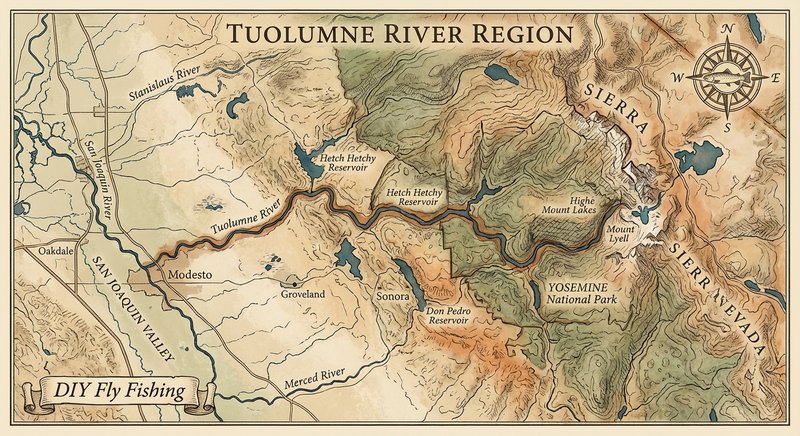
Tuolumne River
Fly fishing in California · Intermediate · Best seasons: Spring, Summer, Fall
Target Species
Rainbow Trout, Brown Trout
About This Water
Below Don Pedro Reservoir with rainbow and brown trout. Scenic canyon fishing.
Fishing Recommendations
Welcome to the "T," one of the most rugged, beautiful, and rewarding fly fishing destinations in the Sierra Nevada. As a Wild and Scenic River, the Tuolumne offers a diverse experience ranging from the gentle meanders of high-elevation meadows to the thundering whitewater of deep granite canyons.
Here is your comprehensive guide to fly fishing the Tuolumne River.
🎣 Location Overview
The Tuolumne River is a jewel of the Central Sierra. For the fly angler, it is primarily divided into two distinct personalities:
- Tuolumne Meadows (Yosemite National Park): High-altitude (8,600 ft), meandering meadow water. It is classic "dry fly" territory where the river winds through granite flats.
- The Main Stem & Canyons: Below Hetch Hetchy and down through the "Early Intake" toward Lumsden. This is rugged, "pocket water" fishing. The terrain is steep, the rocks are slick, and the fish are opportunistic.
What makes it special is the solitude. Once you hike a mile away from the road in the Grand Canyon of the Tuolumne or the Lumsden area, you are in true wilderness fishing for wild, hard-fighting trout in crystal-clear water.
🐟 Target Species & Behavior
- Rainbow Trout: These are the primary residents. In the faster canyon water, they are incredibly strong for their size. They hold in the "cushion" in front of boulders, in the seams of fast chutes, and at the tails of deep pools.
- Brown Trout: Found more frequently in the deeper pools of the lower sections and the undercut banks of Tuolumne Meadows. They are stealthy and often require a precise streamer or large terrestrial to coax out.
- Behavior: Because the growing season is short (especially in the high country), these fish are generally aggressive. However, in the slow water of the Meadows, they can be extremely "technical" and leader-shy.
📅 Best Times to Fish
Optimal Seasons
- Spring (Late May – June): This is tricky due to snowmelt. In high runoff years, the river is dangerous and unfishable. However, as the "freshet" drops, the Salmonfly hatch occurs on the lower sections (near Lumsden), providing some of the best dry-fly fishing of the year.
- Summer (July – August): The prime window for Tuolumne Meadows. As the meadows dry out, the mosquitoes fade and the grasshoppers move in. This is the peak time for dry fly action.
- Fall (September – October): My personal favorite. Water levels are low and stable. The Brown trout begin to move and become more aggressive before spawning. The air is crisp, and the crowds in Yosemite vanish.
Best Times of Day
- Mid-Summer: Morning (until 11 AM) and "Golden Hour" (the last 90 minutes of light) are most productive.
- Fall: The water needs to warm up. 10 AM to 4 PM is the sweet spot.
🪰 Recommended Flies & Techniques
Top Fly Patterns
- Dries:
- Hoppers: Parachute Hopper (size 8-12), Dave’s Hopper.
- Attractors: Royal Wulff, Stimulator (Orange or Yellow), Humpty.
- Caddis/Mayflies: Elk Hair Caddis (Tan/Olive), Parachute Adams (14-18), Quigley Cripples.
- Big Wood: Rogue River Stone or Sofa Pillow (during the Salmonfly/Golden Stone hatch).
- Nymphs:
- Pheasant Tail (14-18), Copper John (Red/Silver), Prince Nymph, and Golden Stonefly patterns (size 8-10).
- Streamers:
- Woolly Buggers (Olive or Black), Muddler Minnows.
Effective Techniques
- High-Stick Nymphing: In the canyon sections, use a heavy stonefly nymph with a smaller dropper. Keep your line off the water to avoid the complex currents.
- Hopper-Dropper: This is the "bread and butter" on the Tuolumne. A buoyant foam hopper with a 2-foot dropper to a Pheasant Tail or Zebra Midge works wonders in pocket water.
- The "Stealth" Approach (Meadows): In the slow meadow water, stay low. Crawl on your knees if you have to. Long leaders (9-12ft) and 5x or 6x tippet are mandatory here.
💡 Pro Tips & Local Knowledge
- Read the "Bubble Line": In the fast water of the canyons, 90% of the fish are in 10% of the water. Look for the foam lines; that is the conveyor belt of food.
- The Lumsden Stretch: If fishing outside the Park, the stretch near Lumsden Bridge is legendary but the road is notoriously rough. A high-clearance vehicle is highly recommended.
- The "Hike-to-Fish" Ratio: The further you walk, the better the fishing. If you are willing to hike 3+ miles into the Grand Canyon of the Tuolumne from Glen Aulin, you will find fish that rarely see a fly.
- Granite is Slippery: The rocks here are "Sierra Ice." Wear felt soles or studs, and use a wading staff. A fall in these canyons can be serious.
⚠️ Important Information
Access
- Tuolumne Meadows: Accessed via Tioga Road (Hwy 120). Note that this road closes in winter (usually Nov–May).
- Lower Sections: Accessed via Cherry Oil Road or Lumsden Road near Groveland.
Regulations & Permits
- National Park: If fishing inside Yosemite, you must follow NPS regulations. No lead weights, no bait, and barbless hooks are highly encouraged. A California fishing license is required even inside the Park.
- Wild Trout Sections: Parts of the Tuolumne have special "Catch and Release" or restricted limit regulations. Always check the current California Department of Fish and Wildlife (CDFW) regulations for "District: Sierra" before casting.
- Wilderness Permits: If you plan on overnighting in the canyon to fish, you must obtain a wilderness permit from Yosemite National Park or the Stanislaus National Forest.
Safety
- Bears: This is active Black Bear country. Use bear-proof canisters for food and never leave a cooler in your car at the trailhead.
- Water Levels: Always check the "Tuolumne River below Early Intake" flow gauges. Flows above 800-1,000 cfs make wading very difficult and dangerous in the canyon.
Bug Hatches & Matching Flies
| Hatch | Type | Peak months | Time of day | Hook sizes | Matching flies |
|---|---|---|---|---|---|
| Blue-Winged Olive Baetis | mayfly | March, April, September, October | Late Morning/Afternoon | #18-22 | RS2 #18-22, Parachute Adams #18-22, Pheasant Tail #18-20 |
| Golden Stonefly Calineuria californica | stonefly | June, July | Morning/Evening | #6-10 | Kaufmann's Stone #6-10, Rogue River Stone #8-10, Pats Rubber Legs #8-12 |
| Pale Morning Dun Ephemerella excrucians | mayfly | June, July, August | Late Morning/Early Afternoon | #14-18 | Sparkle Dun #16-18, Split Case PMD #14-16, PMD Cripple #16-18 |
| Green Drake Drunella doddsii | mayfly | July, August | Afternoon/Evening | #10-12 | Humpy (Green) #10-12, Quigley Cripple #10-12, Hare's Ear #10-12 |
| Spotted Sedge Hydropsyche | caddis | June, July, August, September | Evening | #14-18 | Elk Hair Caddis #14-18, LaFontaine's Deep Sparkle Pupa #14-16, Goddard Caddis #14-16 |
| Little Yellow Sally Isoperla | stonefly | June, July | Afternoon/Evening | #14-16 | Yellow Sally Stimulator #14-16, Mercer's Poxyback Sally #14-16, Crystal Meth Stone #14-16 |
| Salmonfly Pteronarcys californica | stonefly | May, June | All Day | #4-8 | Chubby Chernobyl #6-10, Bitch Creek Nymph #4-8, Clark's Stone #6-8 |
| Grasshoppers Acrididae | terrestrial | August, September | Late Morning/Afternoon | #8-12 | Dave's Hopper #8-12, Parachute Hopper #10-12, Morrish Hopper #8-12 |
| Black Carpenter Ants Camponotus | terrestrial | July, August | All Day | #12-16 | Chernobyl Ant #12-14, Fur Ant #14-16, Transparant #14-16 |