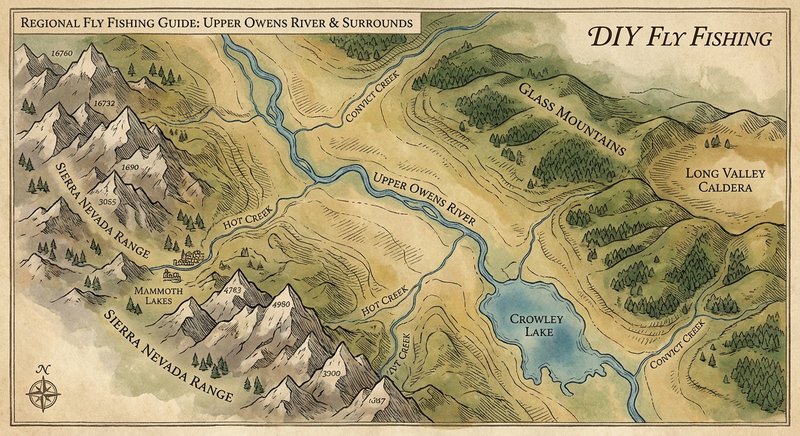
Upper Owens River
Fly fishing in California · Intermediate · Best seasons: Summer, Fall
Target Species
Brown Trout, Rainbow Trout
About This Water
A meadow stream in the Long Valley area. Technical fishing for wild brown and rainbow trout.
Fishing Recommendations
🎣 Upper Owens River, California: A Fly Fishing Guide
The Upper Owens River is a legendary "spring creek style" fishery located in the High Sierra, just north of Mammoth Lakes. Meandering through a vast, treeless meadow beneath the towering peaks of the Minarets and Mt. Morrison, it offers some of the most scenic and technically rewarding fishing in the West.
🎣 Location Overview
The Upper Owens is a classic meadow stream characterized by deep undercut banks, tight oxbow bends, and glassy glides.
- What makes it special: Unlike the turbulent freestone rivers nearby, the Upper Owens is gentle and slow-moving. It acts as a primary spawning tributary for the massive fish living in Lake Crowley.
- Water Characteristics: It is cold, alkaline, and nutrient-rich, supporting a massive biomass of insects. The bottom is mostly pumice and gravel.
- Why Anglers Love It: It offers the chance to catch a "fish of a lifetime" in a relatively small, intimate stream. It is one of the few places in California where you can sight-fish to 20-plus-inch trout in water barely three feet deep.
🐟 Target Species & Behavior
The Upper Owens holds a mix of resident fish and migratory "lake-run" fish.
- Resident Rainbow & Brown Trout: These fish stay in the river year-round. They are typically 8–14 inches, brilliantly colored, and very "buggy." They hold in the riffles and along the edges of weed beds.
- Lake-Run Rainbows (Spring/Early Summer): Massive rainbows move up from Crowley Lake to spawn.
- Lake-Run Browns (Fall/Winter): Huge, aggressive predatory Brown Trout migrate up the river starting in late September.
- Behavior: During the summer, fish are opportunistic, feeding on heavy hatches. In the fall, they become more territorial. Because the water is clear and slow, these fish are extremely spooky. A clumsy shadow or a heavy footfall on the bank will send them scurrying.
📅 Best Times to Fish
Summer (June – August)
- Conditions: The "dry fly" season. Excellent hatches of Mayflies and Caddis.
- Time of Day: Early morning for tricos; mid-morning for PMDs; late evening for caddis.
- Window: July is peak for "match the hatch" enthusiasts.
Fall (September – November)
- Conditions: This is the season for trophy hunters. Large Brown Trout begin their migration.
- Time of Day: Mid-day as the water warms slightly. Overcast days are prime for streamer fishing.
- Window: Late October is legendary for the arrival of the "Crowley Steelhead" (large rainbows) and big Browns.
🪰 Recommended Flies & Techniques
Top Fly Patterns
- Nymphs: Zebra Midges (#18–22), Pheasant Tails (#16–20), Copper Johns (#16–18), and San Juan Worms (red or wine, especially after rain).
- Dry Flies: Parachute Adams (#16–20), Elk Hair Caddis (#16–18), Tricos (#20–22), and Hoppers (#8–12) in late summer.
- Streamers: Egg patterns (for lake-run season), Woolly Buggers (black or olive), and Sculpzilla.
Effective Techniques
- Dry-Dropper: This is the bread and butter for summer. Use a high-visibility hopper or foam attracter with a small unweighted nymph dropped 2–3 feet below.
- Indicator Nymphing: Necessary for the deep oxbow bends. Use small indicators (like New Zealand wool) to avoid spooking fish.
- The "Slow Swing": When targeting large fall Browns, swing a streamer or a large leech pattern through the deep undercuts.
Presentation Tips
- The Reach Cast: Essential to combat the micro-currents of the meanders.
- Long Leaders: Use 9–12 foot leaders tapering to 5x or 6x tippet for residents; 3x or 4x for the big lake-runs.
💡 Pro Tips & Local Knowledge
- Stay Off the Skyline: The banks are flat and the fish can see for miles. Kneel when approaching a hole and stay at least 10 feet back from the bank.
- Fish the "Bends": The biggest fish almost always sit in the deepest part of the "U" in an oxbow, tucked right under the grass overhang.
- The "Benton Crossing" Secret: Most people fish right by the bridge. If you have a high-clearance vehicle, drive further upstream or downstream. The fish get less pressure the further you walk from the parking areas.
- Watch the Wind: The Owens Valley is notoriously windy in the afternoon. If the wind picks up, switch to a heavier streamer or a "hopper-copper-dropper" rig to cut through the gusts.
⚠️ Important Information
- Access: Primarily via Benton Crossing Road off Hwy 395. There are several dirt turnouts with public access. Much of the river is on LADWP (Los Angeles Dept. of Water and Power) land, which is open to the public but has strict "no camping" rules near the water.
- Regulations:
- Above Benton Crossing Bridge: Generally open year-round, but catch and release only with barbless hooks during the winter season.
- Below the Bridge: Closely tied to the general trout season (late April to Nov 15).
- Always check the current California CDFW regulations before heading out, as they can change.
- Gear: A 9ft 5-weight rod is the perfect all-around tool. Bring polarized sunglasses—they are mandatory for spotting fish in the glare of the meadow.
- Safety: The area is high altitude (approx. 7,000ft). Hydrate often and wear heavy sunblock. Watch out for soft "sinkhole" mud near the river's edge.
Bug Hatches & Matching Flies
| Hatch | Type | Peak months | Time of day | Hook sizes | Matching flies |
|---|---|---|---|---|---|
| Midges Chironomidae | midge | January, February, March, December | All Day | #18-24 | Zebra Midge #18-22, Griffith's Gnat #20-22, Top Secret Midge #20-24 |
| Blue Winged Olive (BWO) Baetis | mayfly | March, April, October, November | Late Morning/Afternoon | #18-22 | RS2 #18-22, Parachute Adams #18-22, Pheasant Tail #18-20 |
| Spotted Sedge / Grannom Hydropsyche / Brachycentrus | caddis | May, June, July | Evening | #14-18 | Elk Hair Caddis #14-18, LaFontaine's Sparkle Pupa #16-18, Bird's Nest #14-16 |
| Pale Morning Dun (PMD) Ephemerella | mayfly | June, July, August | Morning/Early Afternoon | #16-18 | PMD Sparkle Dun #16-18, Frenchie #16-18, Mercer's Trigger Emp #16-18 |
| Trico Tricorythodes | mayfly | August, September | Early Morning | #20-24 | Trico Spinner #20-24, CDC Trico Emerger #22-24 |
| Grasshoppers Acrididae | terrestrial | July, August, September | Midday/Afternoon | #8-12 | Dave's Hopper #10-12, Chernobyl Ant #8-12, Morrish Hopper #10-12 |
| Little Yellow Stonefly Isoperla | stonefly | June, July | Morning/Evening | #14-16 | Yellow Stimulator #14-16, Iron Lotus #16 |
| Callibaetis Callibaetis | mayfly | July, August | Morning/Afternoon | #14-16 | Callibaetis Spinner #14-16, Hare's Ear #14-16 |