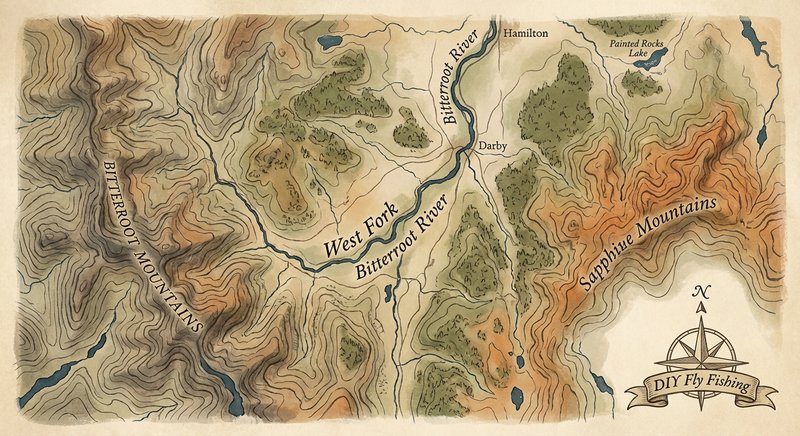
West Fork Bitterroot River
Fly fishing in Montana · Intermediate · Best seasons: Summer, Fall
Target Species
Cutthroat Trout, Bull Trout
About This Water
Remote tributary with wild cutthroat and bull trout. Wilderness fishing in the Selway-Bitterroot.
Fishing Recommendations
Welcome to the West Fork of the Bitterroot River. As a guide, I consider this one of the most reliable and scenic gems in Western Montana. While the main stem of the Bitterroot gets the fame, the West Fork offers a more intimate, rugged, and "classic Montana" feel.
Below is your comprehensive guide to fishing this spectacular freestone/tailwater hybrid.
🎣 Location Overview
The West Fork of the Bitterroot originates high in the Selway-Bitterroot Wilderness, flowing through a dramatic canyon before being impounded by the Painted Woods Dam (forming Painted Woods Reservoir). The primary fishery is the tailwater section below the dam down to its confluence with the East Fork near Connor, MT.
What makes it special is its consistency. Because the dam regulates flow and temperature, the West Fork often stays clear when other regional rivers are "blown out" by mud or spring runoff. It is characterized by boulder-strewn pocket water, deep emerald pools, and swift runs flanked by towering Ponderosa pines and granite cliffs. It is significantly smaller and more manageable for wading than the main Bitterroot.
🐟 Target Species & Behavior
Westslope Cutthroat Trout
The star of the show. These are native, stunningly colored fish with bright orange slashes under the jaw.
- Behavior: They are famously surface-oriented. Unlike pressured rainbows, a Westslope Cutthroat will often move five feet to smash a dry fly.
- Holding Water: They love foam lines, the "seams" between fast and slow water, and the quiet water behind large boulders.
Bull Trout
The "wolves" of the river. These are federally protected char that can grow to massive sizes (24+ inches).
- Behavior: They are apex predators. They don't care about bugs; they eat whitefish and smaller trout.
- Holding Water: Deep, dark holes and the tails of massive pools.
- Note: You may not intentionally target Bull Trout in the West Fork. However, you will often hook them incidentally while streamer fishing or see them "stalking" a cutthroat you are reeling in.
📅 Best Times to Fish
Summer (Late June – August)
- The Window: This is the prime time for dry fly enthusiasts. Once the "Salmonfly" hatch hits (usually late June), the river explodes.
- Conditions: High sun means terrestrials (hoppers/ants) become the main course in July and August.
- Time of Day: Early morning for nymphing; 10:00 AM to 4:00 PM for the best dry fly action.
Fall (September – October)
- The Window: My personal favorite. The crowds vanish, and the Cottonwoods turn gold.
- Conditions: Water levels are low and crystal clear. You’ll see hatches of Blue-Winged Olives (BWO) and Mahogany Duns.
- Time of Day: Mid-day is best as the water warms up slightly, triggering insect activity.
🪰 Recommended Flies & Techniques
Dry Flies (The Bread & Butter)
- Attractors: Purple Haze (Size 12-16) is a legendary Montana fly that works here year-round.
- Stoneflies: Chubby Chernobyl (Gold or Orange, Size 8-12).
- Terrestrials: Amy’s Ant, Morrish Hopper, or a simple Cinnamon Ant.
- Mayflies: Parachute Adams or Sparkle Duns for BWO hatches in the fall.
Nymphs (For the Deep Slots)
- Pat’s Rubber Legs: The go-to imitation for the Golden Stonefly nymphs that live under every rock.
- Perdigons: In silver or purple. These sink fast in the heavy West Fork currents.
- Tactics: Use a "Hopper-Dropper" rig. Hang a small nymph 2-3 feet below a large buoyant dry fly.
Streamers (For the Big Boys)
- Patterns: Sparkle Minnow (Gold), Black Wooly Bugger, or an Olive Sculpzilla.
- Technique: "Strip and Pause" through deep pools or swing them through the tail-outs of runs.
💡 Pro Tips & Local Knowledge
- The "Westslope Slash": Cutthroats often rise with a quick, aggressive splash. Beginners often "trout set" too fast and pull the fly away. Wait a split second until the fish's head goes back down before lifting the rod.
- The Canyon Section: The stretch below the dam is steep and bouldery. If you like "pocket water" fishing—short, accurate casts into small buckets—this is your heaven.
- The Lower Meadow: Closer to the confluence with the East Fork, the river slows down. Here, the fish are more selective and the wading is easier.
- Check the Gauges: The West Fork is a "working river" for irrigation. If the dam release drops suddenly, the fishing can turn off for 24 hours. Check the USGS gauges before you drive.
⚠️ Important Information
- Access: Montana has the best stream access laws in the US. You can walk the river as long as you stay below the high-water mark. There are numerous FWP (Fish, Wildlife & Parks) access sites along West Fork Road (Hwy 473).
- Regulations:
- Bull Trout: Must be released immediately without being removed from the water. Targeting them is illegal.
- Hooks: It is highly recommended to use barbless hooks to protect the fragile mouths of the native Cutthroats.
- Safety: This is Grizzly Bear country. Always carry bear spray on your person (not in your pack) and make noise if you are hiking through thick brush to get to a hole.
- Wading: The rocks here are notoriously slippery ("snot rocks"). Felt-soled boots or studs are highly recommended.
Guide’s Final Word: The West Fork isn't about catching the most fish; it’s about catching the most beautiful fish in a stunning environment. Slow down, watch the foam lines, and enjoy the scenery. Tight lines!
Bug Hatches & Matching Flies
| Hatch | Type | Peak months | Time of day | Hook sizes | Matching flies |
|---|---|---|---|---|---|
| Skwala Stonefly Skwala americana | stonefly | March, April | Late Morning/Afternoon | #8-12 | Skwala Stone #10-12, Pat's Rubber Leg #8-12, Bullet Skwala #12 |
| Blue Winged Olive Baetis tricaudatus | mayfly | April, May, September, October | Afternoon | #16-20 | Parachute Adams #16-20, RS2 #18-20, Pheasant Tail Nymph #16-20 |
| Salmonfly Pteronarcys californica | stonefly | June, July | All Day | #4-8 | Chubby Chernobyl #4-8, Cat Puke #6, Fluttering Salmonfly #6 |
| Golden Stonefly Hesperoperla pacifica | stonefly | June, July | Morning/Evening | #8-12 | Rogue River Stone #8-10, Golden Girdled Sedge #8-12, Water Walker #10 |
| Pale Morning Dun Ephemerella excrucians | mayfly | June, July, August | Morning/Afternoon | #14-18 | PMD Sparkle Dun #16-18, Split Case PMD #16-18, Parachute PMD #14-18 |
| Green Drake Drunella doddsii | mayfly | June, July | Afternoon | #10-12 | Green Drake Hairwing #10-12, Quigley Cripple #12, Drake Nymph #10-12 |
| Spotted Sedge / Tan Caddis Hydropsyche | caddis | July, August, September | Evening | #14-18 | Elk Hair Caddis #14-18, LaFontaine's Deep Pupa #14-16, X-Caddis #16 |
| Grasshoppers Acrididae | terrestrial | August, September | Late Morning/Afternoon | #8-14 | Morrish Hopper #10-12, Dave's Hopper #8-14, Pink Pookie #10-12 |
| Spruce Winged Midge / Trico Tricorythodes | mayfly | August, September | Early Morning | #20-24 | Trico Spinner #20-22, Griffith's Gnat #20-24, Zebra Midge #20-22 |