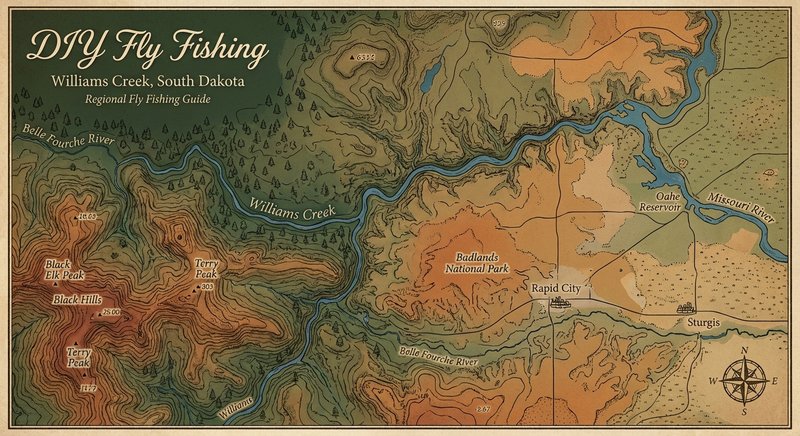
Williams Creek
Fly fishing in South Dakota · intermediate · Best seasons: spring, summer, fall
Target Species
Brown Trout
About This Water
Black Hills tributary with wild brown trout. Quality stream through forest.
Fishing Recommendations
Williams Creek is one of the Black Hills' best-kept secrets. Located in the central Black Hills of South Dakota, this tributary to the famed Rapid Creek offers a quintessential "blue-lining" experience for anglers who value solitude, wild fish, and technical small-stream tactics over trophy sizes.
🎣 Location Overview
Williams Creek is a rugged, intimate mountain stream that flows through the Black Hills National Forest before joining Rapid Creek near Silver City. What makes this water special is its wild character. Unlike the more accessible tailwaters in the region, Williams Creek is characterized by tight overhead canopies, plunge pools, and undercut banks.
The water is crystal clear and remains cold throughout the year due to heavy forest shading and spring-fed inflows. It is not a place for long, soaring casts; rather, it is a theater for "ninja fishing"—short, precise presentations in a lush, wilderness setting. Anglers love it because you can spend an entire day here and rarely see another soul.
🐟 Target Species & Behavior
The primary resident of Williams Creek is the Wild Brown Trout. You may occasionally find a wandering Brook Trout in the higher reaches, but the Browns own this water.
- Behavior: These are wild, stream-born fish. They are incredibly wary and possess an "edge-of-the-seat" spook factor. If they see your shadow or feel a heavy footfall, the pool is "done" for thirty minutes.
- Holding Patterns: Look for fish in the "pillows" in front of boulders, deep under the roots of overhanging willows, and at the very tail-outs of pools during low light.
- Feeding: They are opportunistic feeders. Because the biomass in a small creek is lower than a mainstem river, they can’t afford to be too picky—provided your presentation is natural.
📅 Best Times to Fish
Optimal Seasons
- Spring (Late April – June): This is the window for the first major hatches. As the Black Hills thaw, the fish become active. Note: June can bring some runoff, but Williams Creek clears much faster than the larger rivers.
- Summer (July – August): Prime time for dry flies and terrestrials. While other SD waters might get too warm, the canopy here keeps the water oxygenated and cool.
- Fall (September – October): Perhaps the best time. The Brown Trout begin to color up for the spawn and become more aggressive. The changing aspen leaves provide a stunning backdrop.
Best Times of Day
- Spring/Fall: 10:00 AM to 4:00 PM (when the water warms slightly).
- Summer: Dawn and dusk. The "witching hour" just before dark often brings the largest residents out from under the cut banks.
🪰 Recommended Flies & Techniques
Top Fly Patterns
- Dry Flies:
- Elk Hair Caddis (Size 14–18): The staple of the Black Hills.
- Parachute Adams (Size 16–20): For technical flat-water sections.
- Hippie Stomper or Amy’s Ant (Size 12–14): High-floating terrestrials that act as great indicators.
- Nymphs:
- Bead-head Pheasant Tail (Size 16–18): Mimics the natural mayfly nymphs.
- Zebra Midge (Size 18–22): Essential for the slower, deeper pools.
- Streamers:
- Small Olive Wooly Bugger (Size 10–12): Strip these through the deeper plunge pools.
Effective Techniques
- The "Bow and Arrow" Cast: Due to the thick brush, this is often the only way to get a fly into a pocket.
- Dry-Dropper: This is the most effective way to cover Williams Creek. Use a buoyant dry fly with a small unweighted nymph dropped 12–18 inches below it.
- High-Sticking: Minimal fly line on the water to prevent drag caused by the complex micro-currents of the creek.
💡 Pro Tips & Local Knowledge
- Gear Selection: Leave the 9-foot 5-weight at home. The ideal tool is a 7-foot to 8-foot 3-weight rod. A shorter rod allows you to maneuver under the branches.
- Stealth is Everything: Wear drab colors (earth tones) to blend into the forest. Approach every pool from downstream, staying low—even crawling on your knees if necessary.
- Hike In: The further you get from the access points near the confluence with Rapid Creek, the better the fishing becomes. The fish in the upper reaches see very little pressure.
- The "One Cast" Rule: In these small pools, your first cast is your best (and often only) chance. Make sure your leader is straightened and your fly is dry before you fire.
⚠️ Important Information
- Access: Much of the creek is within the Black Hills National Forest, meaning public access is excellent. However, always carry a GPS or map (like OnX) to ensure you aren't wandering onto private mining claims or residential pockets near Silver City.
- Regulations: A South Dakota fishing license is required. Be sure to check the current SD Game, Fish & Parks (GFP) handbook, as regulations on tackle (barbless hooks, etc.) can vary by specific management area.
- Safety: This is mountain lion and northern timber rattlesnake country. While encounters are rare, keep your eyes open.
- Wading: The creek is small enough that you'll spend as much time walking the bank as you will in the water. Sturdy wading boots with felt or high-traction rubber are a must, as the rocks can be incredibly slick.
Guide’s Final Word: Williams Creek isn't about the "grip and grin" photo with a 20-inch trout. It’s about the art of the stalk and the beauty of a wild 10-inch Brown Trout that looks like it was painted with jewels. Respect the water, and it will reward you.
Bug Hatches & Matching Flies
| Hatch | Type | Peak months | Time of day | Hook sizes | Matching flies |
|---|---|---|---|---|---|
| Blue-Winged Olive Baetis | mayfly | April, May, September, October | Late Morning/Afternoon | #18-22 | Parachute Adams #18-22, RS2 #20-22, Pheasant Tail #18-22 |
| Grannom Caddis Brachycentrus | caddis | April, May | All Day | #14-16 | Elk Hair Caddis #14-16, Peacock Caddis #14-16, Deep Sparkle Pupa #14-16 |
| Pale Morning Dun Ephemerella excrucians | mayfly | June, July | Morning/Early Afternoon | #16-18 | PMD Sparkle Dun #16-18, Split Case PMD #16-18, Quill Gordon #16 |
| Yellow Sally Isoperla | stonefly | June, July | Afternoon/Evening | #14-16 | Yellow Sally Stone #14-16, Iron Lotus #16, Stimulator #14-16 |
| Trico Tricorythodes | mayfly | July, August, September | Early Morning | #20-24 | Trico Spinner #20-24, Drowned Trico #20-22 |
| Little Black Stonefly Capniidae | stonefly | February, March | Mid-day | #16-20 | Black Zebra Midge #18-20, Black Stimulator #18 |
| Grasshoppers Orthoptera | terrestrial | August, September | All Day | #10-14 | Fat Albert #10-12, Parachute Hopper #12-14 |
| Cinnamon Ant Formicidae | terrestrial | July, August | All Day | #16-20 | Cinnamon Ant #16-18, Transparant #18-20 |
| Midges Chironomidae | midge | January, February, March, November, December | All Day | #20-26 | Zebra Midge #20-24, Griffith's Gnat #20-22 |