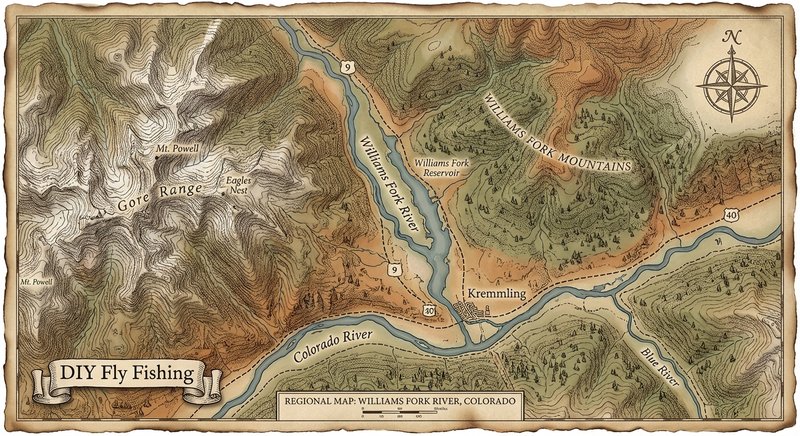
Williams Fork River
Fly fishing in Colorado · Intermediate · Best seasons: Summer, Fall
Target Species
Rainbow Trout, Brown Trout
About This Water
Below Williams Fork Reservoir offers excellent tailwater fishing. Less crowded alternative to more famous waters.
Fishing Recommendations
The Williams Fork River is one of Colorado’s best-kept secrets. While the nearby Blue and Colorado Rivers draw the massive crowds, "The Fork" offers a more intimate, technical, and rewarding tailwater experience for the discerning angler. Located in Grand County near the town of Parshall, this river is a classic Colorado gem that rewards stealth and precision.
🎣 Location Overview
The Williams Fork is a bottom-release tailwater flowing from the Williams Fork Reservoir into the Colorado River. It is characterized by two distinct personalities: the rugged, willow-choked canyon section immediately below the dam and the meandering, meadow-style water as it approaches the confluence with the Colorado.
What makes it special is the cold, consistent water temperature provided by the dam, which keeps trout active even during the heat of mid-summer. It is a "technical" river; the trout are savvy, the willows are thick, and the wading can be tricky. Anglers love it because it offers a "hike-in" feel with a high density of fish, often without the drift-boat traffic found on larger western rivers.
🐟 Target Species & Behavior
The river is primarily a Brown and Rainbow Trout fishery.
- Brown Trout: These are the residents. They are notorious for hiding under the deeply undercut banks and beneath overhanging willows. In the fall, large lake-run Browns often move up from the Colorado River, providing a chance at a trophy.
- Rainbow Trout: Found mostly in the riffles and at the heads of deep pools. They are hard-fighting and lean, often feeding heavily on the prolific midge and mayfly hatches.
- Behavior: These are tailwater fish. They are "PhD educated" and have excellent eyesight. They will often hold in surprisingly shallow water near the banks to avoid the main current, moving into the deeper "buckets" only when pressured or during the heat of the day.
📅 Best Times to Fish
Optimal Seasons
- Summer (July – August): This is prime time for dry fly action. As the surrounding hay meadows come to life, the terrestrial bite becomes world-class.
- Fall (September – October): This is "Big Fish" season. The Brown trout become aggressive as they prepare to spawn. The crowds thin out, and the scenery is spectacular.
Best Times of Day
- Summer: 8:00 AM to 11:00 AM (Midges/Early Mayflies) and 4:00 PM to Dusk (Caddis/Spinners).
- Fall: 10:00 AM to 3:00 PM. The water needs to warm up slightly to trigger insect activity.
Prime Conditions
Cloudy, overcast days are legendary on the Williams Fork. These conditions trigger massive Blue-Winged Olive (BWO) hatches and make the larger, more cautious trout feel comfortable enough to leave their undercut banks to feed in the open.
🪰 Recommended Flies & Techniques
Top Fly Patterns
- Nymphs: RS2 (Grey or Black, sizes 18-22), Barr’s Emerger (BWO, sizes 18-20), Pheasant Tail (size 18-20), and Zebra Midges (Red or Silver, sizes 20-22).
- Dries: Parachute Adams (size 18-22), Elk Hair Caddis (size 16-18), and Griffith’s Gnat (size 20).
- Terrestrials (Summer): Amy’s Ant, Hoppers (Tan/Green), and small foam beetles or ants.
- Streamers (Fall): Sculpzilla, Black or Olive Wooly Buggers, and the Gold-Ribbed Hare’s Ear Streamer.
Effective Techniques
- Technical Nymphing: A two-fly nymph rig under a small, sensitive indicator is the bread and butter here. Use 6X fluorocarbon tippet; these fish are leader-shy.
- Dry-Dropper: In the summer, a "Hopper-Copper-Dropper" rig is deadly. Use a high-floating terrestrial as your indicator and hang a small midge or emerger 18-24 inches below it.
- The "Willow Flip": Because the banks are so overgrown, traditional backcasts are often impossible. Master the roll cast and the bow-and-arrow cast to get your fly under the overhanging branches.
💡 Pro Tips & Local Knowledge
- Stealth is Mandatory: Do not just stomp up to the bank. The Williams Fork is narrow. If you can see the fish, they have likely already seen you. Wear earthy tones, stay low, and move slowly.
- Work the Under-Cuts: Some of the biggest Browns live in "caves" created by the banks. Drift your nymphs or terrestrials as close to the grass edge as possible—literally inches away.
- Watch the Flows: The river fishes best between 150 and 300 cfs. If the dam is releasing over 500 cfs, the river becomes difficult to wade and the fish pushed tight against the banks. Check the USGS gauges before you drive.
- The Confluence: The last half-mile before the Williams Fork joins the Colorado River is a "Big Fish" zone. Streamer stripping in this section during October can produce the fish of a lifetime.
⚠️ Important Information
- Access: Public access is available through the Williams Fork River Public Access Area managed by Colorado Parks and Wildlife (CPW). Respect the private property boundaries, which are clearly marked.
- Regulations:
- Catch and Release only for all trout.
- Fishing is restricted to artificial flies and lures only.
- A valid Colorado Fishing License is required.
- Wading Safety: The rocks in the Williams Fork are notoriously "greasy" with Didymo (rock snot). Felt-soled boots or studs are highly recommended to avoid taking a swim.
- Wildlife: This is moose country. It is very common to encounter them in the thick willows near the river. Give them a wide berth—they are much more dangerous than the local bears.
Guide’s Final Word: The Williams Fork is a "chess match" river. It will frustrate you, snag your flies in the bushes, and demand your best casting—but when you land a buttery 20-inch Brown Trout in a stream only 20 feet wide, you'll understand why it's a legendary Colorado water.
Bug Hatches & Matching Flies
| Hatch | Type | Peak months | Time of day | Hook sizes | Matching flies |
|---|---|---|---|---|---|
| Midges Chironomidae | midge | January, February, March, April, November, December | All Day | #18-24 | Zebra Midge #18-22, Top Secret Midge #20-24, Griffith's Gnat #18-22 |
| Blue Winged Olive (BWO) Baetis | mayfly | April, May, September, October | Late Morning/Afternoon | #18-22 | RS2 #18-22, Parachute Adams #18-22, JujuBaetis #18-22 |
| Pale Morning Dun (PMD) Ephemerella | mayfly | July, August | Morning/Early Afternoon | #16-18 | Pheasant Tail #16-18, CDC PMD Emerger #16-18, Sparkle Dun #16-18 |
| Trico Tricorythodes | mayfly | August, September | Early Morning | #20-24 | Trico Spinner #20-24, Sunray Trico #20-22 |
| Brachycentrus (Mother's Day Caddis) Brachycentrus occidentalis | caddis | May | Afternoon/Evening | #14-16 | Peeping Caddis #14-16, Elk Hair Caddis #14-16, LaFontaine's Deep Sparkle Pupa #14-16 |
| Golden Stonefly Hesperoperla pacifica | stonefly | June, July | Morning/Afternoon | #8-12 | Pat's Rubber Legs #8-12, Chubby Chernobyl #10-12 |
| Yellow Sally Isoperla | stonefly | July | Afternoon/Evening | #14-16 | Yellow Sally Dry #14-16, Iron Lotus #16 |
| Terrestrials Formicidae/Orthoptera | terrestrial | August, September | Late Morning/Afternoon | #10-18 | Parachute Ant #16-18, Fat Albert #10-14, Black Beetle #14-16 |