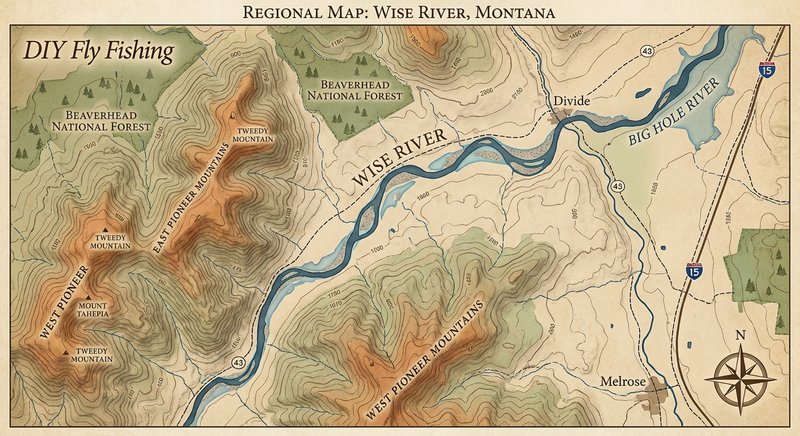
Wise River
Fly fishing in Montana · Beginner · Best seasons: Summer, Fall
Target Species
Brook Trout, Rainbow Trout
About This Water
Tributary of the Big Hole with wild brook and rainbow trout. Small stream fishing at its finest.
Fishing Recommendations
Welcome to one of the Big Hole Valley’s best-kept secrets. As your guide, I can tell you that the Wise River is the quintessential high-country Montana freestone stream. It is a major tributary to the Big Hole River, but it offers a much more intimate, "small water" experience. It’s a place where you can escape the drift boat crowds of the main stems and truly wade-fish in solitude.
🎣 Location Overview
The Wise River flows through a stunning glacial valley flanked by the Pioneer Mountains. It is characterized by classic "pocket water"—a relentless series of riffles, deep pools, and boulder gardens.
What makes it special is its connectivity and purity. It lacks major dams, meaning the water stays cold, oxygenated, and clear. Because it is a high-gradient stream, the fish here are opportunistic and aggressive. While the Big Hole is famous for its size, the Wise is famous for its action. It’s the kind of place where a well-placed dry fly rarely goes ignored.
🐟 Target Species & Behavior
- Brook Trout: These are the gems of the upper reaches. In the meadows and headwaters, you’ll find vibrant Brookies. They are extremely aggressive and will often move several feet to smash a dry fly. Look for them in the slower "tail-outs" of pools and under overhanging banks.
- Rainbow Trout: Found throughout the system, particularly in the middle and lower canyon stretches. These fish live in the "heavy" water—look for them in the seams where fast water meets slow water, or directly behind large boulders (the "cushion").
- Bonus - Westslope Cutthroat & Browns: While you asked for Brookies and Rainbows, don't be surprised to hook into a native Westslope Cutthroat in the upper sections or a solid Brown Trout near the confluence with the Big Hole.
📅 Best Times to Fish
Optimal Months: July through September
- Summer (July - August): This is prime time. The spring runoff (which can be brutal here) has usually subsided by early July. This is the window for "Hopper-Dropper" fishing.
- Fall (September - October): The Brook Trout take on their spectacular spawning colors. The water gets lower and more technical, requiring a stealthier approach.
Best Times of Day
- Summer: 9:00 AM to 11:00 AM (nymphing/early dries) and 5:00 PM to dusk (the "witching hour" for caddis).
- Fall: Mid-day is best. Wait for the sun to warm the water slightly to activate the bugs; 11:00 AM to 4:00 PM is the sweet spot.
🪰 Recommended Flies & Techniques
Top Fly Patterns
- Dry Flies:
- Royal Wulff or Royal Trude (Sizes 12-16): The classic attractor for the Wise.
- Chubby Chernobly (Tan/Orange, Size 10-12): Excellent as a high-visibility hopper or indicator.
- Elk Hair Caddis (Tan, Sizes 14-16): Essential for evening rises.
- Nymphs:
- Pheasant Tail (Sizes 14-18): A staple for the Rainbows in the riffles.
- Pat’s Rubber Leg (Brown/Black, Size 10-12): For the deeper holes in the canyon section.
- Streamers:
- Olive Woolly Bugger (Size 8-10): Swing these through the deep pools for larger resident Browns and Rainbows.
Techniques
- The "Hopper-Dropper": This is the most effective way to fish the Wise. Use a buoyant dry fly (like a Chubby) and hang a small nymph 18-24 inches below it.
- High-Sticking: Because of the pocket water, you’ll have multiple currents between you and the fish. Keep as much fly line off the water as possible to avoid drag.
- Dapping: In the brushy upper meadows, you may not even cast. Simply poke your rod tip through the willows and drop your fly onto the surface.
💡 Pro Tips & Local Knowledge
- The "Pioneer Mountains Scenic Byway": This road follows the river for miles. Don't just fish near the campgrounds. Pull off at any unmarked turnout and hike 15 minutes away from the road; the fishing quality improves exponentially.
- Focus on the "Bubble Line": On the Wise, the fish are looking up. If you see a line of bubbles or foam, that’s the "conveyor belt" of food. If your fly isn't in that line, you're fishing empty water.
- Wet Wading: In July and August, leave the waders in the truck. The water is refreshing, and the rocks can be slippery; felt-soled wading boots or studs are highly recommended.
⚠️ Important Information
- Access: Much of the Wise River is within the Beaverhead-Deerlodge National Forest, providing excellent public access. However, there are pockets of private ranch land near the town of Wise River—always look for "Blue Block" signs or use an app like OnX to ensure you are on public ground.
- Regulations: A valid Montana Fishing License is required. The Wise River generally falls under the Central District regulations, but always check the MT FWP (Fish, Wildlife & Parks) handbook for the current year regarding "Hoot Owl" (temperature) restrictions during hot summers.
- Wildlife: This is Bear Country (Black and Grizzly). Always carry bear spray and know how to use it, especially when fishing the brushy meadow sections where visibility is low.
Tight lines, and enjoy the solitude of the Pioneer Mountains!
Bug Hatches & Matching Flies
| Hatch | Type | Peak months | Time of day | Hook sizes | Matching flies |
|---|---|---|---|---|---|
| Salmonfly Pteronarcys californica | stonefly | June, July | All Day | #4-8 | Rogue River Stone #4-6, Pat's Rubber Legs #4-8, Chubby Chernobyl #6-8 |
| Golden Stonefly Hesperoperla pacifica | stonefly | June, July | Morning/Afternoon | #8-12 | Water Walker Golden #8-10, Golden 20-Incher #8-12 |
| Blue Winged Olive (BWO) Baetis | mayfly | April, May, September, October | Afternoon | #16-20 | Parachute Adams #16-20, RS2 #18-20, Pheasant Tail #16-20 |
| Pale Morning Dun (PMD) Ephemerella excrucians | mayfly | July, August | Late Morning/Afternoon | #14-18 | Sparkle Dun PMD #16-18, Split Case PMD #16-18, Rusty Spinner #14-18 |
| Mother's Day Caddis Brachycentrus occidentalis | caddis | May | All Day | #14-16 | Elk Hair Caddis #14-16, Peeping Caddis #14-16 |
| Yellow Sally Isoperla | stonefly | July, August | Afternoon/Evening | #12-16 | Little Yellow Stone #14-16, Iron Sally #14-16 |
| Spruce Moth Choristoneura occidentalis | terrestrial | August | Morning/Afternoon | #12-14 | Spruce Moth Dry #12-14, Balloon Caddis #14 |
| Trico Tricorythodes | mayfly | August, September | Early Morning | #20-24 | Trico Spinner #20-22, Zebra Midge #20-22 |
| Grasshoppers Orthoptera | terrestrial | August, September | Afternoon | #8-12 | Morrish Hopper #10-12, Pantone Hopper #8-12 |