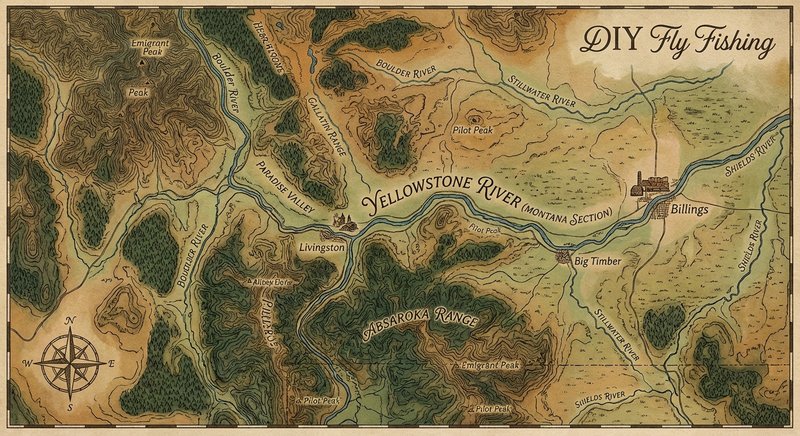
Yellowstone River (Montana Section)
Fly fishing in Montana · Intermediate · Best seasons: Summer, Fall
Target Species
Cutthroat Trout, Rainbow Trout, Brown Trout
About This Water
The longest undammed river in the lower 48 states. Paradise Valley section offers world-class fishing for cutthroat, rainbow, and brown trout.
Fishing Recommendations
The Yellowstone River in Montana is the crown jewel of American freestone rivers. As the longest undammed river in the lower 48 states, it remains a wild, powerful, and ever-changing ecosystem. From the Yellowstone National Park boundary at Gardiner down through the majestic Paradise Valley to the plains of Billings, this river offers over 100 miles of world-class trout water.
🎣 Location Overview
The Montana section of the Yellowstone is legendary for its "big water" feel. Unlike the manicured spring creeks nearby, the Yellowstone is raw. It is characterized by massive cobble bars, deep turquoise pools, braided channels, and heavy riffles.
What makes it special is its freestone nature. Because there are no dams, the river’s flow is dictated entirely by snowmelt and weather. This results in a highly productive insect biomass and trout that are famously strong. Anglers love it for the "Hopper-Dropper" fishing—the ability to twitch a large foam terrestrial on the surface while trailing a nymph, attracting aggressive strikes from wild, hard-fighting fish.
🐟 Target Species & Behavior
- Yellowstone Cutthroat Trout: The native soul of the river. They are most prevalent from Gardiner through the Paradise Valley. Cutthroats are notorious for their willingness to rise to a dry fly and are often found in "soft" water, back eddies, and right against the bank.
- Rainbow Trout: Found throughout the river, particularly in the faster riffles and heavy seams. They are acrobatic fighters and favor well-oxygenated water.
- Brown Trout: The "predators" of the river. While they take dries, the largest Browns are often caught on streamers or nymphs in deep holes, undercut banks, and around submerged timber. They become particularly aggressive and territorial in the fall.
📅 Best Times to Fish
Summer (Late June – August)
- The Window: Fishing usually kicks off in late June or early July once the spring runoff (the "big rise") subsides and the water clears.
- Conditions: High sun and warm days. This is the era of the Salmonfly hatch (late June/early July) and the legendary Hopper season (August).
- Time of Day: Early starts are key to beat the heat and the wind.
Fall (September – October)
- The Window: This is many guides' favorite time. The crowds thin out, and the "Big Sky" scenery turns golden.
- Conditions: Cooler water temperatures reinvigorate the fish. You'll see prolific Baetis (BWO) hatches on overcast days.
- Time of Day: Mid-morning through late afternoon as the water warms up.
🪰 Recommended Flies & Techniques
Dry Flies (The Main Event)
- Attractors: Chubby Chernobyl (Size 6-12) in gold, purple, or tan. This is the universal "point" fly for a two-fly rig.
- Terrestrials: Morrish Hopper, Panty Dropper Hopper, and Dave’s Hopper. Don't forget ants and beetles in August.
- Mayflies/Caddis: Parachute Adams (12-18), Elk Hair Caddis (12-16), and Sparkle Duns for the PMD hatches.
Nymphing
- The "Stonefly Lead": Pat’s Rubber Legs (Size 6-10) in brown/orange or black.
- Droppers: Lightning Bugs, Copper Johns, and Pheasant Tails (Size 14-18).
- Fall Specials: Zebra Midges and Soft Hackle Baetis patterns.
Streamers
- Patterns: Galloup’s Dungeon (Olive or White), Sparkle Minnow, and the classic Wooly Bugger.
- Technique: "Pounding the banks" from a drift boat. Cast inches from the grass and strip aggressively.
💡 Pro Tips & Local Knowledge
- Embrace the Wind: Livingston is one of the windiest places in America. If you can’t cast into a 20mph gust, you'll struggle. Practice a low, side-arm "power cast" to keep your line under the wind.
- The "Inside Out" Approach: Most anglers cast toward the banks. However, during high-sun summer days, fish often move to the "middle" of the river to hold in deep, cool slots between boulders. Don't ignore the center of the river.
- The Shields River Factor: Pay attention to the Shields River (enters near Livingston). If it rains up that drainage, it can dump mud into the Yellowstone, "blowing out" the river from Livingston downstream while the water upstream in Paradise Valley remains crystal clear.
- Rowing Caution: If you are floating, Yankee Jim Canyon is for expert oarsmen only (Class III rapids). Most recreational floats occur between Gardiner and Emigrant, or Emigrant and Livingston.
⚠️ Important Information
- Access: Montana has the best stream access laws in the country. You can fish anywhere below the high-water mark, provided you enter from a legal access point (Bridge, Fishing Access Site/FAS).
- Permits: You need a Montana Fishing License plus a Conservation License and an AIS (Aquatic Invasive Species) Prevention Pass. These can be bought online via the MyFWP website.
- Regulations: The Yellowstone is generally open year-round, but specific sections have different rules regarding harvest vs. catch-and-release (especially for Cutthroats). Always check the MT Fish, Wildlife & Parks (FWP) regulations before hitting the water.
- Safety: The Yellowstone is a big, powerful river. Always wear a PFD when in a boat, and be cautious when wading; the "Yellowstone Rollers" (round, slick rocks) make for treacherous footing.
Guide’s Final Word: The Yellowstone is a mood ring. It can be a gentle dry-fly paradise one day and a raging, wind-swept beast the next. Respect the river, watch the clouds over the Absarokas, and keep your hopper twitching.
Bug Hatches & Matching Flies
| Hatch | Type | Peak months | Time of day | Hook sizes | Matching flies |
|---|---|---|---|---|---|
| Salmonfly Pteronarcys californica | stonefly | June, July | All Day | #2-8 | Rogue River Stone #4-6, Pat's Rubber Legs #4-8, Cat Puke #4-6 |
| Golden Stonefly Hesperoperla pacifica | stonefly | July | Morning/Afternoon | #6-10 | Chubby Chernobyl #8-12, Golden Stone Nymph #8-10, Water Walker #8-10 |
| Mother's Day Caddis Brachycentrus occidentalis | caddis | May | Afternoon/Evening | #14-16 | Elk Hair Caddis #14-16, LaFontaine's Deep Sparkle Pupa #14-16, Iris Caddis #14-16 |
| Pale Morning Dun (PMD) Ephemerella excrucians | mayfly | July, August | Morning/Afternoon | #16-18 | Parachute Adams #16-18, Split Case PMD #16-18, PMD Sparkle Dun #16-18 |
| Blue Winged Olive (BWO) Baetis spp. | mayfly | April, May, September, October | Afternoon | #18-22 | RS2 #18-22, BWO Sparkle Dun #18-20, Pheasant Tail Nymph #18-22 |
| Grasshoppers Melanoplus spp. | terrestrial | August, September | Late Morning/Afternoon | #6-12 | Morrish Hopper #8-12, Pink Pookie #10-12, Parachute Hopper #10-14 |
| Yellow Sally Isoperla spp. | stonefly | July, August | Afternoon/Evening | #12-16 | Yellow Sally Foamstone #14-16, Kush's Yellow Sally #14-16 |
| Midges Chironomidae | midge | March, April | Late Morning | #18-24 | Zebra Midge #18-22, Griffith's Gnat #18-22, Mother's Day Midge #20-22 |