Agulowak River
Fly fishing in Alaska · Advanced · Best seasons: Summer, Fall
Target Species
Rainbow Trout, Arctic Grayling, Northern Pike
About This Water
Remote Wood-Tikchik drainage with trophy rainbows. Pristine wilderness fishing.
Fishing Recommendations
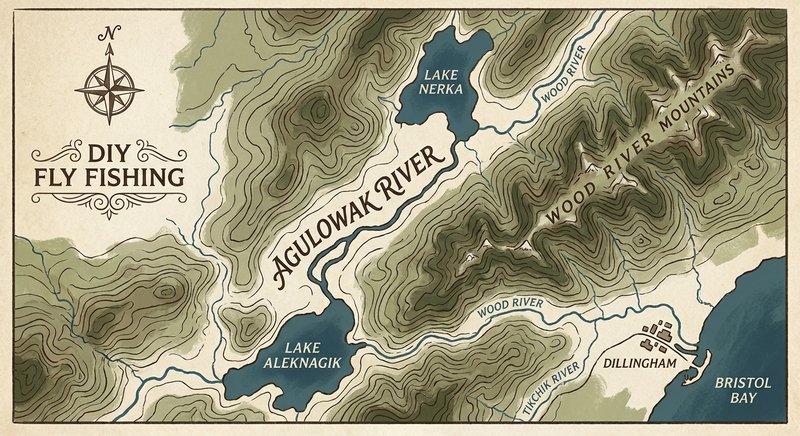
The Agulowak River, located within the Wood-Tikchik State Park in Southwest Alaska, is often described as a "fish factory." Connecting Lake Nerka to Lake Aleknagik, this short but incredibly productive four-mile stretch of water is legendary among fly anglers for its sheer biomass of fish.
Here is your comprehensive guide to fly fishing the Agulowak.
🎣 Location Overview
The Agulowak (often called "the Wak" by locals) is a wide, relatively shallow, and clear-flowing river. What makes it special is its role as a critical corridor for millions of Sockeye Salmon.
Unlike the technical, spring-creek-style rivers of the Lower 48, the Agulowak is all about abundance. The river features a gravel bottom, classic riffle-run-pool sequences, and extensive "braids" where the water splits around islands. It is a classic "drop-down" fishery where resident fish move from the deep lakes into the river to feast on the salmon cycle.
🐟 Target Species & Behavior
Rainbow Trout
The Rainbows here are wild, leopard-spotted, and incredibly powerful.
- Behavior: They are highly migratory. In early summer, they follow the smolt (juvenile salmon) heading to sea. In late summer/fall, they key in on salmon eggs and decomposing flesh.
- Holding Water: Look for "bucket" depressions behind spawning salmon, deep cut banks, and the tail-outs of large runs.
Arctic Grayling
The Agulowak is one of the finest Grayling fisheries in the world.
- Behavior: They are surface-oriented and opportunistic. They will often hold in the slower side channels or right in the middle of the main current in softer seams.
- Feeding: They love dry flies, even when there isn't a visible hatch.
Northern Pike
While the main river is dominated by trout and grayling, the "mouths" (where the river enters/leaves the lakes) and the weedy sloughs hold massive Pike.
- Behavior: They are ambush predators. They sit in the lily pads and weed edges waiting for smolt or even small grayling.
- Feeding: Aggressive strikers that favor large, flashy movement.
📅 Best Times to Fish
Optimal Seasons
- June (Early Summer): The "Smolt Out-migration." Huge numbers of juvenile salmon head to the ocean. Fishing is fast-paced and aggressive.
- July: Transition month. Great for dry fly fishing for Grayling and the beginning of the Sockeye Salmon run.
- August & September (Prime Fall): The "Egg and Flesh" season. This is when the largest Rainbows are caught as they gorge on salmon eggs.
Best Times of Day
In the Alaskan summer, the "midnight sun" means fish feed around the clock. However, low-light periods (early morning/late evening) often see the largest Rainbows move into shallower water to feed.
🪰 Recommended Flies & Techniques
For Rainbow Trout
- Technique: Nymphing with beads (indicator fishing) is the gold standard here in late summer. In June, swinging streamers is preferred.
- Patterns:
- Beads: 6mm and 8mm plastic beads in "mottled orange," "tangerine," and "dead egg" white.
- Streamers: Sculpzilla (olive/white), Dali Lama (black/white), and localized Smolt patterns.
- Flesh Flies: "Ginger Lace" or "Bunny Flesh" in cream and light orange.
For Arctic Grayling
- Technique: Dry fly fishing. Grayling have small mouths, so don't go too large.
- Patterns:
- Dries: Parachute Adams (#12-16), Elk Hair Caddis, and Royal Wulff.
- Nymphs: Gold Ribbed Hare’s Ear, Pheasant Tail.
For Northern Pike
- Technique: Heavy leaders or wire tippet are a must. Strip large streamers near weed lines.
- Patterns:
- Streamers: Large Pike Bunnies, Barry’s Pike Fly, and anything with chartreuse and flashy tinsel.
💡 Pro Tips & Local Knowledge
- The "Smolt Bust": In June, watch for "boils" on the surface near the river mouth. This is Rainbows and Char "busting" schools of salmon smolt. Cast a silver streamer right into the middle of the commotion and strip fast.
- Match the Egg: Experienced guides know that the color of the salmon eggs changes as they sit in the water. Start with bright "fresh" orange beads and transition to "pale/washed out" beads as the season progresses.
- Wade With Caution: The Agulowak has many "unseen" drop-offs. The water is exceptionally clear, which makes it look shallower than it is. Always use a wading staff.
- The Upper River: Most people fish the lower section near Lake Aleknagik. If you have a jet boat, the upper stretches near the Lake Nerka outlet offer more solitude and some of the largest Grayling.
⚠️ Important Information
Access
- The Agulowak is remote. Access is primarily by floatplane from Dillingham or by boat from the Aleknagik boat launch.
- Many anglers stay at fly-out lodges (like Mission Lodge or Bear Trail Lodge) that frequent this river.
Regulations & Permits
- License: An Alaska State Fishing License is required.
- Regulations: The Agulowak is generally Catch and Release only for Rainbow Trout.
- Salmon: If you intend to keep salmon, you must check the current ADF&G (Alaska Dept. of Fish and Game) emergency orders, as quotas change yearly.
Special Considerations
- Bears: This is high-density Brown Bear country. They are there for the salmon. Always carry bear spray, make noise, and never leave fish or food unattended on the bank.
- Gear: 5-weight rod for Grayling; 7-weight rod for Rainbows; 9-weight rod for Pike. Bring high-quality Gore-Tex waders—the water is cold!
Bug Hatches & Matching Flies
| Hatch | Type | Peak months | Time of day | Hook sizes | Matching flies |
|---|---|---|---|---|---|
| Blue Winged Olive Baetis spp. | mayfly | June, August, September | Afternoon | #16-20 | BWO Sparkle Dun #18-20, Pheasant Tail #16-18, RS2 #18-20 |
| Spotted Sedge Hydropsyche spp. | caddis | July, August | Evening | #12-16 | Elk Hair Caddis #14-16, LaFontaine's Deep Sparkle Pupa #14-16, Peacock Caddis #14-16 |
| Yellow Sally Isoperla spp. | stonefly | July | Late Afternoon/Evening | #12-16 | Yellow Sally Foam Dry #14-16, Iron Lotus #14-16 |
| Midges Chironomidae | midge | May, June, September | All Day | #18-24 | Zebra Midge #18-22, Griffith's Gnat #18-20 |
| Gray-Winged Yellow Quill Ameletus spp. | mayfly | July, August | Afternoon | #12-14 | Hare's Ear #12-14, Parachute Adams #12-14 |
| American Grannom Brachycentrus occidentalis | caddis | June | Mid-day | #14-16 | Holy Grail #14-16, Cased Caddis #12-14 |
| Little Brown Stonefly Nemouridae | stonefly | June | Morning/Afternoon | #14-18 | Copper John #16-18, Stimulator #16 |
| March Brown Rhithrogena morrisoni | mayfly | June | Afternoon | #12-14 | March Brown Wet Fly #12-14, Gold Ribbed Hare's Ear #12-14 |