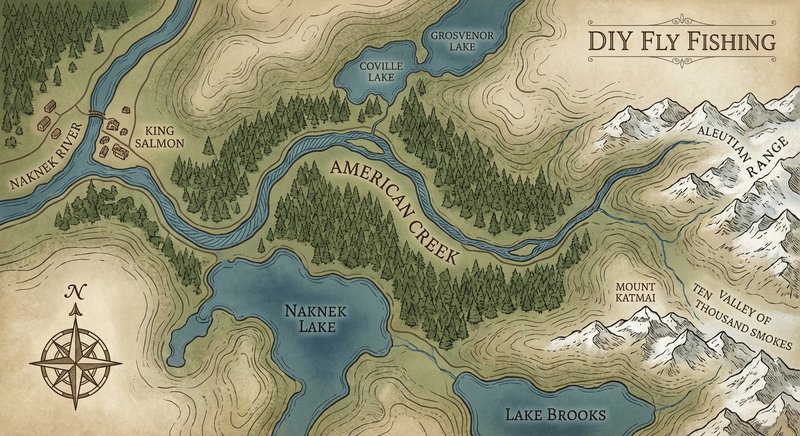
American Creek
Fly fishing in Alaska · Advanced · Best seasons: Summer, Fall
Target Species
Rainbow Trout, Sockeye Salmon
About This Water
Katmai area stream with excellent rainbow trout. Remote fly-in fishing.
Fishing Recommendations
Welcome to one of the crown jewels of the Bristol Bay watershed. As a guide, I consider American Creek in Katmai National Park to be the quintessential Alaskan fly-fishing experience. It is remote, rugged, and holds some of the most beautiful "Leopard" Rainbow Trout on the planet.
Here is your comprehensive guide to fishing American Creek.
🎣 Location Overview
American Creek is a medium-sized tributary flowing through the heart of Katmai National Park and Preserve. It originates at Hammersly Lake and winds approximately 40 miles down to Lake Coville.
What makes it special is its remoteness and diversity. It is accessible only by floatplane. The creek is often divided into three distinct sections:
- The Upper Braids: Shallow, winding, and intimate water.
- The Canyon: A high-gradient, boulder-choked section that requires expert rowing if you are on a multi-day float.
- The Lower Meanders: Slower, deeper water as it approaches the lake.
Anglers love American Creek because it offers a "small water" feel compared to the massive rivers like the Kvichak or Naknek, allowing for sight-fishing and precise presentations.
🐟 Target Species & Behavior
Rainbow Trout (Leopard Rainbows)
These are the stars of the show. Named for their dense, vivid black spotting that covers them from nose to tail, these fish are aggressive and strong.
- Behavior: In early summer, they are spread out in riffles and behind boulders, hunting insects and sculpins. Once the salmon arrive, they become "conveyor belt" feeders, positioning themselves directly behind spawning Sockeye to intercept eggs.
Sockeye Salmon (Red Salmon)
- Behavior: Sockeyes enter the system in July. While they don't feed once they enter freshwater, they are highly territorial. In American Creek, they turn a brilliant crimson. Most anglers target them for their incredible fighting power or as the "food source" that brings the big trout into the system.
Dolly Varden / Arctic Char
- Often overlooked but abundant, these fish follow the same patterns as the trout, gorging on eggs and flesh in the late summer.
📅 Best Times to Fish
July (The Arrival)
- Conditions: Long daylight hours and generally milder weather.
- Fishing: This is the transition period. Early July features great dry fly and streamer fishing. By mid-to-late July, the Sockeye begin to push into the creek in massive numbers.
August (The Feast)
- Conditions: Peak "Salmon Cycle."
- Fishing: This is prime time for the "egg drop." The trout are concentrated behind spawning salmon. This is the most productive window for high numbers of fish.
September (The Flesh & The Bigs)
- Conditions: Colder, shorter days, and potential for "horizontal" rain.
- Fishing: As salmon die off, "flesh flies" (imitating decomposing salmon meat) become the ticket. This is when the largest, heaviest trout are caught as they bulk up for the winter.
🪰 Recommended Flies & Techniques
The Egg Bio-Cycle (Late July – August)
- Technique: Nymphing with indicators.
- Flies: Beads. 6mm and 8mm plastic beads in colors like "Mottled Roe," "Orange Clear," or "Peach."
- Pro Tip: Match the bead color to the stage of the salmon spawn. Use bright oranges for fresh eggs and pale peaches for "dead" eggs.
Streamer Stripping & Swinging
- Technique: Swinging through deep pools or stripping along cut banks.
- Flies: Sculpzilla, Dolly Llama (Black/White or Olive), and Near Nuff Sculpin.
- Presentation: Cast toward the bank and strip erratically to trigger a predatory strike from a Leopard Rainbow.
Dry Fly Action (June – Early July)
- Technique: Matching the hatch in the braids.
- Flies: Caddis patterns, Stimulators, and Mouse Patterns.
- Pro Tip: Fishing a mouse (like an Articulated Mouse) is the most exhilarating way to catch American Creek trout. Cast to the bank and "skitter" it across the surface.
💡 Pro Tips & Local Knowledge
- The "Canyon" Secret: If you can safely access the Canyon section, look for the "slack water" pockets behind massive boulders. Giant trout hide here to escape the heavy current, waiting for eggs to drift into the eddy.
- Be Bear Aware: Katmai is home to the world’s highest concentration of Brown Bears. You will see them on American Creek. They have the right of way. Never compete with a bear for a fishing hole, and never carry food in anything other than a bear-resistant container.
- The "Walking" Technique: When fishing beads behind salmon, don't just stand still. Slowly "walk" your way down a gravel bar to cover every inch of the "trout zone" behind the redds (salmon nests).
⚠️ Important Information
Access
- Fly-in Only: You must charter a floatplane from King Salmon or Brooks Camp, or stay at a fly-out lodge (e.g., Kulik Lodge, Enchanted Lake Lodge).
- Float Trips: Many anglers do a 7-day raft trip from Hammersly Lake down to Coville. This requires high-level wilderness skills and bear safety knowledge.
Regulations & Permits
- National Park Rules: You are inside Katmai National Park. A valid Alaska fishing license is required.
- Catch and Release: American Creek is strictly Catch and Release for Rainbow Trout. Single, barbless hooks are mandatory to protect the fishery.
- Lead Ban: Use of lead weights is often restricted; check current Katmai superintendent's orders for the latest on non-toxic shot requirements.
Gear Recommendations
- Rods: 6-weight or 7-weight fast-action rods are ideal for handling wind and large trout.
- Waders: High-quality Gore-Tex waders are a must. The water is cold, and you will be in it all day.
- Layers: Even in July, temperatures can drop to the 40s (F) with wind and rain. Pack high-quality synthetics or wool.
Guide’s Final Word: American Creek is a bucket-list destination. Treat the fish with respect—keep them in the water for photos—and the creek will reward you with the best trout fishing of your life.
Bug Hatches & Matching Flies
| Hatch | Type | Peak months | Time of day | Hook sizes | Matching flies |
|---|---|---|---|---|---|
| Grannom Caddis Brachycentrus | caddis | June, July | Afternoon/Evening | #12-16 | Elk Hair Caddis #14-16, Peacock Caddis #12-14, Holy Grail #14-16 |
| Blue Winged Olive Baetis | mayfly | August, September | Afternoon | #18-22 | Parachute Adams #18-22, RS2 #20, Pheasant Tail #18-20 |
| Golden Stonefly Hesperoperla pacifica | stonefly | June, July | All Day | #8-12 | 20 Incher #8-12, Golden Rogue Foam Stone #8-10, Pat's Rubber Leg #8-12 |
| Common Midge Chironomidae | midge | June, July, August, September | Morning/Evening | #18-24 | Zebra Midge #18-22, Griffith's Gnat #20-22, Black Beauty #20-22 |
| Spotted Sedge Hydropsyche | caddis | July, August | Evening | #12-16 | LaFontaine's Deep Sparkle Pupa #14-16, Goddard Caddis #12-14, Copper John #14-16 |
| Brown Dun Ameletus | mayfly | June, July | Afternoon | #12-14 | Ameletus Nymph #12-14, Hares Ear #12-14, Adams #12-14 |
| Crane Fly Tipulidae | terrestrial | August, September | Afternoon | #8-12 | Daddy Long Legs #8-12, Crane Fly Larva #10-12 |
| Little Brown Stonefly Nemouridae | stonefly | June | Late Morning | #14-18 | Little Brown Stone #16, Prince Nymph #14-18 |