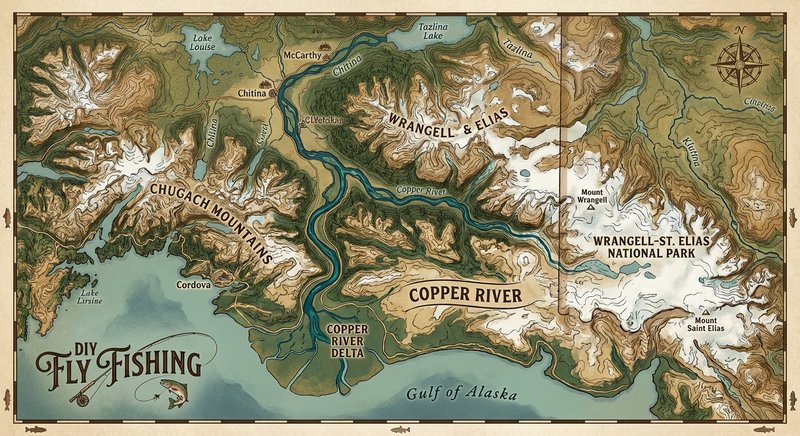
Copper River
Fly fishing in Alaska · Advanced · Best seasons: Summer
Target Species
Sockeye Salmon, King Salmon
About This Water
Famous for its Copper River salmon. Challenging fishing in dramatic glacial river setting.
Fishing Recommendations
The Copper River in Alaska is legendary—not just for the sheer volume of salmon that return to its glacial waters, but for the raw, untamed power of the river itself. As a guide, I tell clients that the Copper is a "working river." It is high-volume, silt-laden, and produces some of the most nutrient-rich salmon in the world.
Here is your comprehensive guide to fly fishing the Copper River system during the peak summer months.
🎣 Location Overview
The Copper River is a massive drainage, flowing over 290 miles from the Wrangell Mountains to the Gulf of Alaska near Cordova. What makes it special is its glacial character. The water is often "Copper" or milky-grey due to high glacial silt content.
Anglers love the Copper because it is one of the most productive salmon factories on Earth. While the mainstem is often too heavy and turbid for traditional fly fishing, its many tributaries (like the Gulkana, Klutina, and Tonsina) offer world-class fly fishing opportunities. You aren't just fishing; you are immersed in a landscape of towering peaks, massive glaciers, and dense grizzly bear habitat.
🐟 Target Species & Behavior
Sockeye Salmon (Reds)
- Behavior: Sockeye are unique because they don't actively "strike" flies out of aggression as often as other species. They are plankton feeders in the ocean. In the river, they travel in tight, fast-moving "strings" very close to the bank to avoid the heavy main current.
- Holding: Look for "seams" where fast water meets slower water along the shore. They are rarely more than 3–6 feet from the bank.
King Salmon (Chinook)
- Behavior: The Kings in the Copper system are massive and incredibly powerful. They are aggressive and territorial. Unlike Sockeye, they will move a distance to hammer a fly.
- Holding: They prefer deeper holes, "buckets" behind large boulders, and the tail-outs of deep runs. They hold near the bottom to conserve energy for their journey upstream.
📅 Best Times to Fish
The Copper River summer season is short and intense.
- Optimal Months:
- King Salmon: Mid-June through mid-July. The run usually peaks in late June.
- Sockeye Salmon: June through early August. Two distinct runs occur; the first in June and a second, often larger run in mid-to-late July.
- Best Times of Day: In the land of the midnight sun, "time of day" matters less than tide cycles (near the delta) or light levels. Early morning and late evening provide the best visibility and less human pressure, though salmon move 24/7.
- Prime Conditions: Dropping water levels and clearing visibility. Heavy rain causes glacial melt or mudslides, which can "blow out" the river with debris.
🪰 Recommended Flies & Techniques
Sockeye Techniques: "The Sockeye Swing" (Flossing)
Sockeye require a specific technique because they rarely "eat" a fly.
- Fly Patterns: Sparse is better. Use Copper River Reds, Sockeye Specials, or simple Green/Orange Comets. Size 4–6 hooks.
- Technique: Use a weighted leader or "split shot" to get the fly to the bottom. Cast at a 45-degree angle upstream, let the fly sink, and "swing" it across the bottom. The goal is for the line to enter the fish’s open mouth as it breathes, setting the hook in the corner of the jaw.
King Salmon Techniques: Big & Bright
- Fly Patterns: Intruders, Bunny Leeches, and Fat Freddies in Chartreuse, Cerise, or Blue/Black. You want a fly with a lot of movement (marabou or rabbit strip).
- Technique: Spey casting or heavy single-hand swinging. You must get the fly deep. Use T-14 or T-17 sink tips. Swing the fly slowly through deep pools, waiting for the "thump."
💡 Pro Tips & Local Knowledge
- Follow the Clear Water: The mainstem Copper is often too silty for the fish to see a fly. Focus your efforts on the confluences where clear-water tributaries (like the Gulkana) meet the main river. The fish will "duck into" the clear water to clean their gills.
- Short Leaders for Sockeye: If your leader is too long, your fly will ride too high. Keep your leader between 4–6 feet of 20lb fluorocarbon to ensure the fly stays in the "zone."
- Heavy Gear is Mandatory: For Kings, do not bring anything less than a 10-weight. These fish are fighting the heaviest current in Alaska; if you under-gun yourself, you will break off or exhaust the fish to death. For Sockeye, an 8-weight is standard.
- The "L" Shore: On the Copper, look for "L" shaped points in the bank. These create small eddies where Sockeye rest before pushing past the point.
⚠️ Important Information
- Access: Much of the Copper is accessed via the Richardson Highway (near Glennallen) or the Edgerton Highway (to Chitina). Many of the best spots require a jet boat or a bush plane (flying out of Gulkana or Chitina).
- Regulations: Alaska Department of Fish & Game (ADF&G) regulations are strict and can change mid-season based on fish counts (Emergency Orders). Always check the Upper Copper/Upper Susitna regulatory area before fishing.
- Permits: You need a standard Alaska Sport Fishing License. If targeting Kings, you must purchase a King Salmon Stamp.
- Safety: This is Grizzly Country. Carry bear spray or a firearm, and never fish alone. The river is extremely cold and fast; a wading belt and life jacket (if in a boat) are non-negotiable.
- Land Ownership: Much of the land along the Copper is owned by Native Corporations (like Ahtna, Inc.). You often need a specific land use permit to cross their land or fish from their banks. Respect all private property signs.
Bug Hatches & Matching Flies
| Hatch | Type | Peak months | Time of day | Hook sizes | Matching flies |
|---|---|---|---|---|---|
| Blue-Winged Olive Baetis tricaudatus | mayfly | May, September | Afternoon | #16-20 | Parachute Adams #16-20, RS2 #18-20, Pheasant Tail #16-18 |
| American Grannom Brachycentrus occidentalis | caddis | June | Late Afternoon/Evening | #12-16 | Peacock Caddis #14-16, Deep Sparkle Pupa #14-16, Elk Hair Caddis #14-16 |
| Giant Salmonfly Pteronarcys californica | stonefly | June, July | Morning/Afternoon | #4-8 | Pat's Rubber Leg #6-8, Rogue River Stone #4-6 |
| Midges Chironomidae | midge | May, June, July, August, September | All Day | #18-24 | Zebra Midge #18-22, Griffith's Gnat #20-22, Top Secret Midge #20-22 |
| Golden Stonefly Hesperoperla pacifica | stonefly | July | Morning/Evening | #8-12 | Golden Stone Nymph #8-12, Chubby Chernobyl #10-12 |
| Spotted Sedge Hydropsyche | caddis | July, August | Evening | #12-16 | LaFontaine Sparkle Pupa #14-16, Godzilla Caddis #12-14 |
| Mosquito Aedes spp. | terrestrial | June, July | All Day | #12-16 | Mosquito Dry #12-16, Black Gnat #14-16 |
| Pale Morning Dun Ephemerella excrucians | mayfly | July, August | Late Morning/Afternoon | #14-18 | PMD Sparkle Dun #16-18, Split Case PMD #14-16 |