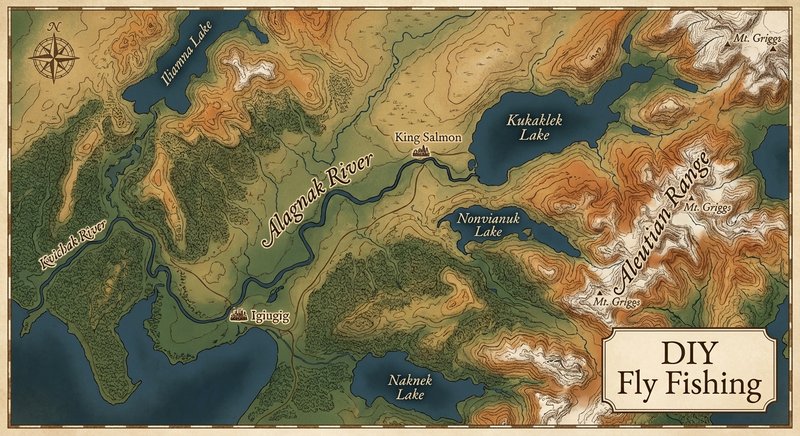
Alagnak River
Fly fishing in Alaska · Intermediate · Best seasons: Summer, Fall
Target Species
Rainbow Trout, King Salmon, Silver Salmon
About This Water
Wild and scenic river with five species of Pacific salmon. Rainbow trout fishing after salmon spawn.
Fishing Recommendations
The Alagnak River, often referred to as the "Branch River," is a legendary wild and scenic waterway located in the Bristol Bay region of Southwest Alaska. Flowing from the Kukaklek and Nonvianuk Lakes within Katmai National Park, it is widely considered one of the most productive freshwater fisheries on the planet.
As your guide, here is your comprehensive briefing for a successful expedition to the Alagnak.
🎣 Location Overview
The Alagnak is famous for its "Braids"—a section where the river splits into dozens of winding channels, gravel bars, and islands. This creates an incredible variety of fly fishing water, from deep holding pools to shallow riffles and slow-moving sloughs.
What makes it special is its pristine wilderness. It is a designated Wild and Scenic River, meaning there are no dams and minimal development. The water is generally clear, allowing for sight-fishing in many areas. Anglers love it because it offers the "Big Three" Alaskan experiences: massive salmon runs, legendary "Leopard" Rainbow Trout, and frequent encounters with Alaskan Brown Bears.
🐟 Target Species & Behavior
Rainbow Trout
The Alagnak is home to the famous Leopard Rainbow, named for their dense, beautiful spotting. These fish are residents, but their behavior shifts based on the salmon cycle.
- Early Summer: They are aggressive predators chasing salmon smolt and insects.
- Mid-to-Late Summer: They become "egg junkies," sitting behind spawning salmon to intercept drifting eggs.
- Fall: They transition to "flesh eaters," gorging on the decaying pieces of spawned-out salmon.
King Salmon (Chinook)
The heavyweights of the river. They enter the Alagnak in late June and July.
- Behavior: They hold in the deepest channels and the "seams" where fast and slow water meet. They are territorial and strike out of aggression rather than hunger once they enter the river.
Silver Salmon (Coho)
The favorite of many fly anglers due to their acrobatic fights and willingness to take a fly on the surface.
- Behavior: They prefer "soft" water—sloughs, backwaters, and the edges of the main current. They are highly aggressive and will often chase a fly for several yards before smashing it.
📅 Best Times to Fish
- Late June – July (The King & Chum Window): Best for targeting fresh King Salmon and the initial push of Sockeye and Chum. Rainbow fishing is excellent with streamers and even some dry fly action (Caddis/Mayflies).
- August (The Transition): This is "Egg Season." The river is full of Pink and Chum salmon spawning. Rainbow fishing is at its peak. Silver Salmon begin to arrive mid-month.
- September (The Silver & Flesh Window): Prime time for Silver Salmon. Rainbows are at their fattest, feeding on salmon flesh. This is arguably the best time for trophy trout.
Time of Day: In the land of the midnight sun, the "best time of day" is less about the sun and more about the tides (near the mouth) or water temperature. However, early morning and late evening often see the most surface activity for Silvers and Trout.
🪰 Recommended Flies & Techniques
For Rainbow Trout
- Beads (6mm - 10mm): Mottled orange, apricot, and washed-out pink. This is the most effective way to catch rainbows during the salmon spawn.
- Flesh Flies: "Battlefield" ginger, white, and peach bunny leeches.
- Mice: Mr. Hankey or White-Bellied Articulated Mice. Skittering these across the surface in the braids is the ultimate thrill.
For King Salmon
- Intruders: Large, heavy patterns in chartreuse, pink/purple, or orange/black.
- Technique: Use a 9-10 weight rod with a heavy sink tip (T-14 or T-17). Cast 45 degrees downstream, let it sink deep, and swing the fly through the holding pool.
For Silver Salmon
- Pink Pollywog: A foam surface fly. Stripping this across a quiet slough will induce heart-stopping topwater strikes.
- Hareball Leeches: Pink, purple, or fuchsia.
- Technique: Use an 8-weight rod with a weighted fly. A "strip-strip-pause" retrieve is generally more effective than a dead swing.
💡 Pro Tips & Local Knowledge
- Read the Salmon: If you want trophy Rainbows, find the spawning Chum or Pink salmon. Look for the "tail-fanning" motion on gravel bars. The trout will be stacked directly behind them in the "slick" waiting for eggs.
- The Alagnak Twitch: When fishing for Silvers in slow water, don't just strip. Give your rod tip a sharp twitch to make the fly "jerk" vertically. This often triggers a strike from a following fish.
- Don't Overlook the Chums: Often called "Dog Salmon," Chums are incredibly strong and will crush a swung fly. They are great practice for Kings and provide a massive fight on an 8-weight.
- Wading Safety: The Alagnak has many "quick-sand" style silt pockets and sudden drop-offs in the braids. Always use a wading staff and never wade deeper than your waist.
⚠️ Important Information
Access
The Alagnak is remote. You cannot drive there. Access is via bush plane (usually a Cessna Caravan or DeHavilland Otter) from King Salmon, AK. Most anglers stay at a fly-in lodge or book a multi-day float trip.
Regulations & Permits
- License: You need a valid Alaska Fishing License. If targeting Kings, you must purchase a King Salmon Stamp.
- Barbless Hooks: Most areas of the Alagnak are catch-and-release for Rainbow Trout, and barbless hooks are highly recommended (and often required by local lodge policy) to protect the resource.
- Check the Regs: Alaska Dept. of Fish & Game (ADF&G) regulations can change mid-season based on fish counts. Always check the "Bristol Bay Sport Fishing" emergency orders before flying in.
Wildlife & Environment
- Bears: You are in high-density Brown Bear country. Carry bear spray, keep your food secured, and never keep fish on the bank. Give bears the right of way—they were there first.
- Gear: Even in summer, Alaska is cold and wet. Bring high-quality Gore-Tex waders and plenty of layers (merino wool/fleece). Avoid cotton at all costs.
Bug Hatches & Matching Flies
| Hatch | Type | Peak months | Time of day | Hook sizes | Matching flies |
|---|---|---|---|---|---|
| Chironomids Chironomidae | midge | June, July | All Day | #18-24 | Zebra Midge #18-22, Griffith's Gnat #20-24, Ice Bud Midge #18-20 |
| Blue Winged Olive Baetis | mayfly | June, September | Afternoon | #16-20 | RS2 #18-20, Parachute Adams #16-18, Pheasant Tail Nymph #16-20 |
| American Grannom Brachycentrus occidentalis | caddis | June, July | Morning/Evening | #12-16 | Holy Grail #14-16, Elk Hair Caddis #14-16, Peacock Caddis Larva #12-14 |
| Giant Stonefly Pteronarcys californica | stonefly | June | Afternoon | #4-8 | Pats Rubber Legs #4-8, Rogue River Stone #6-8, Bitch Creek Nymph #6-8 |
| Yellow Sally Isoperla | stonefly | July, August | Evening | #14-16 | Yellow Stimulator #14-16, Yellow Sally Nymph #14-16, Little Yellow Stone #16 |
| Pale Morning Dun Ephemerella | mayfly | July | Late Morning/Afternoon | #14-18 | PMD Sparkle Dun #16-18, Split Case PMD #16, PMD Quigley Cripple #16 |
| Spotted Sedge Hydropsyche | caddis | July, August | Evening | #12-16 | Hydropsyche Larva #12-14, Godzilla Caddis #12-14, LaFontaine Sparkle Pupa #14-16 |
| Grey Drake Siphlonurus | mayfly | August | Afternoon/Evening | #10-12 | Grey Wulff #10-12, Hare's Ear Nymph #10-12, Parachute Grey Drake #12 |