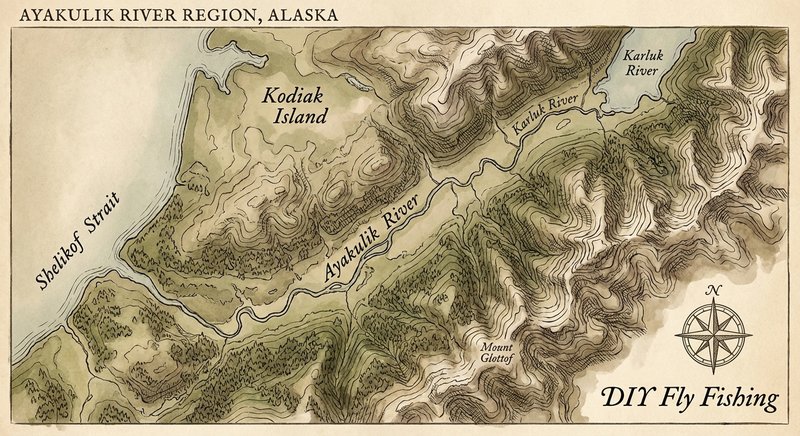
Ayakulik River
Fly fishing in Alaska · Advanced · Best seasons: Summer, Fall
Target Species
Silver Salmon, Steelhead, Dolly Varden
About This Water
Kodiak Island river with excellent salmon and steelhead. Remote wilderness setting.
Fishing Recommendations
The Ayakulik River, located on the remote southwestern tip of Kodiak Island, is often spoken of in hushed, reverent tones by seasoned Alaskan anglers. It is a true wilderness river, accessible only by floatplane, and offers some of the most prolific salmon and steelhead runs in the world.
Here is your comprehensive guide to fly fishing this Alaskan gem.
🎣 Location Overview
The Ayakulik is a quintessential coastal Alaskan river. It is relatively short, winding its way through the rolling tundra of the Kodiak National Wildlife Refuge before emptying into the Shelikof Strait.
What makes it special: Unlike the glacial "milky" rivers of the mainland, the Ayakulik is generally clear with a stable gravel bottom. It is exceptionally "fishy" water—meaning it has a classic pool-riffle-run structure that fly anglers dream of. Its isolation means lower pressure than the Kenai Peninsula, and its proximity to the ocean ensures that the fish you hook are "chrome bright" and full of salt-water energy.
Water Characteristics: The river is medium-sized and very wadeable in most conditions. It features long, sweeping gravel bars and deep "resting" holes where salmon and steelhead congregate to wait for water rises or to prepare for spawning.
🐟 Target Species & Behavior
Silver Salmon (Coho)
Silvers are the entertainers of the Ayakulik. They are aggressive, highly visual, and famous for acrobatic leaps.
- Behavior: They hold in "soft" water—slow-moving sloughs, backwaters, and the edges of main currents. They travel in schools; if you catch one, there are likely fifty more nearby.
- Feeding: In the river, they strike out of aggression. They love a moving target.
Steelhead
The Ayakulik hosts one of the healthiest runs of wild, native steelhead in Alaska. These are fall-run fish, coming in fresh from the North Pacific.
- Behavior: They are the "ghosts" of the river. They hold in the "seams" (where fast and slow water meet) and at the heads of deep pools. Unlike salmon, they are wary and require technical presentations.
- Feeding: They will take swung streamers or dead-drifted nymphs/eggs.
Dolly Varden
These are the opportunists of the river. They follow the salmon runs to gorge on eggs and loose flesh.
- Behavior: They sit directly behind spawning salmon. If you see a redd (spawning bed) with King or Pink salmon, the Dollies are sitting in the "trough" just downstream.
- Feeding: Almost exclusively salmon eggs or small flesh pieces during the fall.
📅 Best Times to Fish
- Silver Salmon: Late August through September. This is the prime window. The fish begin entering in August, but the numbers peak in mid-September.
- Steelhead: Late September through October. The Ayakulik is a late-season steelhead fishery. You want to be there when the temperatures drop and the first frosts hit the tundra.
- Dolly Varden: August through October. They are present whenever salmon are spawning.
Prime Conditions: The Ayakulik is sensitive to rain. A "spud" (rise in water) will trigger a fresh push of fish from the ocean. Conversely, if the water gets too low and clear, the fish become "stale" and spooky.
🪰 Recommended Flies & Techniques
For Silver Salmon
- Technique: "The Strip." Cast across and slightly downstream, letting the fly sink, then strip it back with erratic tugs.
- Top Flies: Pink or Purple Flashabous, Hareball Leeches, and the Pink Skykomish Sunrise.
- Topwater: On calm mornings, use a Pink Foam Polliwog. Watching a Silver wake behind a topwater fly is the pinnacle of the sport.
For Steelhead
- Technique: "The Swing" (Spey or single-handed). Cast 45 degrees downstream, mend, and let the fly swing through the tension of the current.
- Top Flies: Intruders (Blue/Black or Pink/Orange), Egg Leech patterns, and Articulated Bunnies.
For Dolly Varden
- Technique: Dead-drifting under an indicator. You must match the "egg" to the salmon currently spawning.
- Top Flies: Beads (8mm or 10mm in "mottled orange" or "light roe"), Glo-Bugs, and Flesh Flies (white or ginger).
💡 Pro Tips & Local Knowledge
- The "Lower" River Focus: The first two miles above the tidewater are the most productive for fresh, sea-bright fish. If you are staying at a lodge or camping, try to time your fishing with the incoming tide; fresh pods of fish move in as the tide pushes.
- Bear Safety is Non-Negotiable: Kodiak is home to the world’s largest brown bears. On the Ayakulik, you will see them. They use the same gravel bars you do. Never keep fish on a stringer; if you keep a fish, bleed it and get it into a bear-proof container or back to camp immediately. Always carry bear spray and make noise.
- Vary Your Retrieve: For Silvers, if they aren't hitting a fast strip, try a "dead drift" into a swing. Sometimes they want it right in their face without the movement.
- The "Dolly" Indicator: If you are struggling to find Steelhead, look for concentrations of Dolly Varden. Steelhead often hold in similar (though slightly faster) water nearby.
⚠️ Important Information
- Access: This is a "Fly-in" only destination. Most anglers fly into Kodiak City and then take a floatplane (bush plane) to the river. There are a few lodges (like the Ayakulik River Lodge) and some limited DIY float trip options.
- Regulations: Alaska Department of Fish & Game (ADF&G) regulations are strict.
- Steelhead: Generally catch-and-release only with single-hook, unbarbed requirements.
- Salmon: Limits vary by year based on escapement counts. Always check the current "Emergency Orders" before flying out.
- Gear: A 7-weight or 8-weight rod is the tool of choice. It has enough backbone for a 15lb Silver or a 12lb Steelhead but is still fun for Dollies. Bring a high-quality reel with a sealed drag—the salt air and powerful fish will wreck cheap gear.
- Weather: October on Kodiak is brutal. Bring high-end Gore-Tex waders, a heavy wading jacket, and plenty of synthetic layers. If you get wet, you get cold, and the trip is over.
Bug Hatches & Matching Flies
| Hatch | Type | Peak months | Time of day | Hook sizes | Matching flies |
|---|---|---|---|---|---|
| Blue Winged Olive Baetis tricaudatus | mayfly | May, September, October | Late Morning/Afternoon | #16-20 | BWO Sparkle Dun #18-20, RS2 #18-22, Pheasant Tail #16-20 |
| Chironomids Chironomidae | midge | April, May, June, September | All Day | #18-24 | Zebra Midge #18-22, Griffith's Gnat #20-24, Ice Midge #20-22 |
| Giant Salmonfly Pteronarcys californica | stonefly | June, July | Afternoon | #4-8 | Kaufmann's Stone #4-8, Pat's Rubber Leg #6-10, Rogue River Stone #6-8 |
| Yellow Sally Isoperla spp. | stonefly | July, August | Late Afternoon/Evening | #12-16 | Yellow Stimulator #14-16, Little Yellow Sloan #14-16, Mercer's Missing Link #14-16 |
| Spotted Sedge Hydropsyche spp. | caddis | July, August | Evening | #14-16 | Elk Hair Caddis #14-16, LaFontaine's Deep Pupa #14-16, Soft Hackle Hare's Ear #14-16 |
| American March Brown Rhithrogena morrisoni | mayfly | June, July | Afternoon | #12-14 | March Brown Western #12-14, Gold Ribbed Hare's Ear #12-14, March Brown Spun Dun #14 |
| Grannom Caddis Brachycentrus occidentalis | caddis | May, June | Morning/Evening | #14-18 | Peacock Caddis #16-18, Holy Grail #14-16, Caddis Larva #14-18 |
| Golden Stonefly Hesperoperla pacifica | stonefly | July, August | Evening | #8-12 | Golden Stone Nymph #8-12, Chubby Chernobyl #8-10, Twenty Incher #10-12 |