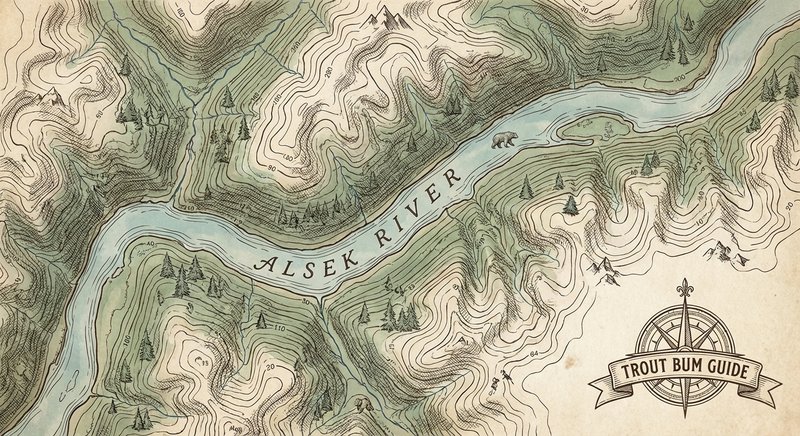
Alsek River
Fly fishing in Alaska · Advanced · Best seasons: Summer, Fall
Target Species
Steelhead, King Salmon, Sockeye Salmon
About This Water
World-class wilderness float with steelhead and salmon. Glacier-fed adventure fishing.
Fishing Recommendations
The Alsek River is one of the last truly wild frontiers in North America. Flowing from the Yukon Territory through the St. Elias Mountains and into the Gulf of Alaska, this glacial system is raw, powerful, and remote. Fishing here isn't just about the catch; it’s about survival and solitude in a landscape dominated by towering peaks, calving glaciers, and massive grizzly bears.
For the fly angler, the Alsek offers a unique challenge: navigating high-volume, sediment-heavy glacial water to find windows of clarity where world-class salmon and steelhead congregate.
🎣 Location Overview
The Alsek is a massive glacial river system known for its dramatic scenery and "big water" character. What makes it special is its isolation—most of the lower river is accessible only by bush plane or multi-day rafting expeditions starting at Dry Bay.
The water characteristics vary wildly. The main stem is often "milky" or turbid due to glacial silt. However, the Alsek's magic lies in its tributaries, side channels, and sloughs. As the main river pulses, fish push into these clearer side-waters to rest and spawn. Anglers love the Alsek because it offers a "Jurassic Park" feel; you are fishing in a prehistoric landscape where the fish are aggressive, fresh from the salt, and rarely see a fly.
🐟 Target Species & Behavior
King Salmon (Chinook)
These are the heavyweights. Alsek Kings are known for their girth and power.
- Behavior: They hold in the deep, walking-speed runs and at the heads of pools. They are looking for "high-percentage" holding water where they can conserve energy.
- Feeding: They aren't feeding to survive at this stage, but they strike out of territorial aggression.
Sockeye Salmon
The Alsek sees massive runs of Sockeye.
- Behavior: They travel in tight schools along the "seams" (the edge where fast and slow water meet). They prefer shallow, gravelly bars and side channels.
- Feeding: Sockeye are notoriously picky. They require precise "flossing" techniques or very small, sparse flies presented directly at eye level.
Steelhead (Fall Run)
The Alsek/Tatshenshini system hosts a rugged strain of wild steelhead.
- Behavior: They are highly migratory and move quickly. Look for them in "classic" steelhead water—tailouts of pools and around large boulders that break the current.
- Feeding: They are much more predatory than the salmon, often willing to chase a swung fly or crush a large streamer.
📅 Best Times to Fish
Summer (June – July)
- Primary Target: King Salmon and Sockeye.
- Conditions: Long daylight hours (nearly 20+ hours of light). This is peak runoff season, so the main stem will be high. Focus on the lower river near Dry Bay.
- Prime Window: Late June is the sweet spot for "bright" Kings.
Fall (Late August – October)
- Primary Target: Steelhead and Silver (Coho) Salmon.
- Conditions: Water levels begin to drop and clear as the glacial melt slows down. The weather becomes volatile—expect rain and wind.
- Prime Window: September is the gold standard for multi-species action.
🪰 Recommended Flies & Techniques
Techniques
- Spey Casting: This is the preferred method for the Alsek. A 9wt or 10wt Spey rod for Kings; an 8wt for Steelhead. Use heavy sink tips (T-14 or T-17) to get through the glacial "push."
- The Swing: For Kings and Steelhead, a traditional down-and-across swing is most effective.
- The Sockeye Strip: For Sockeye, use a single-hand 7wt or 8wt with a weighted fly and a long leader to "line" them in shallow water.
Top Fly Patterns
- Kings: Large Intruders (Pink/Orange or Blue/Black), Prom Dress streamers, and Comets. Think big, bright, and heavy.
- Steelhead: Egg Leach patterns, Hobbit Spey, and Purple Perils. Purple and black are the "money" colors in silty water.
- Sockeye: Red Eye Dialog, Sockeye Special, or small Nymphs (Size 4-8) in bright green or orange.
💡 Pro Tips & Local Knowledge
- The "Clear Water" Rule: In a glacial system, fish the "seams" where a clear-running tributary enters the silty main stem. Fish will stack up in that mixing zone to clear their gills and rest.
- Vary Your Sink Rate: The Alsek’s flow changes daily. Carry a wallet of various T-series tips. If you aren't ticking the bottom occasionally, you aren't deep enough for the Kings.
- Bear Safety is Non-Negotiable: This is high-density Grizzly territory. Always fish with a partner, carry bear spray on your person (not in your pack), and consider a firearm if you are experienced. Never leave fish carcasses near your camp.
- Watch the Tide: If fishing the lower reaches near Dry Bay, the tide affects fish movement. Fresh "chrome" fish push in on the high tide.
⚠️ Important Information
Access
- Remote Only: There are no roads to the Alsek. Most anglers fly into Dry Bay, AK via bush plane from Yakutat.
- Rafting: Many anglers float the river from Dalton Post (Yukon) to Dry Bay—a 10-12 day trip through the Grand Canyon of the Alsek (Class IV-V rapids).
Regulations & Permits
- Licensing: You will need an Alaska Non-Resident Sport Fishing License. If targeting Kings, you must purchase a King Salmon Stamp.
- Glacier Bay National Park: Much of the river flows through National Park land. Commercial guides must have a CUA (Commercial Use Authorization).
- Retention: Rules change annually based on escapement numbers. Always check the ADF&G (Alaska Department of Fish and Game) emergency orders before your trip.
Special Considerations
- The Wind: The Alsek is a wind funnel. Expect "Katabatic" winds blowing off the glaciers. A heavy-grain Spey line is your best friend to punch through the gusts.
- Hypothermia: Even in summer, the water is barely above freezing. Use high-quality breathable waders with heavy fleece layering underneath.
Bug Hatches & Matching Flies
| Hatch | Type | Peak months | Time of day | Hook sizes | Matching flies |
|---|---|---|---|---|---|
| Chironomids (Midges) Chironomidae | midge | May, June, September | All day | #18-24 | Zebra Midge #18-22, Griffith's Gnat #20-22, Ice Midge #20 |
| Blue-Winged Olive (BWO) Baetis spp. | mayfly | May, September | Mid-day/Afternoon | #16-20 | Parachute Adams #16-20, RS2 #18-20, Pheasant Tail #16-18 |
| Giant Salmonfly Pteronarcys californica | stonefly | June, July | Afternoon | #4-8 | Pats Rubber Legs #4-8, Sofa Pillow #6-8, Rogue River Stone #6 |
| American Grannom Brachycentrus occidentalis | caddis | May, June | Late Afternoon/Evening | #12-16 | Peacock Caddis #14-16, Deep Sparkle Pupa #14-16, Elk Hair Caddis #12-16 |
| Little Black Stonefly Capniidae | stonefly | April, May | Mid-day | #14-18 | Early Girl Stone #16, Prince Nymph #14-18, Black Copper John #16-18 |
| Pale Morning Dun (PMD) Ephemerella spp. | mayfly | July, August | Late Morning/Afternoon | #14-18 | PMD Sparkle Dun #16-18, Split Case PMD #14-16, Light Cahill #14-16 |
| Golden Stonefly Hesperoperla pacifica | stonefly | July, August | Evening | #8-12 | Golden Stone Nymph #8-12, Chubby Chernobyl (Gold) #8-10, Stimulator #10-12 |
| Spotted Sedge Hydropsyche spp. | caddis | July, August, September | Evening | #12-16 | Holy Grail Caddis #14-16, LaFontaine's Emergent Pupa #14, Tan Elk Hair Caddis #12-16 |