Brooks River
Fly fishing in Alaska · Intermediate · Best seasons: Summer, Fall
Target Species
Sockeye Salmon, Rainbow Trout, Arctic Grayling
About This Water
Famous Katmai National Park stream. Watch bears catching salmon while you fish.
Fishing Recommendations
Welcome to one of the most iconic fly fishing destinations on the planet. As your guide to the Brooks River in Katmai National Park, it’s important to understand that this isn’t just a fishing trip—it’s an immersion into a raw, prehistoric ecosystem. Here, you are not the top of the food chain; you are sharing the water with the world’s highest concentration of Alaskan Brown Bears.
🎣 Location Overview
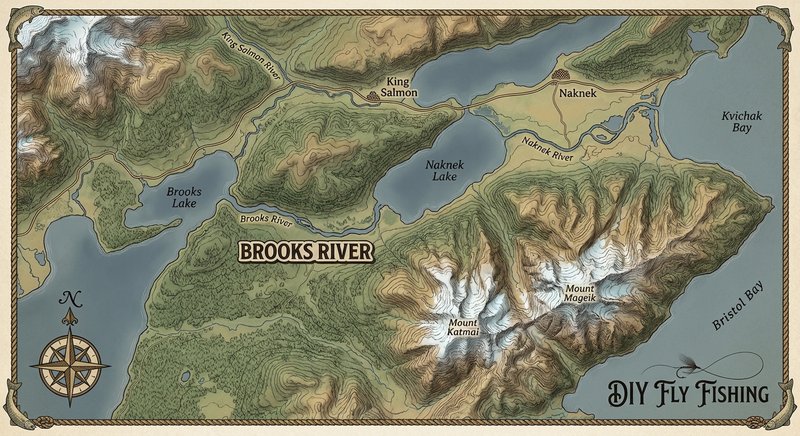
The Brooks River is a short, mile-and-a-half stretch of water connecting Brooks Lake to Naknek Lake. Despite its short length, it is legendary. What makes it special is the Brooks Falls, a natural barrier where thousands of Sockeye salmon congregate, creating a massive nutrient influx that fuels some of the largest Rainbow Trout in Alaska.
The water is generally crystal clear, allowing for incredible sight-fishing opportunities. It varies from the slow, meandering "Oxbow" section to the swifter, gravel-bottomed reaches near the falls. Anglers love it because it offers the rare chance to catch trophy trout while watching 800-pound bears snorkel for salmon just yards away.
🐟 Target Species & Behavior
Rainbow Trout
These are not your typical stream trout. These are "leopard" rainbows—heavily spotted and built like footballs.
- Behavior: They are opportunistic followers. In July, they hover behind spawning Sockeye to intercept kicked-up nymphs and eggs. In September, they become lethargic but focused, sitting in deep holes waiting for "flesh" (decaying salmon meat).
- Holding Spots: Look for "seams" behind active salmon redds (nests) and the soft water at the edges of the main current.
Sockeye (Red) Salmon
- Behavior: Sockeye enter the river in massive pulses. Unlike other salmon, they don't strike out of aggression as often. Fishing for them usually involves the "flossing" technique (the Bristol Bay drift) to get the fly into their mouths as they breathe and move.
- Holding Spots: They stack up in the lower river and below the falls in massive, shimmering red clouds.
Arctic Grayling
- Behavior: The "sailfish of the north." They are insectivores and much more willing to rise for a dry fly than the trout.
- Holding Spots: Usually found in the upper river near the outlet of Brooks Lake, seeking out slower side channels and eddies.
📅 Best Times to Fish
July: The Sockeye Run & The Egg Drop
- Conditions: The river is crowded with both fish and bears.
- Experience: This is peak Sockeye season. Rainbow trout are incredibly active, gorging on fresh eggs.
- Prime Window: July 1st – July 20th.
Late August – September: The Flesh Season
- Conditions: The Sockeye have spawned and are dying. The water turns "milky" with decaying fish matter.
- Experience: This is the time for trophy Rainbows. The fish are at their heaviest weight of the year.
- Prime Window: September 5th – September 25th.
Best Time of Day: Early morning and late evening are best to avoid the heaviest float-plane tourist crowds, though bear activity is high at all hours.
🪰 Recommended Flies & Techniques
For Rainbow Trout
- July (The Egg): 6mm and 8mm beads in "Oregon Cheese," "Salmon Roe," or "Mottled Orange."
- September (The Flesh): Flesh flies in "Dirty White," "Peach," or "Ginger." Use "Bunny Leeches" to mimic chunks of salmon drifting in the current.
- Technique: Indicator nymphing is king here. You want a dead drift that mimics an egg or a piece of flesh tumbling naturally along the bottom.
For Sockeye Salmon
- Patterns: Small, sparsely dressed flies like the Sockeye Special, Black Gnat, or a simple Coho Charlie.
- Technique: The "Brooks River Swing." Cast slightly upstream, let the weight sink the fly to the fish's level, and feel for the "hook-up" in the mouth.
For Arctic Grayling
- Patterns: Elk Hair Caddis, Parachute Adams, or small Gold-Ribbed Hare’s Ear nymphs.
- Technique: Standard dry fly presentation with a 4wt or 5wt rod.
💡 Pro Tips & Local Knowledge
- The "Bear Shuffle": You will spend 30% of your time fishing and 70% of your time watching bears. If a bear moves toward your hole, you must yield the spot immediately. Do not leave fish on the line if a bear is within 50 yards—break them off.
- Sight Fish Everything: Because the water is clear, don't just blind cast. Spend time on the banks (where safe) or using polarized glasses to spot the "dark shadows" behind the red salmon. Those shadows are the Rainbows.
- Wade Deep, Fish Shallow: Many anglers wade right over the fish. The Rainbows often sit in surprisingly shallow water (less than 2 feet) right behind the salmon redds.
- The Lower River Mystery: While everyone rushes to the falls, the "Lower River" near the bridge often holds massive trout that drop down from Naknek Lake to feed.
⚠️ Important Information
Access & Logistics
- Location: Accessible only by float plane (usually from King Salmon or Anchorage).
- Brooks Camp: Most anglers stay at Brooks Lodge (booked 18 months in advance) or the NPS campground.
Regulations & Safety
- Barbless Hooks Only: Mandatory for all fishing in the park.
- Catch & Release: Highly encouraged/required for Rainbows and Grayling.
- Bear Safety: You must attend "Bear School" at the Visitor Center upon arrival. You are required to stay 50 yards away from bears (100 yards if they are with cubs).
- Gear: 7wt or 8wt rod for Salmon; 6wt for Rainbows; 4wt for Grayling. High-quality wading boots (no felt) and a heavy-duty waterproof pack are essential.
The "Freezer" Rule
There is a strictly regulated "Fish Storage Structure" (The Freezer). You cannot carry food or kept fish on the river. Everything must be stored in bear-proof containers or the designated building.
Guide’s Final Word: The Brooks River is a privilege. Treat the bears with respect, the fish with care, and the landscape with awe. You’re fishing in a masterpiece. Tight lines!
Bug Hatches & Matching Flies
| Hatch | Type | Peak months | Time of day | Hook sizes | Matching flies |
|---|---|---|---|---|---|
| Midges Chironomidae | midge | May, June, September | All Day | #18-24 | Zebra Midge #18-22, Griffith's Gnat #20-22, Brooks Sprout Midge #20 |
| Blue Winged Olive Baetis spp. | mayfly | May, September | Mid-day/Afternoon | #16-20 | RS2 #18-20, Parachute Adams #16-20, Pheasant Tail #16-18 |
| American Grannom Brachycentrus occidentalis | caddis | June, July | Afternoon/Evening | #12-16 | Peacock Caddis #14-16, Deep Sparkle Pupa #14-16, Elk Hair Caddis #14-16 |
| Giant Salmonfly Pteronarcys californica | stonefly | June | All Day | #4-8 | Pats Rubber Legs #6-8, Rogue River Stone #4-6 |
| Golden Stonefly Hesperoperla pacifica | stonefly | July | Evening | #8-12 | Golden Stone Nymph #10-12, Chubby Chernobyl (Gold) #8-12 |
| Spotted Sedge Hydropsyche spp. | caddis | July, August | Evening | #14-16 | LaFontaine's Emergent Pupa #14-16, Goddard Caddis #14-16 |
| Speckled Spinner Callibaetis spp. | mayfly | July, August | Morning/Afternoon | #14-16 | Callibaetis Spinner #14-16, Hare's Ear Nymph #14-16 |
| October Caddis Dicosmoecus atripes | caddis | September, October | Afternoon | #8-12 | Orange Stimulator #8-10, Morrish October Caddis Pupa #10 |
| Black Fly Simulium spp. | midge | June, July, August | All Day | #18-22 | Black Beadhead Larva #20-22, Black Gnat #18-20 |