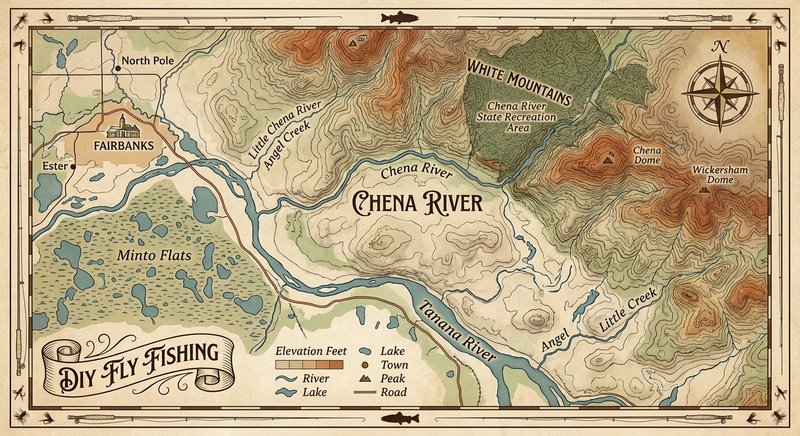
Chena River
Fly fishing in Alaska · Beginner · Best seasons: Summer
Target Species
Arctic Grayling, King Salmon, Silver Salmon
About This Water
Interior Alaska river near Fairbanks with grayling and salmon. Accessible year-round.
Fishing Recommendations
The Chena River is one of Alaska’s most unique and accessible fly fishing treasures. Flowing right through the heart of Fairbanks and extending deep into the interior wilderness, it offers a rare combination of roadside convenience and world-class sport fishing. Whether you are targeting the iconic "Sailfish of the North" (Arctic Grayling) or the powerful Pacific Salmon, the Chena is a river of remarkable character.
🎣 Location Overview
The Chena is a classic interior Alaska river characterized by its tannic, "tea-colored" water. Despite the dark tint, the water is remarkably clear, allowing for excellent sight-fishing opportunities in the upper reaches.
What makes the Chena special is its status as a catch-and-release trophy grayling fishery in certain sections. The river is divided into two distinct personalities:
- The Lower Chena: Slower, deeper, and flows through Fairbanks. This is primarily a corridor for migrating salmon.
- The Upper Chena: Located within the Chena River State Recreation Area (accessible via Chena Hot Springs Road). This is where the fly fishing magic happens—think gravel bars, sweeping bends, log jams, and riffles.
🐟 Target Species & Behavior
Arctic Grayling
The crown jewel of the Chena. They are opportunistic feeders known for their massive, iridescent dorsal fins.
- Behavior: Grayling hold in the "seams" where fast water meets slow water. They are famous for their willingness to rise for dry flies even when no hatch is present.
- Feeding: They focus on aquatic insects (caddis, mayflies), terrestrial insects (ants, beetles), and occasionally salmon eggs or fry.
King Salmon (Chinook)
The heavyweights. They enter the river in late June and July to spawn.
- Behavior: Kings are not feeding once they enter the river; they are driven by the spawning instinct. They hold in deep, dark pools and at the "tail-outs" of runs.
- Response: They strike out of aggression. You need to put the fly right in their face.
Silver Salmon (Coho)
Available later in the summer (August/September), Silvers are aggressive and acrobatic.
- Behavior: They prefer slower "froggy" water, back eddies, and the edges of main currents.
- Feeding: They are much more likely to "chase" a fly than a King salmon.
📅 Best Times to Fish
- Optimal Months: June through August.
- Arctic Grayling: Prime time is mid-June to late August. Once the spring runoff (breakup) subsides in early June, the dry fly action is non-stop.
- King Salmon: July is the peak. They usually reach the upper Chena by the second or third week of July.
- Silver Salmon: Late August through September.
- Prime Conditions: Overcast days often provide the best grayling fishing, as they feel more secure coming to the surface. However, with 20+ hours of daylight in mid-summer, you can catch fish at midnight just as easily as at noon.
🪰 Recommended Flies & Techniques
For Arctic Grayling
- Dry Flies: This is the preferred method. Use Elk Hair Caddis (#12-16), Klinkhammers, Parachute Adams, and Black Gnats.
- Terrestrials: When the wind blows, Chernobyl Ants or foam beetles are deadly.
- Nymphing: If they aren't rising, a Gold-ribbed Hare’s Ear or a Pheasant Tail under a small indicator will produce numbers.
- Technique: Use a 3-weight or 4-weight rod. Grayling have "soft" mouths, so a gentle hook set is required.
For King & Silver Salmon
- Patterns: Egg Leach patterns, Bunny Leaches (Pink, Chartreuse, or Purple), and the Comet.
- Technique: For Kings, use a heavy sink-tip line and a 9-weight rod. You must "swing" the fly deep. For Silvers, an 8-weight rod with a slow strip-and-pause retrieve often triggers a strike.
💡 Pro Tips & Local Knowledge
- The "Chena Hot Springs Road" Strategy: The river parallels this road for over 50 miles. Focus your efforts between Milepost 37 and Milepost 55. The further you walk away from the bridge access points, the larger the grayling tend to be.
- Look for Wood: Grayling in the Chena love "sweepers" (downed trees overhanging the water). Cast your dry fly just upstream of a sunken log and watch for the rise.
- Sight Fishing: Even with the tannic water, if you wear high-quality polarized glasses (amber or copper lenses), you can spot the orange-blue tint of a grayling’s dorsal fin in the ripples.
- The "Smack": Grayling often miss the fly on the first rise. If they splash at it and miss, don't move the fly. They will often circle back and inhale it if you leave it drifting naturally.
⚠️ Important Information
Access
- Roadside: Numerous pull-outs along Chena Hot Springs Road provide access to the State Recreation Area.
- Float Trips: Putting in at the Angel Rocks trailhead and floating to a downstream bridge is a popular way to reach untouched water (be prepared for sweepers and log jams).
Regulations & Permits
- Catch and Release: The Chena River is strictly catch-and-release for Arctic Grayling from its mouth up to the dam, and specific gear restrictions (unbordered single-hook artificial lures) often apply.
- Salmon Closures: King Salmon populations have been struggling. Check the ADF&G (Alaska Department of Fish and Game) "Emergency Orders" before you head out, as salmon fishing is frequently closed to protect spawning runs.
- License: You need a valid Alaska Sport Fishing License. If targeting King Salmon (if open), you also need a King Stamp.
Special Considerations
- Bears and Wildlife: You are in Grizzly and Moose country. Always carry bear spray, make noise when walking through thick brush, and never leave fish remains or food near your fishing spot.
- Bug Protection: The mosquitoes in the Interior are legendary. Bring high-DEET repellent and a head net—you will thank me later.
Bug Hatches & Matching Flies
| Hatch | Type | Peak months | Time of day | Hook sizes | Matching flies |
|---|---|---|---|---|---|
| Midges Chironomidae | midge | May, June, September | All Day | #18-24 | Griffith's Gnat #18-22, Zebra Midge #18-22, Traun River Midge #20-24 |
| Blue Winged Olive Baetis spp. | mayfly | May, September | Mid-day/Afternoon | #16-20 | Parachute Adams #16-20, RS2 #18-20, Pheasant Tail #16-18 |
| American Grannom Brachycentrus occidentalis | caddis | June | Evening | #12-16 | Elk Hair Caddis (Olive) #14-16, Peacock Caddis #14-16, LaFontaine's Deep Sparkle Pupa #14-16 |
| Yellow Sally Isoperla spp. | stonefly | July | Afternoon/Evening | #14-16 | Yellow Sally Dry #14-16, Stimulator (Yellow) #14-16, Kaufmann's Stone (Yellow) #14-16 |
| March Brown Rhithrogena morrisoni | mayfly | June | Morning/Afternoon | #12-14 | March Brown Dry #12-14, Gold Ribbed Hare's Ear #12-14, March Brown Wet #12-14 |
| Spotted Sedge Hydropsyche spp. | caddis | July, August | Evening | #14-16 | Elk Hair Caddis (Tan) #14-16, Hydropsyche Larva #14-16, Iris Caddis #14-16 |
| Carpenter Ant Camponotus herculeanus | terrestrial | July, August | Afternoon | #10-14 | Black Foam Ant #12-14, Chernobyl Ant #10-12, Fur Ant #14-16 |
| Pale Morning Dun Ephemerella spp. | mayfly | July | Morning/Mid-day | #14-18 | PMD Sparkle Dun #16-18, Pale Morning Dun Parachute #14-16, Micro Mayfly (Yellow) #16-18 |