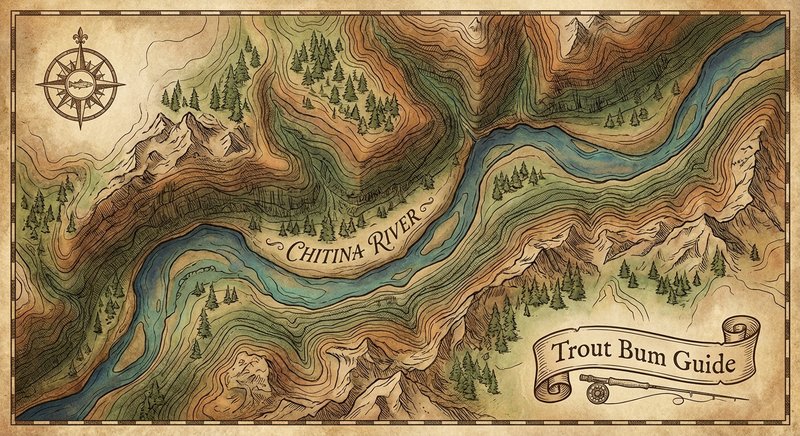
Chitina River
Fly fishing in Alaska · Intermediate · Best seasons: Summer
Target Species
Sockeye Salmon, King Salmon, Dolly Varden
About This Water
Copper River tributary accessible by road. Sockeye dipnetting and sportfishing.
Fishing Recommendations
Welcome to one of the most rugged and powerful fishing destinations in the Great Land. As your guide, I must first set the stage: the Chitina River is a massive, glacial tributary of the Copper River, located within the shadow of the Wrangell-St. Elias National Park.
Fly fishing here is not for the faint of heart. The water is often "glacial milk"—thick with silt—which makes traditional sight-fishing impossible. However, for the angler who understands how to work the seams, the rewards are world-class.
🎣 Location Overview
The Chitina River is a wild, high-volume glacial system. It is famous globally for its massive runs of Copper River salmon. What makes this area special is its raw, prehistoric feel. You are surrounded by towering peaks and massive glaciers.
The water is characterized by high turbidity (low visibility) and extreme current speeds. Because of this, fly fishing is rarely done in the "main pipe" of the river. Instead, anglers focus on clear-water confluences, backwater sloughs, and tributary mouths where the silt settles or is diluted by mountain runoff. This is "short-game" fishing; the fish hug the banks to stay out of the heavy current, meaning you’ll often find them right at your feet.
🐟 Target Species & Behavior
Sockeye Salmon (Red Salmon)
- Behavior: Sockeyes are "travelers." They don't typically strike out of aggression or hunger once they enter the silted river. They move in tight schools along the shoreline "seams."
- Holding: They stay in the "soft" water within 3–6 feet of the bank to avoid the crushing main current.
King Salmon (Chinook)
- Behavior: The giants of the river. They are aggressive and territorial. Unlike Sockeye, they will occasionally move to strike a fly if it passes directly through their lane.
- Holding: They prefer deeper holes and the "slots" behind large submerged boulders or at the mouths of clear tributaries like the Tebay or Hanagita.
Dolly Varden
- Behavior: These are the opportunistic scavengers of the system.
- Feeding: They follow the salmon runs. Early summer they hit fry and smolt; late summer they transition almost exclusively to salmon eggs and "flesh" (decaying salmon meat).
📅 Best Times to Fish
- Optimal Months: Mid-June through early August.
- June: Best for King Salmon and the start of the Sockeye run.
- July: Peak Sockeye month and prime for Dolly Varden.
- August: Sockeye begin to turn red; Dollies are at their fattest feeding on eggs.
- Best Time of Day: Because the water is glacial, "diurnal fluctuation" matters. In the heat of the afternoon, glaciers melt faster, causing the river to rise and get muddier. Early morning (3 AM – 9 AM) often provides the lowest, clearest water levels.
🪰 Recommended Flies & Techniques
Sockeye Techniques (The "Chitina Drift")
Since Sockeyes don't "feed," you use a technique often called flossing or the "Kenai Flip."
- Flies: Sparse patterns. Size 4–6 Sockeye Special, Comets, or even just a hook with a bit of chartreuse or orange yarn.
- Rigging: Use a heavy sink-tip or "split shot" to get the fly to the bottom instantly. You want a long leader (6–10 feet).
King Salmon Techniques
- Flies: Large, high-contrast streamers. Intruders, Bunny Leeches, or Fat Freddies in black/blue, pink/purple, or chartreuse.
- Technique: "Swing" the fly. Cast 45 degrees downstream, let it sink deep, and let the current swing it through the holding slots.
Dolly Varden Techniques
- Flies: 6mm or 8mm Beads (Opaque Orange, Mottled Roe) are the gold standard. Also, White/Pink ESLs (Egg Sucking Leeches).
- Technique: Dead-drift under an indicator, mimicking an egg rolling along the bottom.
💡 Pro Tips & Local Knowledge
- Find the "Clear Water Seams": This is the #1 rule. Look for where a clear mountain creek enters the muddy Chitina. Salmon will pull into these clear plumes to "clean" their gills. Your success rate will triple in these spots.
- Short Casts Win: Amateur anglers try to cast to the middle of the river. The fish are within 10 feet of the shore. If you wade too deep, you are literally standing on the fish.
- The "V" Effect: Watch the surface of the water for "V" shaped wakes moving upstream. These are salmon traveling. Aim your drift about 5 feet ahead of the wake.
- Heavy Gear: Use an 8-weight rod for Sockeye and a 10-weight for Kings. These fish are fueled by the Copper River’s rich nutrients and are incredibly powerful.
⚠️ Important Information
Access
- McCarthy Road: This is the primary access point. It is a 60-mile gravel road that can be brutal on tires.
- Chitina Bridge: A popular spot, but it gets crowded with dipnetters. For true fly fishing, consider a Heli-drop or a Jet Boat charter to get upstream into the tributaries.
Regulations & Permits
- License: You need a standard Alaska Sport Fishing License.
- King Stamp: If you are targeting Kings, you must purchase a King Salmon Stamp.
- Emergency Orders: The ADF&G (Alaska Dept. of Fish and Game) frequently closes King fishing or changes bag limits via "Emergency Order" based on sonar counts. Check the ADF&G website the morning you go.
Safety (Crucial)
- Bears: This is high-density Grizzly territory. Carry bear spray, keep a clean camp, and never fish alone.
- The River: The Chitina is cold and dangerous. The silt will fill your waders and pull you down if you fall. Always wear a wading belt and consider a PFD.
- Glacial Quick-Mud: Be careful walking on silt flats; they can behave like quicksand. Test the ground with a wading staff.
Guide’s Final Word: The Chitina is a place of extremes. It’s loud, muddy, and intimidating, but when you hook into a chrome-bright Copper River King in the shadow of a glacier, there is no better feeling in the world. Tight lines!
Bug Hatches & Matching Flies
| Hatch | Type | Peak months | Time of day | Hook sizes | Matching flies |
|---|---|---|---|---|---|
| Blue-Winged Olive (BWO) Baetis tricaudatus | mayfly | May, September | Mid-day/Afternoon | #16-22 | Parachute Adams #18-20, RS2 #18-22, Pheasant Tail #16-20 |
| Giant Black Stonefly Pteronarcys californica | stonefly | June, July | All Day | #4-8 | Pats Rubber Legs #4-8, Rogue River Stone #6-8 |
| Chironomids Chironomidae | midge | May, June, August | Morning/Evening | #18-24 | Zebra Midge #18-22, Griffith's Gnat #20-24 |
| Spotted Sedge Hydropsyche | caddis | July, August | Evening | #12-16 | Elk Hair Caddis #14-16, LaFontaine's Deep Sparkle Pupa #14-16 |
| March Brown Rhithrogena morrisoni | mayfly | June | Afternoon | #12-14 | March Brown Wet #12-14, Gold Ribbed Hare's Ear #12-14 |
| Golden Stonefly Hesperoperla pacifica | stonefly | July | Morning/Evening | #8-12 | 20 Incher Stone #8-10, Stimulator (Yellow) #10-12 |
| Pale Morning Dun (PMD) Ephemerella excrucians | mayfly | July, August | Mid-day | #14-18 | PMD Sparkle Dun #16-18, Frenchie #14-16 |
| Black Gnat Bibio | terrestrial | August | All Day | #16-20 | Black Gnat #18-20, Black Beetle #14-16 |
| Grannom Caddis Brachycentrus | caddis | May, June | Morning/Afternoon | #12-16 | Peacock Caddis #14-16, Caddis Larva #12-14 |