Anchor River
Fly fishing in Alaska · Beginner · Best seasons: Spring, Summer, Fall
Target Species
King Salmon, Steelhead, Dolly Varden
About This Water
Western-most road-accessible river in North America. King salmon and steelhead.
Fishing Recommendations
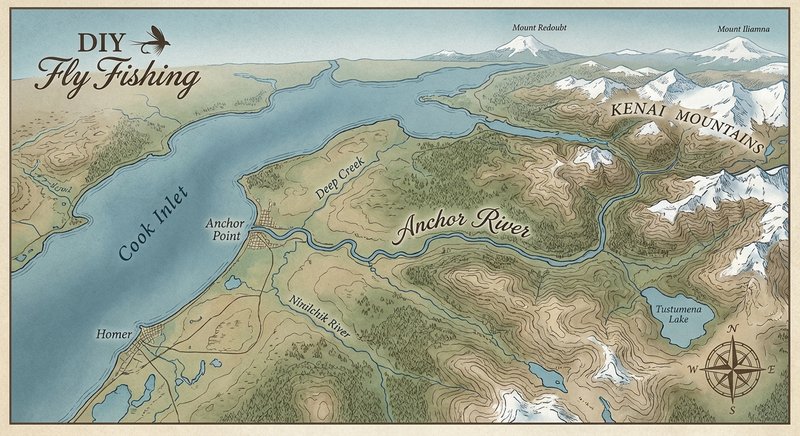
Welcome to the Anchor River, one of the most storied and accessible "small" rivers on Alaska’s Kenai Peninsula. Located near the town of Anchor Point—the westernmost point on the North American highway system—this river offers an intimate fly fishing experience that contrasts sharply with the massive glacial flows of the nearby Kenai River.
As your guide, here is everything you need to know to fish the Anchor like a pro.
🎣 Location Overview
The Anchor River is a classic coastal freestone stream. Unlike the turquoise, glacial-fed rivers nearby, the Anchor is "tannic"—tea-colored from the surrounding muskeg and forests. It is a meandering, gravel-bottomed river that is easily waded, making it a favorite for fly anglers who prefer to fish on foot.
What makes the Anchor special is its proximity to the salt. The lower few miles of the river are tidally influenced, meaning fresh fish are pushing in with every high tide. It offers world-class Steelhead fishing and a highly sought-after King Salmon season, all set against the backdrop of the Aleutian Range volcanoes across the Cook Inlet.
🐟 Target Species & Behavior
King Salmon (Chinook)
The Anchor’s Kings are the first big chrome arrivals of the spring. They are powerful and aggressive.
- Behavior: They hold in the deepest, darkest slots during the day and move into the riffles and tailouts during low-light hours or on a pushing tide.
- Feeding: They aren't feeding to survive at this point, but they strike out of territorial aggression.
Steelhead
These are 100% wild, "high-jumping" fish. The Anchor boasts one of the best road-accessible Steelhead runs in the state.
- Behavior: They enter the river in late August and peak in September/October. They love "swinging" water—steady walking-speed currents over grapefruit-sized cobble.
- Holding: Look for them in the "seams" where fast and slow water meet, or in the tailouts of pools just before the water breaks into a riffle.
Dolly Varden
These are the "blue-collar" fish of the Anchor—hard-fighting, beautiful, and abundant.
- Behavior: They follow the salmon. When the salmon start spawning, the Dollies are right behind them, gorging on loose eggs.
- Feeding: Primarily egg-eaters in late summer/fall, but they will smash alevin patterns or small smolt in the spring.
📅 Best Times to Fish
- Spring (Late May – June): King Salmon Season. This is a highly regulated window. Fishing is usually restricted to specific days (often weekends). The best fishing occurs 2 hours before and after the high tide.
- Summer (July – August): Dolly Varden & Silver Salmon. July is prime time for sea-run Dolly Varden. By mid-August, the Silver (Coho) Salmon begin to arrive.
- Fall (Late August – October): The Steelhead Window. This is the "Holy Grail" on the Anchor. September is the peak. Cold, crisp mornings and falling water levels provide the best conditions.
🪰 Recommended Flies & Techniques
For King Salmon
- Fly Patterns: Large, weighted intruders in Pink/Orange, Blue/Black, or Chartreuse. The "Prom Dress" or "Squidro" patterns are local favorites.
- Technique: Swinging. Use a 8-9 weight Spey or Switch rod with a heavy sink tip (T-11 to T-14). Cast 45 degrees downstream, mend deep, and let the fly swing through the deep holes.
For Steelhead
- Fly Patterns: Pick yer pocket: Glo-bugs (beads) are effective, but many purists prefer swinging Egg Leach patterns, Hoh Bo Speys, or Bunny Leeches in black/blue or purple.
- Technique: Nymphing with an indicator and a 10mm-12mm bead is the most productive method, but swinging a fly on a light sink tip is the most rewarding.
For Dolly Varden
- Fly Patterns: Beads (8mm - 10mm) in "Mottled Roe" or "Orange Clear." Also, small Alevin patterns or Wooly Buggers in olive or white.
- Technique: Dead-drift under an indicator. You want your fly bouncing along the bottom at the exact speed of the current.
💡 Pro Tips & Local Knowledge
- The "Tide Push": If you are fishing the lower river (below the bridge), time your arrival for 2 hours before high tide. As the salt water pushes in, it acts as a conveyor belt bringing fresh, aggressive fish into the river.
- Water Clarity is Key: The Anchor is highly susceptible to "blowing out" (becoming muddy) after heavy rain. If the river looks like chocolate milk, go grab a coffee and wait 24 hours; it clears as fast as it muddies.
- The "Bridge" Crowds: The area near the Sterling Highway bridge is the most popular. If you want solitude, hike upstream. There are miles of public access above the bridge where the fish see far less pressure.
- Cover Water: Don't camp out in one hole all day. Anchor Steelhead are travelers. If you haven't had a strike in 20 minutes, move 50 yards downstream and find a new seam.
⚠️ Important Information
- Regulations: The Anchor River has some of the most complex regulations in Alaska. Check the ADF&G Southcentral Sport Fishing Regulations before you cast.
- Note: The river is often closed to all fishing on Tuesdays and Wednesdays during King season.
- Note: Steelhead are strictly Catch and Release. They should never leave the water.
- Gear: A 9ft 8-weight is the "utility player" here. If you are targeting Steelhead/Dollies specifically, a 7-weight is perfect.
- Wading Safety: While the river is small, it has "cut banks" and hidden holes. Wear a wading belt and felt-soled boots (where legal) or studs, as the rocks can be slimy.
- Bears: This is Alaska. Black bears and Brown bears frequent the river looking for salmon. Carry bear spray, make noise, and never leave your backpack (containing food) on the bank.
Guide’s Final Word: The Anchor River is a "moody" mistress. She can be stingy one day and offer the best fishing of your life the next. Respect the wild Steelhead, watch the tides, and enjoy the scenery—there’s nowhere else like it.
Bug Hatches & Matching Flies
| Hatch | Type | Peak months | Time of day | Hook sizes | Matching flies |
|---|---|---|---|---|---|
| Chironomids Family Chironomidae | midge | April, May, September, October | All day | #18-24 | Zebra Midge #18-22, Griffith's Gnat #20-22, Ice Midge #20 |
| Blue Winged Olive Baetis tricaudatus | mayfly | May, June, September | Afternoon | #16-20 | RS2 #18-20, Parachute Adams #16-18, Pheasant Tail Nymph #16-18 |
| Giant Black Stonefly Pteronarcys californica | stonefly | June, July | Morning/Evening | #4-8 | Pats Rubber Legs #6-8, Kaufmanns Stone #4-8, Chubby Chernobyl #6-10 |
| Little Yellow Stonefly Isoperla spp. | stonefly | July, August | Afternoon/Evening | #14-16 | Yellow Sally Dry #14-16, Little Yellow Sloan #14-16 |
| Spotted Sedge Hydropsyche spp. | caddis | July, August | Evening | #12-16 | Elk Hair Caddis #14-16, Hydropsyche Larva #12-14, Pupa Sparkle Caddis #14-16 |
| March Brown Rhithrogena morrisoni | mayfly | May, June | Afternoon | #12-14 | March Brown Wet Fly #12-14, Western March Brown #12-14 |
| Green Sedge Rhyacophila spp. | caddis | August, September | Morning | #10-14 | Green Weenie #12-14, Caddis Larva (Green) #10-12 |
| Golden Stonefly Hesperoperla pacifica | stonefly | July | Evening | #8-12 | Golden Stone Nymph #8-12, Rogue Foam Stone #8-10 |
| American Grannom Brachycentrus occidentalis | caddis | May | Afternoon | #14-16 | Peacock Caddis #14-16, Beaded Hare's Ear #14-16 |